Question: “Why does the dog have a wet nose?” – not only children, but also reputable scientists. Inexperienced four-legged owners Pets consider a wet, cold nose a sign of good health. If they notice abnormalities in the dog’s behavior, then their first reaction – checking the humidity and temperature of the nose. What reflects a wet nose? And is the “diagnostic” method true?
Content
- 1. A bit of anatomy and physiology
- 2. Wet Nose – Odor Laboratory
- 3. Watch the video why the dog has a wet nose
- 4. Pet nose care
A bit of anatomy and physiology
Dogs belong to the so-called homeothermic (warm-blooded) organisms, however, like their owners. In order to maintain comfortable body temperature, regardless of environmental conditions, in various homoothermal creatures processes – heat production. 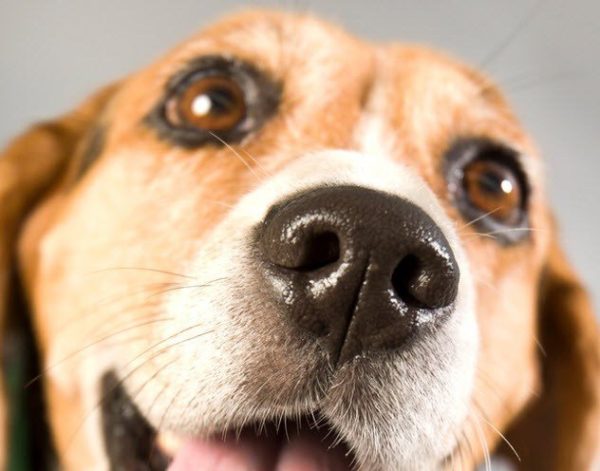
But only internal processes of thermoregulation cannot fully provide the state of isothermia – constant body temperature, they occur in conjunction with physical thermoregulation – heat transfer. That wet dog nose plays an important role in providing heat transfer.
Heat transfer is due to the following factors:
- movement of air heated by body heat;
- heat transfer to objects and environments directly in contact with the body;
- evaporation of moisture from the surface of the body and external mucous membranes respiratory organs;
- heat release with feces – urine and feces.
How efficient will the heat transfer process be depends on:
- body water content;
- surface area.
It is a different body area that determines the fact that normal temperature in dogs of small and medium breeds is higher than in large ones. In humans, heat transfer largely occurs with the release and evaporation of sweat.
But dogs have very few sweat glands, they are located only on paw pads and inside the auricle, therefore cooling occurs due to the respiratory system.
When overheated, the dog begins to breathe faster, opening its mouth and hanging a big tongue. At the same time, moisture from the mucous membranes is intense evaporates, cooling the animal. But in order for the heat transfer to be above, movement of heated and saturated with vapors is necessary air.
If the dog during the heat breathed only its mouth, then the heated the air would again fall in during inspiration. It turns out that for ensure constant air rotation dogs breathe in through their nose and exhale through the mouth.
The English scholar Knut Schmidt-Nielsen, known for his books on animal physiology, found that the bulk of the heat it evaporates through the dog’s nose, and therefore it must receive the maximum possible amount of fluid.
That is why on the nose of the dog is a large nasal gland. It was discovered and described in 1664 by an anatomist from Denmark, Nikolaus The wall. In humans, this gland is absent, therefore, scientists do not Interested and still poorly understood. Her only a function that researchers have recognized is “maintaining wet nose. ”
Depending on the ambient temperature, the dog breathes either only with the nose, or with the nose and mouth. Such a thermal mechanism shortness of breath allows:
- not to change the respiratory rate much, because it would require intense muscle load and muscle production of large amount of energy;
- do not change the depth of breathing, which could negatively affect gas exchange of the lungs.
From the above we can conclude – the temperature and the moisture of the nose in a healthy dog may vary, depending on ambient temperature. The hotter the dog, the more humid and the nose becomes cold.
The same picture is observed with intense physical exertion, only here with thermal dyspnea heat is released, which developed inside the body as a result of intense muscle work. So what if the dog is calm or sleeping and the ambient temperature air is comfortable, then her nose is dry and warm.
Wet Nose – Odor Laboratory
Another function of moisture secreted by the nasal gland is “sorting” of odors. The main source of exploring the world, communication dogs smelling, and its main organ – nose. Olfactory dog receptors are tens of thousands of times more sensitive than human ones, and the area of the brain responsible for the perception and analysis of odors is developed much better.
The inner surface of the nose and oropharynx is plentifully covered odor receptors. To increase the area of fabric with receptors, nature has created specific “labyrinths” – choans, due to which the total area of sensitive tissue is almost equal area of the skin of the dog.
In the epithelium of the nasal cavities of a person contains about 10 million olfactory neurons, while the German Shepherd – more than 225 million.
Different odors are perceived by different groups of receptors. Some are located closer to the nostril openings, others – in the depths oropharynx. So that the smells do not “go astray”, they need to be separated. In that Dog helps wet nose.
Odor is a chemical called an odorant. It easily soluble in liquid. Wet nose and moisture on the surface of the mucosa lining the organ of smell helps to catch and sort the smells. 
On the surface of each receptor is a protein that binds with a specific part of the odorant. Some parts are caught receptors closer to the nostrils, others with air current fall into the remote corners of the choan and there they fall on sensitive zones.
The smell as if decays into “letters”, which are caught by the nose dogs, and a special part of the brain “makes up” of these letters of the word. Than less moisture on the nose and inside, the worse the dog smells, the more difficult it is for her to navigate the world around her.
But moisture on the nose does not only fulfill the above functions. Wet nose is the protection of sensitive olfactory receptors. Moisture on the tip of the nose and inside it is not just water. She consists of a mixture of a large number of proteins that give it viscosity and density.
The film covering the receptors has two layers – the upper water (about 5 microns thick) and lower, more viscous (30 microns). This film protects receptors from aggressive chemicals in inhaled air.
Proteins in the protective film are divided into 2 type:
- orant-binding, which “catch” and “particles” of odors are transferred to the receptors;
- orant-destructive – translating molecules odor to other substances and releasing receptors for new “servings” of orants.
Reducing the amount of fluid on the nose and inner surface “clogs” olfactory receptors.
But this is not all the functions that a wet tip performs. the nose of the dog. In order to “catch” the maximum amount orant molecules, you need to accurately “tune” to the air flow, which carries the smell.
Man to feel the direction of air movement jet, saliva-wetted fingertip. Just such a “weather vane” is for a dog a wet nose. With it, he finely tunes himself. in the right direction and picks up the maximum amount of odors, making up a whole “story” of them.
For small “why” who are interested in this issue, famous Scottish poet and children’s writer Stephen Kenneth wrote an entire book, the one titled, Why a Dog Has a Wet Nose.
If a dog’s wet nose is so important, then care must be taken no less carefully than for the eyes and ears of a pet.
Watch the video why the dog has a wet nose
Pet Nose Care
If the dog has a dry nose, then the reason is not always disease. Dry nose in a dog during sleep and rest. To absence natural hydration of the urine leads to dehydration of the body, caused by lack of drinking water. So that the nose does not dry out, dogs in a bowl should always have fresh water in the required quantity.
Normal nasal moisture may be inhibited by runny crust of dried mucus. They need to be removed with a cloth, moistened with warm water, or an ear stick with oil solution.
The nose is dry in strong winds in frost or heat. In such special cosmetics that prevent excessive drying of the delicate tissues of the nose and protecting it from the harmful effects of ultraviolet rays.
An allergic reaction to dishes, food, pollen of plants. It’s worth eliminating the allergen, and the condition is normal. Dry nose can cause stress.
With fear, psychological strain, change of habitual The dog’s hormonal system responds by releasing cortisol. This substance is also called the hormone of fear. Cortisol leads to a sharp contraction of muscles, including those located in the walls of blood vessels and glands.
It’s worth remembering that a frightened person has a pale face, the heart begins to beat frequently and the limbs become colder. Spasm leads to inhibition of the secretion of the nasal gland.
In the case when the nose is dry, hot, peeling or cracking, then you need to contact a veterinarian. Dry nose can be a symptom. serious pathologies that threaten the life of the animal.