The Tibetan Terrier, despite the name of the breed, is not— Dogs got a similar name with a light hand of European tourists to whom they resembled terriers. History of these cute, shaggy doggies are so ancient and closed to researchers, that much is still unknown about them. but once they lived in Tibetan temples, acting as watchmen. The modern Tibetan more often acts as a companion, and his popularity is growing steadily.
Content
- 1. The origin of the breed
- 2. Description of the breed Tibetan Terrier
- 2.1. Wool and colors
- 3. The nature and character of Tibetan terriers
- 4. Parenting and training
- 5. Care and health
- 6. Breed diseases
- 7. Feeding
- 8. Content
- 9. Phototibetan Terrier
- 10. Video of the otibetan terrier
- 11. Where to get a Tibetan Terrier puppy
Origin of breed
The history of the breed dates back thousands of years, and once it representatives acted as watchmen, shepherds, companions. In addition, it was believed that they protect the home from evil spirits and are the talismans of good luck. In those days, they were called “holy dogs of Tibet,” doggies could not be sold, they could only be a gift. 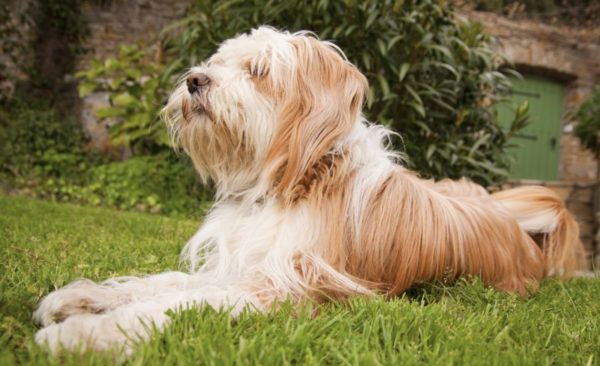
Genetic researchers recently found that these terriers come from the oldest breeds, and thanks to the isolation of Tibet purebred dogs persisted for hundreds of years. First individuals this breed entered the territory of European countries in 1922, then the English doctor brought several terriers to Europe and local spaniels. She became the founder of the first nursery Tibetan terriers and sought to ensure that the breed received recognition of the English Kennel Club.
To date, Tibetan Terriers cannot be found on the lists. the most popular breeds, however they are successful in different countries and are increasingly attracting the attention of dog lovers.
Description of the breed Tibetan Terrier
The purebred representative of the breed has a strong, harmonious physique with a massive skeleton. The body of the dog is well muscled, covered with thick skin. In Tibetan mastiffs, the sexual type – males are more powerful, furry and stocky than females. At evaluation of standard data for males are presented more stringent requirements.
The body weight of the “Tibetans” is independent of gender and varies from 8 to 14 kg, male growth is 38-41 cm, female – 36-39 cm. The dog moves easily, without heaviness, free. By nature, this is a balanced, restrained dog, but at the same time lively and mobile. In any environment, the pet behaves confidently, attentively and responsibly, and at first glance it becomes it is clear that this is a smart, physically strong and hardy animal. IN Representatives of the breed are described as follows:
- The head is proportional, harmonious, has medium size; in adults it is covered with a long and thick woolly coat. The forehead is moderately convex, not wide, in shape resembles a truncated wedge. The occiput is pronounced, but does not stand out, as mound. The eye sockets are moderately marked, hiding under the falling awn. The transition about the frontal part to the muzzle is well defined, its emphasizes the silhouette line. Cheeks covered with dry muscles, jaws well developed.
- The front area is not very dry, the back of the nose is straight, slightly tapers closer to the lobe. The muzzle is not pointed or dull. Lips are elastic, hide teeth with tongue, dental the row is complete. The nose is medium, painted black, with open, rounded nostrils.
- The shape of the eyes is close to round, they are large, expressive, with a confident look. The iris is pigmented in rich brown hue. The eyelids fit snugly. Convex or deeply recessed eyes are considered serious defects.
- Ears of medium size, in the form of triangles, high, but not upright and upright, fall to the head, but do not cling to it. In adults on ears are beautiful, decorating the coat.
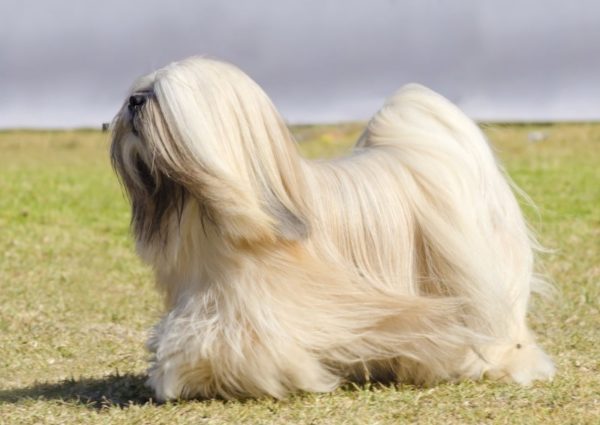
- The body fits in a square shape, with muscular neck, covered with elongated hair, without noticeable bending, with extension to the shoulders.
- Withers strong, but not protruding, covered dry muscles. Sternum in the shape of an oval, of decent depth. If she flattened or not long enough then this is disadvantage.
- The back is short, smooth, muscular, without deflection or bulge. The lumbar belt is a little bulging muscular, moderately wide, not long. Belly line in moderation fit, well-chosen.
- The limbs are strong, covered with dry muscles, smooth, set in parallel. Forelegs strong, but without severity, musculature is expressed, the angles of the joints are correct, the back part of the paws is covered with a long decorative coat. Rear the limbs are more powerful than the front, covered with a long spine, but not look rough or heavy. Joint angles are well defined regular limbs with powerful metatarsus, large brushes, rounded, perfectly assembled.
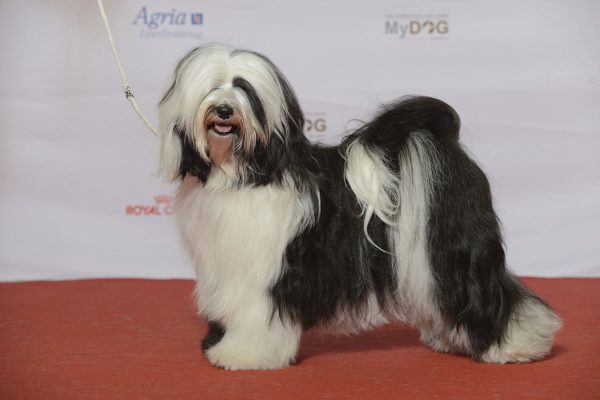
- The area between the fingers has protection in the form of thick wool. Dog participating in exhibitions, it is cut off. Brushes heading forward.
- Tail size is related to dog growth, but more often he reaches the hock joints. When the dog is at rest, the tail is located on the back, covered with long, adorning hair, which forms a bunch or breaks up in the form of a fountain – it depends from the length of the spine. The standard allows bending at the end tail.
Wool and colors
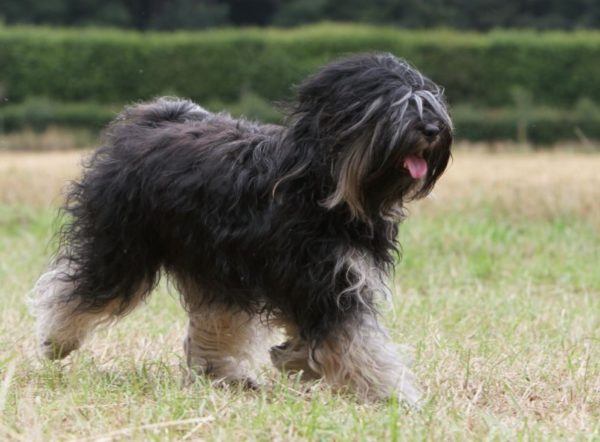
Tibetan terriers have a two-layer coat, consisting of thick, dense, soft undercoat of decent length. In males he better developed than females. The Tibetans have a long arm, it is tougher and thinner than undercoat, has an elastic structure. Wool shiny in nature, on the head and back there is even parting.
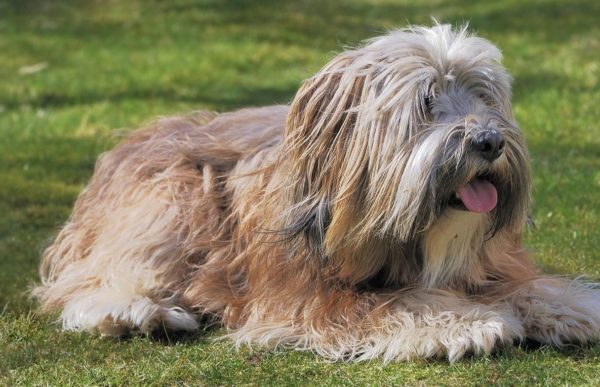
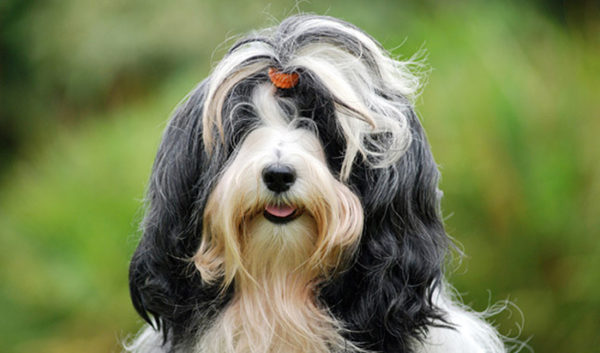
Fluffy or very light hair is serious disadvantage. Dogs with too much are also excluded from breeding silky, curly, soft or heavy coat. In the natural the length of the coat of the terrier almost reaches the ground. Hair, flowing down on the head and ears, smoothly passes into the coat on neck. The bangs close your eyes, and its ends are mixed with vegetation covering the muzzle. What remains open at this a shaggy dog is a nose.
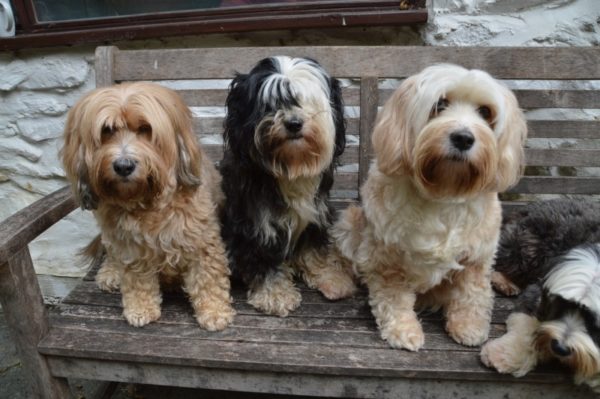
Tibetans have a natural color in harmony with color lobes, lips and eyelids. The standard allows for a variety of colors, plain, two and more color. The main spine may be black, white, peach, cream, fawn, golden or gray – from blue to smoky shades. Most individuals with golden wool are appreciated. They are more often chosen as favorites and talismans bringing good luck to the house.
The nature and character of Tibetan terriers
Researchers believe that the breed of Tibetan terriers was originally bred for shepherd or farm work. These dogs turned out to be real universals and coped with a variety of work. Naturally, this fact, as well as life next to a person is not could not affect the nature of the animals.
Unlike standard terriers, Tibetans are more patient and friendly, they always find a common language with children, even small, although if they get bored, they may snap back. But still you should not have a pet if in the family replenishment is expected or there is a baby.
Tibetan Terrier quickly becomes attached to the family, he strive to participate in all events. Being alone the pet is sad and may even become depressed. In addition, if the dog is often left alone, then he may have serious behavior problems.
The Tibetan shows with all his appearance and behavior important for the family and successfully copes with the role of a watchman. But his vigilance may be excessive. If the dog is not raised, he will bark loudly at the slightest occasion.
The dog is active, needs regular, long walks. During walks, the owner should be careful – if the pet interested in anything, he can start a search activity and get lost. Often the terrier is stubborn and even hearing a voice the owner may not respond.
The dog is quite accommodating, it gets along well with other pets, in including cats. But for this the dog must go through socialization still in puppyhood. Doggie should be taken outside, changed walking routes, visiting various places, introducing others dogs and people.
Such a pet is kind to all household members, loves sit on the handles to be caressed and show attention. At he always eagerly responds to the call to play, and often he himself becomes the instigator of fun games. Start this a four-legged friend can also elderly people, he is moderately active and not cause special trouble.
Parenting and training
To let the dog remember and flawlessly repeat the command, to the owner will have to repeat it many times, returning to passed stage. And it’s not that the “Tibetan” is stupid or lazy, it’s just not interesting to him. Growing representatives of this breed is slow, and until the dog has reached maturity, it is very it’s difficult to concentrate for a long time. 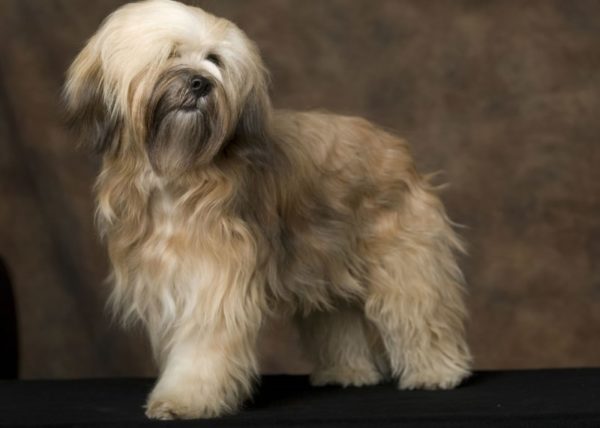
To increase the effectiveness of classes, they should be built so that the lessons are varied, interesting, not boring, in a playful way and did not take much time. To the owner demandingness should be combined with gentleness, patience and hardness. Do not forgive your pet pranks during training, but also it cannot be strictly punished.
Like most shepherds, Tibetan terriers are somewhat masterful and independent, and if the pet is not raised, showing who is the master of the house, the dog will encroach on the place of the leader. If he succeeds in taking him, he should not wait for obedience from the dog.
Tibetan Terrier, which is often left to its own devices and lacking attention, can be very problematic. Then he can often bark for a long time, destroy furniture and personal items, nasty in every way. But no rude methods will help to fix similar behavior, only affection and love give a positive result.
Care and Health
In appearance, you can understand that special care requires luxurious hair of these dogs. It needs to be combed regularly cut every 5-6 months, preferably in the spring and towards the end summers. In hot climates, this can be done more often, and cutting your pet pretty short.
Wash the Tibetan Terrier as necessary, but at least once a 10-14 days, in the winter, one dog per month is enough. Puppies to 14 months old comb every day since their woolly the cover is very soft, it easily gets tangled up and gets stuck in tangles. At more adult wool acquires some stiffness, and its it is enough to comb out every 2-3 days.
The positive thing is that the “Tibetans” practically do not molt, so you can start a similar dog for people suffering an allergy.
Regular inspection is required by the eyes and ears of the pet. In the presence of any pollution to stop the spread of infection, they are removed by decoction or by medical means. Dog’s teeth cleansed of plaque or tartar with a special paste, moslami, large feed pellets.
Walk with the pet twice a day – morning and evening, one walk should last at least 40 minutes. Tibetans are inferior in activity real terriers, but they need to be given the opportunity to run and to play. In the city, it’s better not to let your pet go he didn’t run away, becoming interested in a bird or what kind of animal. It’s enough to train 10-15 minutes a day, but do it daily.
Breed diseases
On average, representatives of the breed live 12 years, although often there are individuals whose life expectancy is 15-18 years old. In general, the breed cannot be called painful, but there is a number of specific diseases that are more common than others diagnosed in Tibetan terriers:
- eye diseases – cataracts, lens dislocation are possible retinal atrophy;
- disorders of bones and muscles;
- neuronal ceroid-lipofuscinosis (a group of neurodegenerative pathologies).
Subject to preventive examinations, these diseases can not be only to identify, but also to warn in a timely manner.
Feeding
Tibetan terriers can be incredibly cute begging for a treat from the master’s table, but owners should know – if give the pet junk food, this will lead to obesity and problems with health. 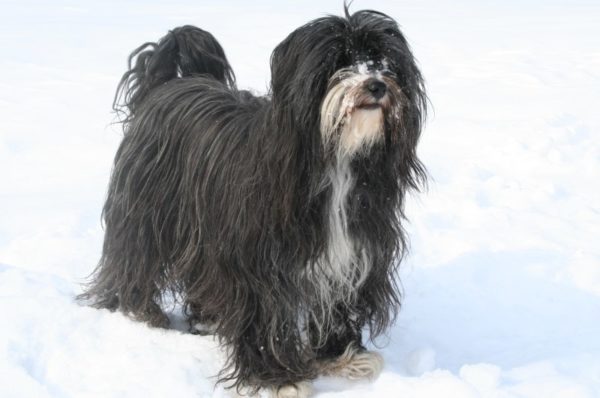
The owner can feed the pet with natural food or ready-made rations, but in any case, the food must be right, quality and balanced.
With natural feeding, the main product should be meat, you can also cook buckwheat or rice porridge. Vegetables and fruits dogs are also present on the menu, like sour-milk eggs products, fish, offal.
Content
The Tibetan Terrier can live both in the apartment and in his house, in In both cases, the dog will feel comfortable. He has a rich wool that protects the dog from the weather, but street maintenance is not for Tibetan. This is due to the fact that the dog needs communication and attention of the owner and other family members. Also street adversely affect the quality of the wool – it will become dirty and get confused.
Phototibetan Terrier 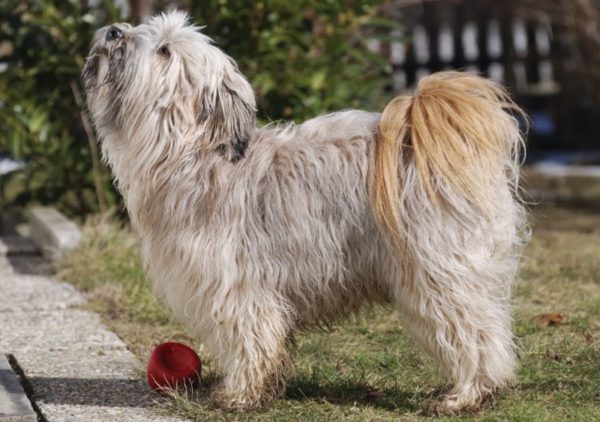
Video of the Otibet Terrier
Where to get a Tibetan Terrier puppy
Owners of Tibetan terriers are sure that a pet is not better it happens – it’s a funny, funny doggie that infects others their positive. And since the number of people wishing to make a similar the dog is growing, there are more and more nurseries involved breeding of this breed, including in Russia. For example, in Moscow there is a Goldie Anshula nursery http://anschula.ucoz.ru/.
In addition, you can buy a puppy “Tibetan” from private breeders. But buying a pet without a pedigree, from random sellers are not recommended, the risks are too great to get a mutt or mestizo, as babies do not have special expressive pedigree signs.
Tibetan Terrier – the breed is not too expensive, and the cost of puppies with a pedigree is an average of 15,000-30000 rubles. For the elite show class representatives may be requested a higher price, and a kid without documents costs much less.
Tibetan Terrier puppy costs people who need a faithful and faithful friend, fun and positive companion. The dog will endlessly love the family, follow her anywhere and enjoy communication. With all this enthusiasm and activity he will be maintained throughout life, until old age.