Assessment of breed characteristics
| Adaptability Definition of how easy a dog is. can adapt to changes in life. |  |
| Shedding Level Level and frequency of hair loss in animal. |  |
| Level of tenderness Level and amount of tenderness and affection that the dog gives back in return for attention to itself. |  |
| Need for Exercise Daily Activity Level dogs. |  |
| Social need Required number of dog contacts with other animals as well as people. |  |
| Housing ratio Factor that determines the level of noise and other inconvenience that the dog can deliver to the owners in the ratio apartment size to dog size. |  |
| Grooming Number of bathing, combing, as well as necessary number of professional grooming sessions required the dog. |  |
| Friendliness in an unfamiliar environment society with strangers or in an unfamiliar environment. |  |
| The tendency to bark The tendency to bark and its frequency and volume. |  |
| Health Issues Potential Health Status dogs. |  |
| Territorial tendency of the dog to protect his house, yard or even a car owner. |  |
| Cat friendliness A trend towards cat tolerance and reduced manifestation of hunting instincts. |  |
| Intelligence Dog’s ability to think and solve emerging difficulties (not to be confused with learning!). |  |
| Education and training Level of difficulty in training a dog perform certain actions. |  |
| Friendliness for children Factor determining how much the dog friendly to children, whether she likes to play with them and endure some children’s pranks. |  |
| Game activity The concept is determined by its very name, and, usually found in almost all dogs. |  |
| Observing Dog’s ability to detect presence a stranger in his territory. |  |
| Friendliness for other dogs Dog’s tendency to find common language with other relatives. |  |
Brief description of the breed
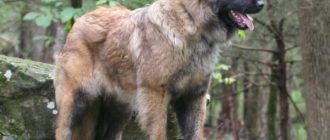
Rhodesian Ridgeback is the only South African dog breed, recognized by the International Cynological Federation. A distinctive feature of these dogs is the presence of a ridge (from English “ridge” – “crest”) – a strip going just below the withers, not reaching the level of the femur, ideally having symmetrical cone shape with characteristic curls at the narrowing point ridge (ridge). Comb hair grows backwards relative to the hairline on the dog’s body. Originally hounds related Rhodesian ridgebacks hunted game, guarded livestock during grazing, guarded human housing. And today this dog is pretty versatile, besides listed features (dog hunter, watchman, guard) Ridgebacks show remarkable results during capture criminals while serving in the police in Europe. Ridgebacks are often turned on to gain a companion dog, as these animals have a living mind, quite balanced temper, do not differ causeless aggression towards people, but can stand up for the owner and his house. Ridgebacks are pretty pretty high (male growth reaches 70 cm, bitches – up to 66 cm), strong and muscular dogs. Their weight is from 30 to 37 kg. Head: skull medium sized, wide between ears. Muzzle: dog’s eyes placed relatively far apart, have a round shape. The nose has a black or brown tint, and with a black lobe the dog’s eyes are darker than brown nose when eyes are yellow. Dog cheekbones are not very pronounced. Bite scissor-shaped, lips tight, dark shade. High ears set, hanging, adjacent to the head, have a shape wide bases tapering to the tips. Neck: strong, without suspension. Torso: chest deep, body powerful, muscular, somewhat curved in the lumbar region. Extremities: straight, bony, with well developed muscular shoulders and hips. Compact feet rounded off. Tail: tapering towards the end, medium length. Several curved but not curled into a ring on the back. Middle set. Wool: short, thick, shiny, medium hard. Color: from light wheat to dark red. Ridgebacks sometimes have dark markings (mask) in the area of the muzzle and ears. Small whites are acceptable markings on the chest and fingers.
Photo of the Rhodesian Ridgeback:

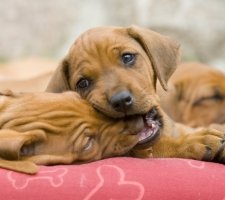
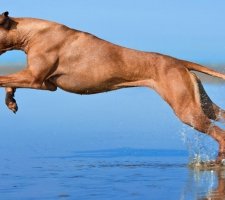

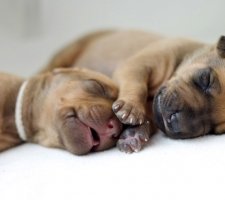
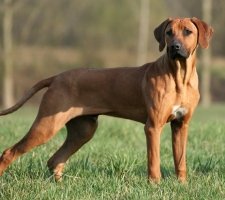
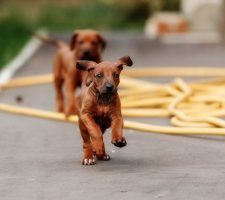

 Photo of dogs of the Rhodesian breed ridgeback |
Origin history
Ridgeback-like dogs inhabited Africa at least least since the beginning of our era. Presumably dogs with with a crest on the back helped the inhabitants of Ethiopian tribes during the hunt for big game, guarded people’s homes from the attacks of the beast. One of the first “owners” of such dogs was a Hottentot tribe, gradually settling not only in East Africa, but also in the south (on place of the current state of Zimbabwe). It was in the south and were rock tribal paintings depicting hunters from their dogs. Most likely, in appearance the dogs of the Hottentots significantly different from modern ridgebacks (both in height and in hair color), but a comb of hair growing in the opposite direction there was an ancient dog. Gradually they interbred with hunting dogs of other tribes (for example, Bushmen – another inhabitants South Africa). At the end of the 17th century, the famous colonial administrator and traveler Jan van Riben, who founded the first the Dutch resettlement Cape colony paved the way to South Africa not only white people, but actually gave access to the import of new animals, including new dogs for Africans. Gradually settlers became interested in Hottentot dogs, emphasizing the high hunting qualities and peaceful disposition of these animals. So in the 18th century, predecessors appeared on a hot continent – the most similar to the current red-ginger Ridgeback dogs with crest in the middle of the back. Further systematic breeding of such dogs occurred in Rhodesia (in what is now Zimbabwe) and already at the beginning of the 20th century, Rhodesian ridgebacks (also called lion dogs – then in South Africa the hunting of lions was not prohibited, therefore, ridgebacks often participated in the capture of this large predator) began to attract the attention of true hunters. In the year 1900 the kennel of these dogs was founded, and two decades later (in 1922 g.) the breed standard was approved, and in 1924 the Rhodesian Ridgeback was recognized by the South African Dog Kennel Union.
The nature of the Rhodesian Ridgeback
These dogs perfectly feel the mood of their master, try Do not bother him with your company, if there is a reason. They are quite intelligent and even in difficult situations will leave I reserve the right to resolve the issue in my own way, which sometimes happens necessary when the owner’s life is in danger. Get along well with children, and with adult members of the host family. To strangers belong not aggressively, but suspiciously. With other pets (especially cats) skirmishes may occur. In other words, ridgebacks – dogs with character and self-esteem. Them can’t be called good-natured, ready to run after everyone who beckoned or the person who offered the treat, but they are not malicious, not bloodthirsty. Rhodesians are very strong and hardy (although not overwhelmingly massive), active but not galloping days idle around the site or the apartment. Barking rarely raised, most often if necessary.
Maintenance and care
Ridgebacks live both in apartments and in enclosures with a kennel-house on the territory of suburban or private houses. Care these dogs do not imply any difficulties even for inexperienced owner – it is enough to cut the dog in a timely manner claws, clean ears, monitor eye condition, pay attention signs of ill health (temperature, depression, indigestion, abnormal discharge from the nose, ears, eyes, genitals, limping gait, etc. – in a word, for all that which clearly signals a disease). Ridgebacks are not worth bathing more often three or even two times a year, and if necessary, only wash the paws after a walk. These dogs are combed infrequently – a couple of times a month, since short hair excludes the formation of tangle, to her foliage, dirt rarely stick. In winter on the shorthair ridgeback can wear a jumpsuit because these dogs They can’t boast of either a luxurious fur coat or a thick undercoat. it justified, because the Rhodesians need long walks daily. It is advisable that during the dog’s walking had the opportunity to run around and play. Very good if u owners have the opportunity to take the dog out into the countryside – in the forest, grove, where you can lower the animal from the leash, giving the opportunity to run and stock up on energy.
Training and training
Since the appearance of a ridgeback baby in the house, its owner needs to keep herself with the dog so that as she grows up she understands who is in the relationship The “master dog” is the main one. Excessive softness and permissiveness make the ridgeback wayward, obeying only their opinion and to your desires. Independence is already in the blood of these dogs, therefore, do not indulge even a small puppy when he climbs on sofa, begs food from the table, jumps on the owner in a fit of joy (in Ridgeback puppies are pretty playful in childhood). Better if as the owner of such a dog will have a fairly strict person who knows how stand one’s ground. Dog trainers note that at least ridgebacks and are wayward, however they study willingly, teams grasp very quickly. But for the right learning process, you need to make contact with the dog. For a comfortable dog stay in society with the owners advised to go with rhodesian ridgebacks General training course on a special training platform under the supervision of a professional, remembering teaching methods. Rhodesian Ridgebacks – dogs in whose veins blood of hunters flows, in addition, they are very strong and strong. Therefore, street cats, small dogs can easily be attacked by a non-trained ridgeback. An untrained dog will pull the owner on a leash to where it at will. That is, when acquiring such an animal, one should always be aware that socialization, training and training she needs. And you should think about training for hunting only when the owner’s plans have an idea to attach such a dog to the prey wild animals.
Health and Disease
Rhodesian Ridgebacks – healthy dogs with quite powerful immunity from nature. Therefore, with the right feeding and reasonable, sufficient physical activity, timely vaccination against a number of diseases, these dogs may well give odds in health plan for many large and medium four-legged. Nevertheless, even strong Ridgebacks are sometimes found: diseases musculoskeletal system – hip dysplasia, osteochondrosis; eye diseases – cataract, entropion; obesity; deafness; skin diseases – dermoid sinus, allergic reactions.