Assessment of breed characteristics
| Adaptability Definition of how easy a dog is. can adapt to changes in life. |  |
| Shedding Level Level and frequency of hair loss in animal. |  |
| Level of tenderness Level and amount of tenderness and affection that the dog gives back in return for attention to itself. |  |
| Need for Exercise Daily Activity Level dogs. |  |
| Social need Required number of dog contacts with other animals as well as people. |  |
| Housing ratio Factor that determines the level of noise and other inconvenience that the dog can deliver to the owners in the ratio the size of the apartment to the size of the dog. |  |
| Grooming Number of bathing, combing, as well as necessary number of professional grooming sessions required the dog. |  |
| Friendliness in an unfamiliar environment society with strangers or in an unfamiliar environment. |  |
| The tendency to bark The tendency to bark and its frequency and volume. |  |
| Health Issues Potential Health Status dogs. |  |
| Territorial tendency of the dog to protect his house, yard or even a car owner. |  |
| Cat friendliness A trend towards cat tolerance and reduced manifestation of hunting instincts. |  |
| Intelligence Dog’s ability to think and solve emerging difficulties (not to be confused with learning!). |  |
| Education and training Level of difficulty in training a dog perform certain actions. |  |
| Friendliness for children Factor determining how much the dog friendly to children, whether she likes to play with them and endure some children’s pranks. |  |
| Game activity The concept is determined by its very name, and, usually found in almost all dogs. |  |
| Observability Dog’s ability to detect presence a stranger in his territory. |  |
| Friendliness for other dogs Dog’s tendency to find common language with other relatives. |  |
Brief description of the breed
The dwarf pinscher (miniature pinscher) is not a miniature Doberman, although his fearlessness is akin to this breed. This little doggie will do for an experienced dog breeder who can do well with character of the animal. The dog of this breed is often described as energetic and fearless. The breed feature is extravagant gait when the dog raises its front legs, bending them in the wrist. The breed is also classified as decorative, but the dwarf pincher himself is sure that he pretty big animal. Curiosity is another character trait. Therefore, you must immediately hide all easily accessible things, including including drugs. The dwarf pinscher is a family dog, she fearlessness will protect the host from potential intruders. Despite the fact that the dog is very affectionate, but all her somewhat impudent behavior is not quite commensurate with the size of the animal. The dog is somewhat stubborn, so the owner will have to make efforts in education. A tiny pinscher without special effort will be able to find a loophole to get through the fence. Check your fence regularly for damage and undermining, otherwise, sooner or later the pinscher will find a way out and jump out into the street. small amounts of fat and hair these dogs need protection by cold. It is advisable to use a variety of clothes for dogs, and the main thing that needs to be protected from the cold is the stomach and rib cage. Most dwarf breeds are difficult to trained at home, pinscher is no exception. Training must begin from the first day when the dog got into house. Dwarf pinchers are prone to molt, therefore require systematic hair care. Usually enough comb hair a couple of times a week. Do not forget about the need to brush your pet’s ears and teeth, and trim claws. This, perhaps, is all the requirements for caring for a dog. Pinscher is very cheerful, courageous and active. He will be a great friend. for all family members. The animal loves to be in the family circle, therefore, do not refuse to participate in family picnics, evening walks and active games with family members. The main feature of the miniature pinscher is his crazy love for the owner. In fact, the only drawback of the breed is the tendency to dig and stalking animals, mostly cats. As already noted, pinscher – a companion dog, so he must live under one roof with the owner and be a full member of the family. Dwarf accommodation pinscher in the yard, in the garage or aviary is unacceptable.
Photo of the dwarf pinscher:
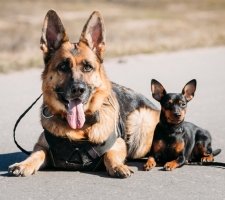
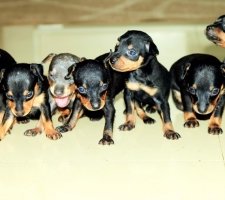
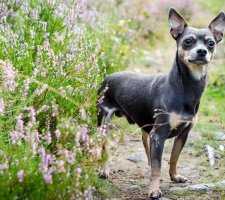
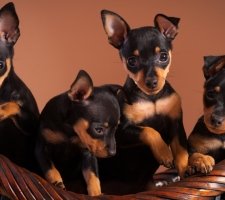
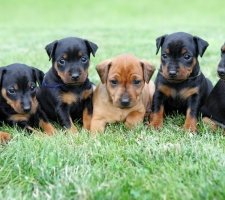
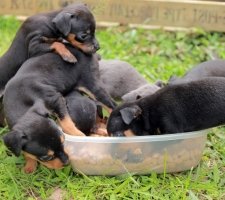
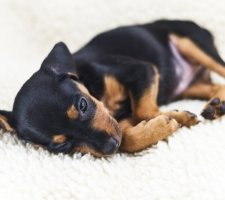
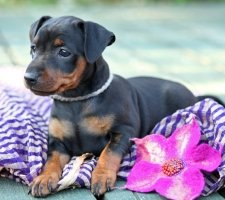
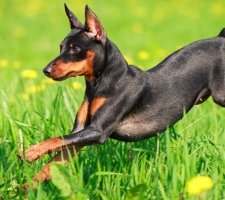 Photo of a dog breed dwarf pinscher |
Origin history
Many people think that the dwarf pinscher is a smaller option. Doberman, but in fact, this breed appeared at about 200 years before the Doberman. It is believed that the breed was bred in Germany by crossing breeds such as dachshund, German pinscher and Manchester Terrier. As a result, a small but energetic and courageous dog. At first the dwarf pincher found popularity in Germany and Scandinavian countries, but popularity The breed began to grow sharply. American Kennel Club the dwarf pincher was registered in 1925, however, as terrier. The club of fans of this breed appeared in 1929, and in 1930 the year the breed was re-qualified, so officially appeared pinscher. IN In 1972, another word was added to the name of the breed: “dwarf”. Since that time, this amazing little dog wears its present title.
The nature of the dwarf pinscher
Contrary to popular belief that the dwarf pinscher was bred as a result of improper selection of the Doberman, in fact this breed is much older than the Doberman. This breed is often called king of small breeds. Indeed, sometimes these pets behave like real kings, they want everything to revolve around them, so that all their desires are satisfied. In addition, dwarf pinchers have a unique graceful gait, which is also similar to royal people. They love to lie on the owner’s lap, to run and frolic. It is worth noting that of the dwarf pinschers excellent guard dogs are obtained. They are ready to raise barking anyone who decides to encroach on their territory.
Maintenance and care
It is very easy to look after a dwarfish pincher as it possesses short and smooth coat. It is enough to comb out a couple of times a week the dog is not a stiff brush. Dwarf pinschers molt very weakly, especially the small size of the dog speaks about insignificant amount of wool. Dogs of this breed are bathed as necessary. To do this, use special shampoos that do not harm wool. Like most small breeds, dwarf pinschers dental problems are common. therefore you need to brush your teeth as often as possible using a special paste prescribed by the veterinarian. Claws are usually cut once every two weeks. If they are actively growing, you can crop as necessary. True, if the dog regularly walks for a long time time outside, then the claws will grind off in a natural way, and this will facilitate the process of caring for the pet.
Training and training
Dwarf pinschers are used to doing what they want. it says that training and training these dogs is a matter of not easy. For many owners of these tiny dogs, training becomes a real challenge. Train the dwarf pinscher capable experienced, demanding and consistent dog breeder, endowed with excellent leadership skills. Classes should be short, otherwise they will quickly bother the pet. Not bad a way to stimulate learning are treats that adore doggie. Crude or aggressive attitude towards a pet completely crosses out all efforts in learning. your pet. If you even give way to a dog once, then training will fail, because the animal will understand that you can manipulate. Please note that learning and socialization need to start at an early age.
Health and Disease
Dwarf pinscher refers to long-lived dogs. Average life expectancy is 13 to 15 years. To the main health problems include: intervertebral disease disk, epilepsy, chronic superficial keratitis (pannus), glaucoma, cataract, generalized progressive atrophy retina, urolithiasis, hypothyroidism, dislocation of the shoulder joint and dislocation of the patella. Dogs of this breed are also prone to obesity and very poorly tolerate low temperatures. Should control the dog’s diet, the diet can be coordinated with by the veterinarian. Do not overfeed the dog. Better to give food several times, but in small portions.