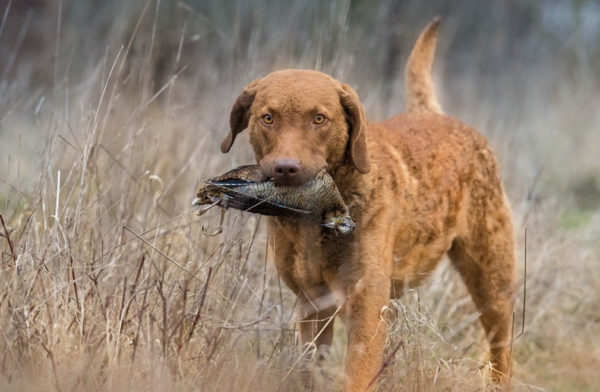
All varieties of retriever are hunting breeds, they are beautiful, hardy and smart. As for Chesapeake Bay retriever, then they are fully consistent with this description, but considered more serious representatives of their group. Representatives of this breed are most often used for hunting, they are active, positive and get along well with a person.
Content
- 1. History of the breed
- 2. Description of the breed Chesapeake Bay Retriever
- 2.1. Chesapeake Bay Retriever colors
- 3. The nature of the breed
- 4. How to train Chesapeake Bay Retriever?
- 5. Care and health
- 6. Diseases of the breed
- 7. How and what to feed a pet?
- 8. Features of the dog
- 9. Photo of the Chesapeake Bay Retriever
- 10. Video about Chesapeake Bay Retriever
- 11. Where to buy a puppy and how to choose the best?
Breed history
If you look into the historical past of the breed, then it began in 1807, when in Maryland during the wreck of a yacht, drowning people were rescued by a crew past a sailing ship. Ship captain in sign gratitude received two dogs that look like representatives of the Newfoundland breed. 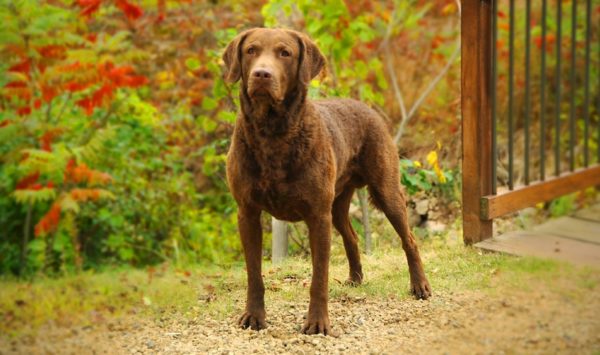
Since these dogs had natural data for working in water, their began to take on duck hunting in the Chesapeake Bay. Later breed underwent a serious selection, as a result of which the dogs received the blood of various kinds of setters, cunhound, retriever, and there is a chance that the irish water took part spaniel.
Work on the design of the breed was completed by the middle of the 19th century, and she got the name Chesapeake Bay Retriever. First specimen of this The breed was registered in 1878, and the creation of the pedigree The club happened in 1917.
Unfortunately, in Russia this type of retriever is not so popular as golden or labrador, but the breed is gaining strength, and on territories of America and Finland its representatives meet often.
Description of the breed Chesapeake Bay Retriever
Chesapeake are very harmoniously composed, these are strong animals, strong, tall and hardy. The standard strictly controls such indicators like height and body weight. Male growth varies from 58.4 to 66 cm, bitches – from 53.3 to 60.9 cm. Males should weigh 29.5-36.3 kg, females – 24.9-31.7 kg.
Dogs of this breed look quite powerful and maybe even a little heavy, but they are very dexterous, by standard, should have good maneuverability and confident delivery.
The standard contains the following description of the breed Chesapeake Bay Retriever:
- The head is large, the forehead is wide, and the transition from it to the face is moderate. In length – the back of the nose and skulls are almost identical, facial area is enough wide, but gradually tapering towards the nose. The muzzle is blunt at the end, lips thin, with pigmentation, close to teeth, not hang down.
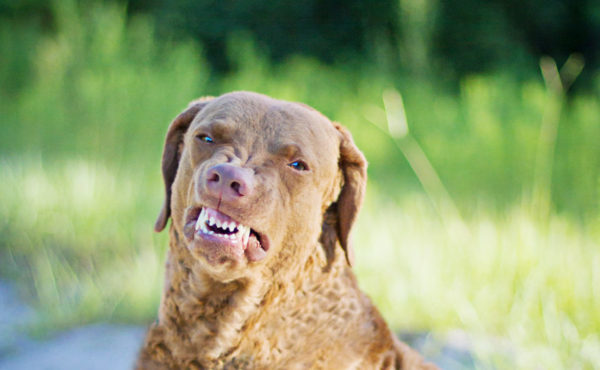
- The jaws are strong, with a full set of large, white teeth and regular, scissor bite. If there are no others flaws, and the dog is correctly folded, the presence of a direct tick-shaped bite.
- The lobe is small, rectangular in shape, very sensitive to everything reacts.
- Eyes of medium size, oval, set wide, with an attentive, expressive look. The shade of the iris ranges from light yellow to orange-brown tone.

- Auricles are medium in thickness, soft, small, descend along the skull, but not pressed against it.
- The body of dogs is harmoniously developed, all its parts proportional to each other. The neck has an extension closer to the withers, well muscled. The line of the spinal column rises smoothly from withers to the croup area.
- The back is shortened, of a decent width, with well-developed muscles. The chest is wide, of good depth, oval in shape.
- Limbs. Front – strong, stable, set flat, arranged parallel to each other. Shoulders have bevel, metacarpals are inclined, not very long. Rear limbs are longer and more powerful than the forelegs, with strong skeleton, elongated hips and wide knee joints. Often there are chesapeaks with dewclaws, but their working dogs necessarily removed.
- The tail is long, thick at the base, but smoothly tapering to an end, outwardly heavy and thick. He either hangs down, or rises to the line of the spinal column. The form straight or in the form of a saber, but never wraps around and never throws himself on his back.
Chesapeake Bay Retriever colors
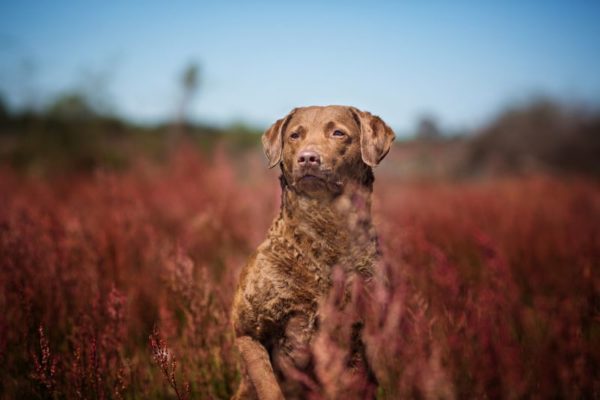
These dogs, with a special passion for water, possess awesome coat. The rest of their hair is tough, thick, short, undercoat is dense, soft. Wool is covered special grease impregnation that prevents moisture from entering thick hair and skin. Dogs hardly get wet.
In the area of the muzzle and paws, their coat is more direct and short. In the area of the shoulders, neck, back and lower back, it can be a little wavy, but curls are not allowed. Availability moderate tows on the hips and in the tail area are allowed, but there are condition – their length should not be more than 4.5 cm.
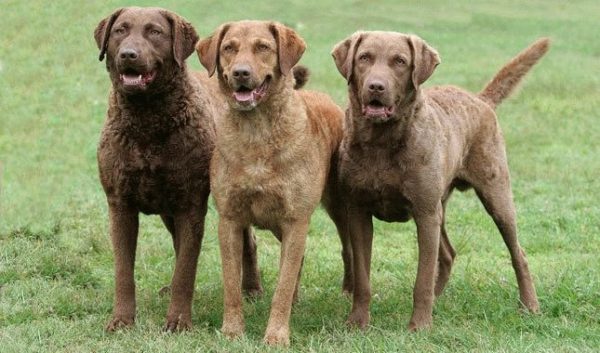
As for the colors, they are as close to natural shades. The palette includes brown tones, including a shade “dried grass” – straw, light, dark in color, “sedge” – from golden red to a shade of light strawberries. Standard allows for small white spots in the chest area, limbs and abdomen.
The nature of the breed
Strength and independence – this is how Chesapeake Bey is described retriever in a nutshell. But it’s hard for owners to briefly describe their unique pets that are able to stay in a long time icy waters, and leaving, become dry after a few minutes.
They are not so friendly with strangers – people and dogs, than, for example, goldens, but not aggressively, but rather cold. Hardness character they surpass all other representatives of hunting rocks. This is what makes Chesapeake the best working dogs. They are more obedient than the other four-legged “hunters”, more successful in offering and hunting down the game.
Talking with dogs of this breed is very, very nice. Start up such a pet is recommended in a family with older children, they they will surely find a common language and spend time together for games and fun.
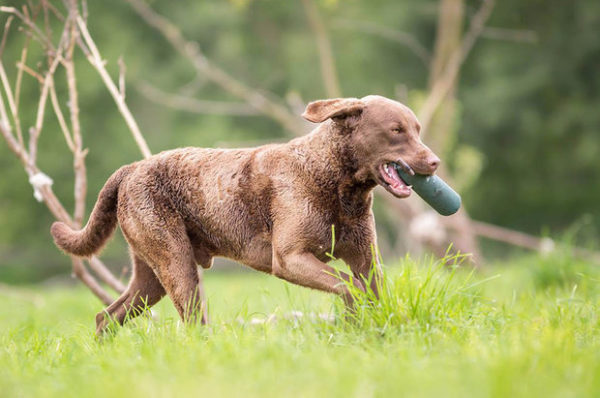
These dogs are happy to port, bringing them again and again. ball or other object. Chesapeake is not a sofa dog, the dog loves walks and swimming, and prefers these activities more than idle lying. After them, the pet’s mood improves, they calmly tolerate the upcoming loneliness and heal.
Chesapeake prone to dominance, so the owner must become for him a real leader, a leader. Experts do not recommend start a puppy of this breed for people who do not have experience with like dogs.
If you compare the chesapeake with other retrievers, then you can note that these animals are more serious and strong-willed, while they very loyal to the owner and family members. Due to the natural alertness to outsiders recommended early socialization pet so that over time it does not become timid or aggressive.
How to train Chesapeake Bay Retriever?
Due to the fact that the chesapeake is a rather independent dog, learning can be difficult. However, it is better if training the owner will be engaged, since this is the pet of one the owner. In any case, he can always get help and consultation with a professional.
If in the future it is supposed to use a dog for hunting waterfowl, you should cultivate devotion in it even with puppyhood. Between the pet and the owner must exist trust is the key to fruitful cooperation. Also not worth it forget that the animal loves and appreciates affection and attention and, having received them or waiting, willingly responds to tasks. 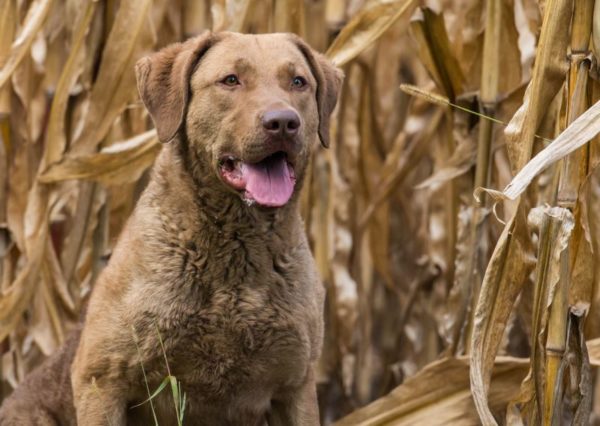
Classes can be conducted in a playful way, then the pleasure of Both the teacher and the diligent student will receive training. At Chesapeaks have an excellent memory, they quickly learn the program. They try to please the owner to get another batch praise.
Often, dogs of this breed begin to show obstinacy, and this means that the owner makes mistakes during training. That’s why it’s important that the dog person knows the breed and was familiar with the training system. Teams from strangers dog skip past ears – he will only obey his members families.
Care and Health
Chesapeake have a dense coat that does not require complicated care. The pet needs to be combed daily with a brush, and the dog really enjoys this procedure.
The dog does not require frequent bathing, just wash it 3-4 times a year. If you do this more often, then detergents can disrupt natural protective layers of the skin and coat. But the splashing in the pond in the warm season will only benefit the pet.
Dog teeth deserve attention, they should be regularly inspect for tartar and clean, they must should be white. The eyes and auricles of these dogs are practically not contaminated, grinding of claws occurs naturally by way.
Like all hunting dogs, chesapeake often come in contact with wild animals and birds, which are often carriers of dangerous pathogens. Therefore, it’s important to vaccinate your pet in a timely manner, treat from external parasites and give drugs with anthelmintic effect.
Breed diseases
Retriever live, including Chesapeake Bay, unfortunately, not very long time – 10-12 years. Most of them are healthy, rarely sick. animals. But they also have a tendency to certain diseases and pathological conditions. These include the following:
- hip dysplasia;
- expansion of the stomach, with or without bowel movements;
- progressive retinal atrophy;
- epileptic seizures.
How and how to feed a pet?
The Chesapeake Bay Retriever is an active, moving animal, so he it takes a lot of protein food. In addition, it is important that the dog receives the necessary amount of calcium – for strong bones and teeth. If a the pet is on natural feeding, he is additionally given vitamin and mineral supplements. 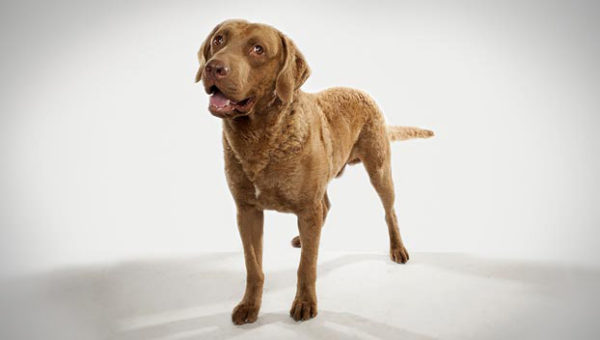
All retrievers have excellent appetite and not too much. picky food, therefore, if the owner is not attentive relate to what and in what quantities his dog eats, he can suffer from obesity. The owner independently chooses:
- Feed the dog natural food – this case, the diet is calculated based on physical activity, gender and animal size; the basis of the menu – about 70%, is meat and offal.
- Feed the dog ready-made production feed – is considered the best option, since the menu It is developed taking into account the needs of a large, active pet. It is recommended to give preference to premium quality products. and super premium.
- Use Mixed Nutrition – Specialists advised not to give regular food and dry granules in one feeding, about the need for additional sources of vitamins and other trace elements should consult a veterinarian.
No matter what type of feeding the owner prefers, most importantly, so that the food is as correct and balanced as possible. Only in this case will the dog grow absolutely mobile.
Features of keeping a dog
Chesapeake Bay Retriever has a dense coat with abundant undercoat, so they feel more comfortable in a cold climate. In hot weather, they will not miss the opportunity to swim, it should take into account when organizing walking around nearby ponds.
The best conditions for a dog is to stay in a private sector with the possibility of walking on a spacious fenced territory. Chesapeake, like other retrievers, is not suitable for a chain. But even in this case, the owner should not neglect the daily, active walking. This is important not only for the dog was able to spend excess energy, but also in terms of socialization – The pet must communicate with other people and dogs.
A representative of this breed can be kept in an apartment if area allows. But in this case you will have to walk with your pet more often and longer – a handsome man who is bored can find an occupation that far from always will benefit the interior. Already six months old a puppy can overcome 1-1.5 km in one walk.
Photo Chesapeake Bay Retriever 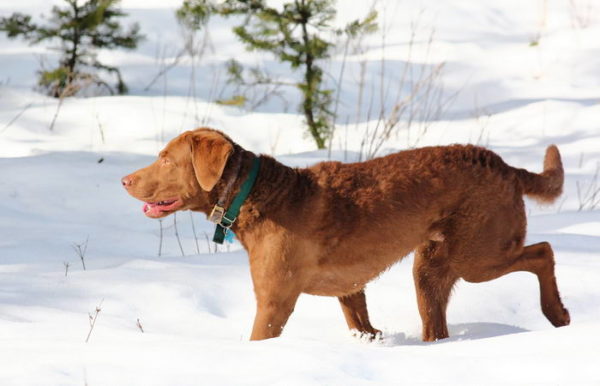
Video about Chesapeake Bay Retriever
Where to buy a puppy and how to choose the best?
In Russia, this breed is still enough rare, therefore, to get a good puppy, you have to look Responsible breeder or nursery specializing in breeding retriever.
Buying a pet from random sellers is not recommended, especially when it comes to offspring without a pedigree. Often people who do not know breed characteristics knit different types retriever, based on their resemblance, not considering the likelihood of genetic disturbances in such an alliance.
There are a number of recommendations to help choose from a litter. best baby:
- the smallest puppy is more prone to pedigree than others diseases and abnormalities;
- the puppy must be healthy, strong, moderately well-fed, he has must be clean eyes, shiny coat, skin without damage and strong legs;
- too bloated tummy, watery eyes, uncertain walk of the baby;
- it is important to evaluate the conditions in which animals are kept, this is confirmation that pets really taken care of properly;
- in order not to acquire a mestizo, you should ask for a pedigree kids and make sure of its authenticity;
- payment for a dog is carried out only when the seller, in addition to the puppy, gave the whole package of documents.
If the future owner is not ready to take care of the little puppy, then he can immediately get a teenager 6-10 months. Usually to this By age, the dog is already mastering the basic rules of behavior and hygiene. But it is worth considering that the acquired bad habits to eradicate much harder. The price of puppies of the breed Chesapeake Bay Retriever on average varies from 40,000 to 55,000 rubles.
When purchasing a pet of this variety of retriever, the owner must take into account the features of his character and temperament. Is not as flexible an dog as it might seem, it requires serious approach and compulsory training. The owner must have leadership qualities to become a leader for this strong, proud dogs.