Cesarean section in cats is a complex surgical procedure for removing kittens from the uterus. This operation is usually performed in urgently when the cat has difficulties with natural childbirth. Most cats recover quickly after the procedure, however, if the cat had given birth for several hours before the operation, then recovery will be slower and she will need additional attention and help with kittens.
How to care for a cat after cesarean section?
An anesthetic was administered to the cat, the effect of which will end pretty fast. Most cats fully recover from anesthesia during their discharge home. full recovery from anesthesia can take two to six hours, depending on used anesthetics, the physical condition of the cat and age at moment of operation, as well as the duration of labor before cesarean.
Immediately after surgery, the cat should carefully be controlled so that it does not fall and does not cause accidental harm yourself or kittens. Kittens should not be left alone with her, until she fully regains consciousness and begins to care for them yourself.
The cat should start eating within a few hours. You should offer her a small amount of food and water every 15-30 minutes in during the first 24 hours after surgery. If she will eat or drink too much or too fast, she may vomit. Her food intake at this time should increase by about 1.5 times, compared with consumption before pregnancy. On the third or the fourth week of kitten care food intake may still be 2-2.5 times higher than normal. At this time, the cat will need quality feed for nursing cats to provide adequate nutrition both her and kittens.
The temperature of the cat may rise by 0.5-1 ° C above normal in during the first 1-3 days, but then it should return to normal. Normal temperatures can range from 38.1 to 39.2 ° C. A cat should never be given acetaminophen or acetylsalicylic acid (aspirin). If the temperature of the cat rises above 40 ° C, then her and kittens should be shown to the veterinarian as soon as possible.
What to do if the cat has discharge from the vulva?
Discharges containing blood are normal which can last up to a week after giving birth. Allocations may be plentiful enough for one to three days, but then they should start to decrease. If the discharge lasts longer than a week, either if their color changes, or a smell appears, then the cat should be checked for infection or any complication. If the cat was sterilized (ovariogysterectomy) during surgery, then there should not be any discharge from the vulva.
When can stitches be removed?
Stitches may or may not be removed depending on used suture material. Many vets use internal, absorbable stitches that will not be visible and not require removal. If the seams are visible, then, as a rule, they should be removed within 10-14 days after surgery.
How to take care of kittens?
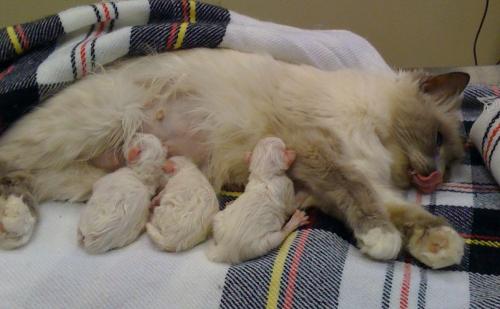
Kittens need immediate care immediately upon arrival to they started drinking milk as quickly as possible. The cat may be sleepy and won’t do it alone. So you may have to help her, laying the cat in a convenient place (for example, a box). Caution put the kittens next to the cat’s nipples. If kittens are reluctant to suck milk, then you can massage some nipples so that it appeared.
What if kittens cry?
Kittens should sleep or suck milk 90% of the time. If they cry or whimper, then this is usually not the case. Uterine infection lack of milk or its low quality are the most common causes of anxiety and ill health of kittens. All cat litter may die if one of these complications is progress. If you have any concerns about them health, then you must show both the cat and kittens to the veterinarian.
If at first the cat lacks its own milk, then you can use artificial in the first one or two days. Your vet should advise you on a suitable substitute milk for kittens, as well as bottles for feeding. When emergency, you can use the following formula: 1 a glass of milk, 1 tablespoon of corn oil, 1 pinch of salt and 3 egg yolks (without protein). Mix until smooth. Mixture 30 ml per 1/8 kg of the kitten’s weight should be served in 24 hours. This volume should be divided into 3-5 feedings. Average weight a newborn kitten is 1/8 kg.
It is advisable that care for the kittens begins immediately after birth, but a healthy newborn kitten can survive without complications in within 12 hours without feeding. However, if newborn weak or dehydrated, then feeding should begin as quickly as possible.
What temperature do kittens need?
Newborn kittens practically do not regulate the temperature your body. While the kittens are near their mother, the temperature Indoors is of little importance. However, if they do not are next to the cat, then the room temperature should be in range 29.5-32ºC. To avoid any risk of hypo- or hyperthermia (cooling or overheating), newborn kittens should be exclusively in the house.
When should kittens be weaned from their mother?
Weaning should begin at the age of kittens at 3 1/2 weeks. The first stage of excommunication is the replacement of mother’s milk a mixture of 50:50 water and milk (not goat or cow). Post the mixture should be in a flat saucer near the kittens. Kittens Noses Should gently soak the mixture 2-3 times a day until they start to pat him. After the kittens readily begin to eat with a mixture, you can start adding some canned food to the feed. After of how they start eating solid food, this happens as usually at the age of six weeks, they can be given to new to the owners.
However, a much better option for development and socialization kittens if they stay with a cat and their litter until the age of 8-10 weeks. This will help reduce the likelihood of behavioral problems, associated with early weaning from the mother and from the litter.