What are bedsores?
Pressure ulcers are the death of soft tissue on or under the skin, arising in places of excessive pressure as a result of violation blood supply. Pressure sores look usually soft. red, often painless areas under the skin that may be filled with liquid.
Pressure ulcers occur, as a rule, as a result of lying on solid surfaces such as cement for extended periods time. They are especially common in large, heavy breeds. dogs.
Pressure ulcers mainly develop in the elbow, on the hips and along sides of hind legs. These ulcers become painful. Dogs often persistently licking bedsores in which over time develops abscess.
What are the causes of pressure sores?
Pressure ulcers almost always result from chronic trauma. skin and subcutaneous tissue as a result of prolonged lying on hard surfaces. Pressure ulcers often occur in large or giant domestic dogs, especially those lying on the cement floor without soft and comfortable bedding. Continuous external pressure on the area body, when blood vessels narrow and blood flow decreases, causes tissue damage and ultimately leads to tissue damage necrosis (necrosis). If external pressure over a long period of time (more than 2 hours) will be higher than pressure inside the capillaries, then the formation of a pressure sore inevitably.
Prevention and prevention of pressure sores
The best way to prevent pressure sores is to provide the dog with high, comfortable and soft litter. Dogs that are sick lie for medical reasons or undergoing postoperative rehabilitation, are at highest risk. They owe wide, soft and fairly thick beds should be provided. The lying dog needs to be turned over every 2-3 hours to prevent prolonged pressure in the elbows, hips and some others. Massage, water therapy and other forms of physical therapies may be helpful as they stimulate circulation.
Dog sores symptoms
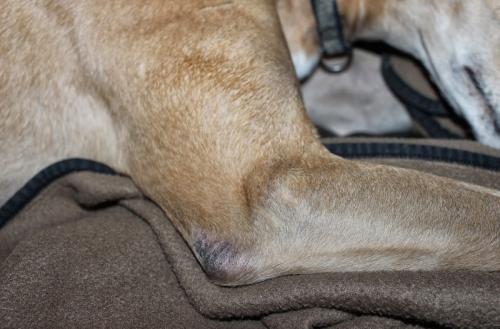
Pressure ulcers are visually evident. Most common pressure sores on the elbows, but they also often occur on the hips, chest, on the sides of the legs, in the hip area and on other parts of the body. Dog owners may not notice a pressure sore until the area begins to ulcerate, or until the dog begins constantly lick the affected area. Dog owners may notice one or more of the following signs of pressure sores in dogs:
- Naked, wrinkled, red-purple and thickened skin area next to the pressure point (protruding bone).
- Liquid-filled area under the skin.
- An ulcer or abscess.
- Permanent licking of the affected area with a dog (may accompanied by a change in the color of the coat).
Dogs at risk
Any dog of any breed and gender can form bedsores. However, the most vulnerable are large and giant breeds such as mastiff, cane corso, irish wolfhound, german Great Dane, Labrador Retriever and other large breeds. Dogs with a weakened immune system is more likely to develop infections in pressure sores. Malnourished and exhausted dogs are also more predisposed to the formation of pressure sores, as they lack soft tissues that are located around the protruding bones.
Dog sores treatment
To prevent further worsening of pressure sores, the patient The dog must be equipped with a soft and comfortable bed. Sometimes this may be enough to reduce the size of the bedsores and prevent their development. There are many mattresses and others. bedding that can be used to treat and prevention of pressure sores. Affected areas and ulcers needed wrap with a soft bandage. Affected areas should be regularly treat with antibacterial drugs and agents, improving microcirculation. In addition, all bedsores should be daily cleaned with antiseptics, which the doctor recommends veterinarian, chlorhexidine is often recommended for these purposes.
If an infection develops in the bedsores, the veterinarian should thoroughly inspect these places. In these cases, as a rule, long-term antibiotic treatment is recommended. Typical course antibiotic treatment lasts at least 4 to 6 weeks. More severe cases of pressure sores require surgical intervention.
Forecasts
Unfortunately, because of the location of pressure sores, where there is constant friction and pressure, they can be difficult enough to treatment. However, most bedsores can be controlled with using the appropriate berth, but for full recovery will take a lot of time. Filled fluid pressure sores often require more invasive techniques, such like surgical drainage.