Classification
Rod: Woodcocks
Family: Snipe
Order: Charadriiformes
Class: Birds
Type: Chordates
Kingdom: Animals
Domain: Eukaryotes
Sizes: body length 35 cm, beak length 7-9 cm, wing length 20 cm. The mass of the bird is about 300 g.
Life span: 10 years
Woodcock – representative of the Snipe family, habitat The species covers a vast territory of Europe and Asia.
Leads mainly solitary lifestyle, feeds on rain worms, insects, mollusks, restricted to plant foods – seeds, shoots and roots.
Against the background of autumn leaves, the woodcock is almost invisible. Can walk at arm’s length and not notice a bird.
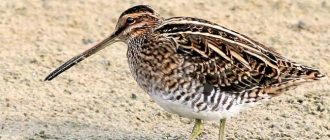
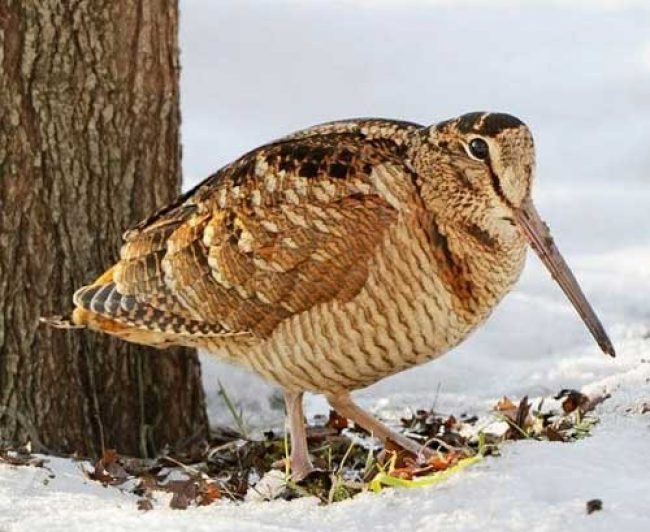
Feathers on the abdomen are light with brown spots, on the wings – brown with dark spots. The head is covered with intermittent rear light and brown stripes.
Content
- 1 Habitat
- 2 Characteristic
- 3 Appearance
- 4 Key Features
- 5 Nutrition
- 6 Reproduction
- 7 Contents
Habitat
Woodcock characteristic habitat – mixed and deciduous forests. In such places there are many bushes and fallen trees, which can be a suitable shelter.
Birds settle in areas with clearings and copses. Prefer high humidity, nest near small ponds: swamps, springs.
From soft soil the bird is easier to get food. In the woods woodcock almost never occurs. Looking for similar places during wintering, often roaming in search of food.
Woodcock nests in Europe and Asia.
Range borders extend from the northern corners of Japan to Ireland, covering the Alps, Mongolia, the Volga region, the lower reaches of the rivers Lena and Yenisei, Scandinavia. It is found among birds. Moscow region.
Winter birds survive in North Africa and The Mediterranean. They can be found in Iran, India, Ceylon and south of the Caucasus.
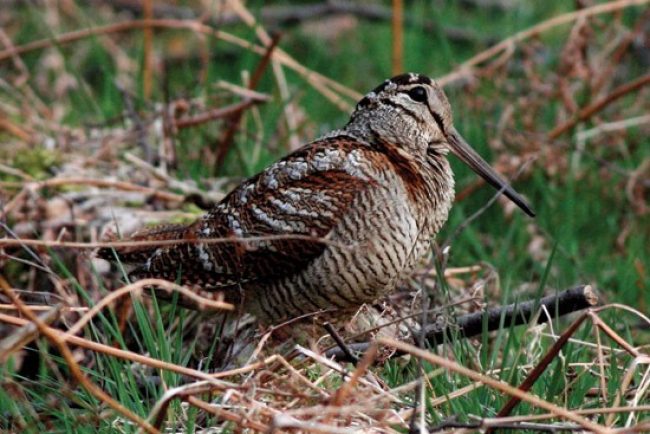
Against the background of grass and branches, a woodcock is almost invisible
Important! Woodcocks in the West Europe and the Atlantic islands, for the most part sedentary.
Characteristic
Woodcock – a representative of the Snipe family. Leads a single Lifestyle. The formation of small groups of individuals is possible, however they will soon decay.
The name of the bird comes from the German word Waldschnepfe, which literally translates to “forest sandpiper”.
Other names of individuals – boletus, birch, boar sandpiper, red sandpiper. The most common currently remains name woodcock.
Compared to close species
In size, the birds are close to a gray pigeon. In the snipe family In total, 8 species stand out that have slight differences in size and plumage. A related woodcock is the usual snipe.
Among the differences, what a woodcock looks like – stripes, edging about eye, wing shape. The closest representative of this genus is Amami Woodcock.
These individuals are found only on islands located in the south. Japan.
Of the external signs – the differences in the white border around eye, a more elongated shape of the wings and a dark longitudinal strip, walking along the tail.
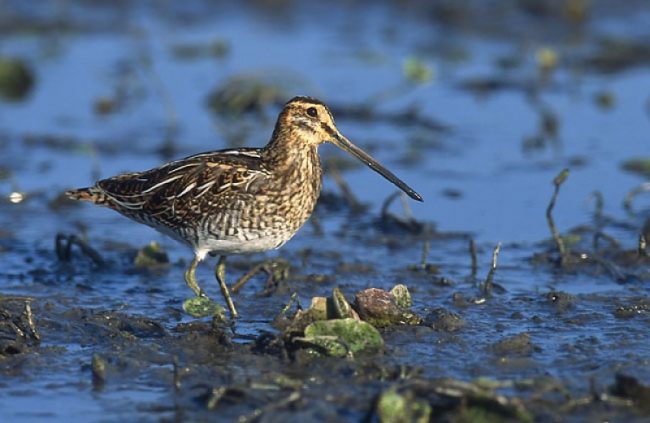
Woodcock is close in size to a gray dove
Woodcock differs from its brethren in habitat. These birds live in moist deciduous and mixed forests, whereas representatives of other species nest in the swamps.
If you are interested in looking at unusual beaks of a bird, We recommend that you familiarize yourself with articlehttps: //kot-pes.com/pticy-s-neobychnymi-klyuvami/
Flights
Wintering birds leave in September. They determine the period flight by:
- shortening the day;
- night frosts. When the temperature drops below zero and the ground freezes, woodcock cannot get its own food.
When the birds begin to fly and how long it will last, in many ways depends on weather conditions.
If a cold snap does not occur and the weather changes gradually, individuals fly south in small flocks or one by one.
In this case, rashes of individuals in wintering areas are not observed. However, with a sharp drop in temperature and frost, woodcocks fly south in large numbers.
Birds fly early in the morning or after the onset the darkness. Weather permitting, flocks may be in air all night.
In the afternoon they go down to rest in the forest glades or fields after harvesting. Such clusters of woodcock in areas where they have not previously nested, called rashes.
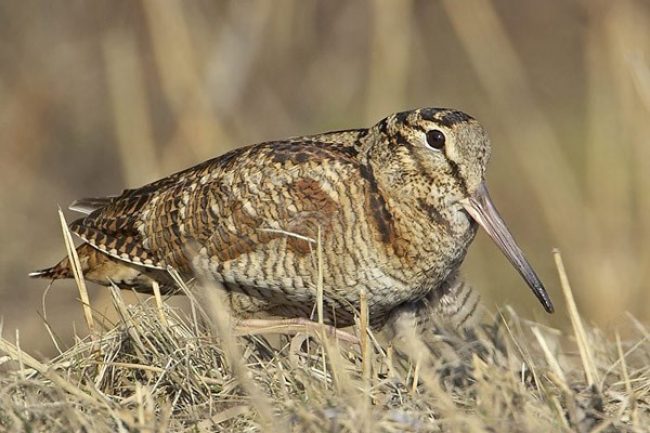
Happy birds descend to rest on fields or lawns
When warmth sets in, birds roam like jays. If the conditions are favorable, the flight may start at the end of February.
When it snows, from late March to mid-May, woodcock is already at nesting sites. Bird flight is carried out as individually or in pairs or small flocks – 6 or more individuals.
You can learn about what other birds fly south in the fall from articleshttps: //kot-pes.com/kakie-pticy-uletayut-na-yug-osenyu/
Interesting! In most individuals of this species, like swallows and swifts, philopathy is observed. This defines the phenomenon in which birds when flying back to their place of birth.
Appearance
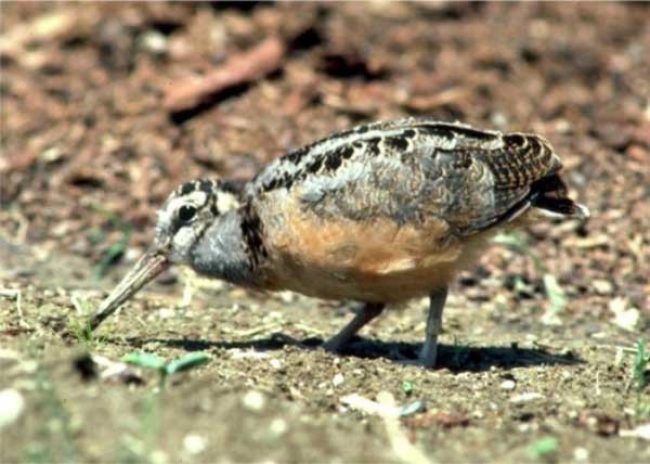
The photo shows that the color of the back and wings of the bird is predominantly rusty brown, visible black, red and gray spots.
On the abdomen, the plumage is light gray with thin transverse stripes. On the inside, the wings are colored more intensely.
This coloring serves as a kind of deterrent mechanism. When a potential adversary comes too close distance, the bird takes off sharply.
This technique discourages the enemy. A few seconds confusion to the bird is enough to hide in the branches trees.
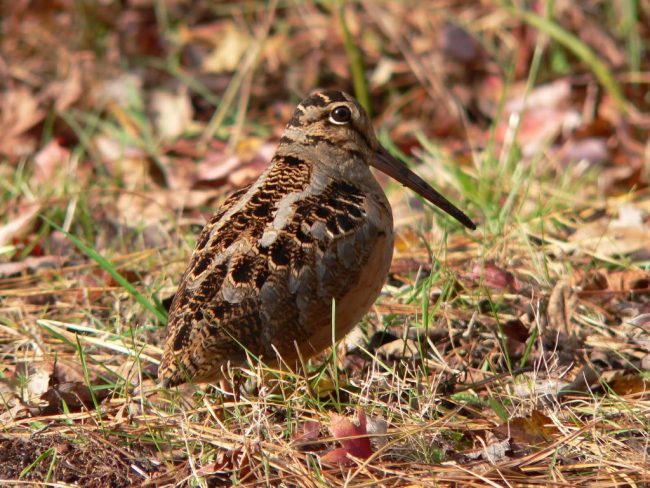
The color of the bird is mainly rusty brown with black and light gray spots
General outlines
What does a woodcock look like in general – stocky, short legs and neck, body reaches 35 cm in length. The long one stands out in the photo straight beak (up to 9 cm).
In its flexible tip there is a huge amount nerve endings, so it is very sensitive.
Important! The bird uses the tip of its beak to locating worms. Having discovered prey, woodcock takes her out of the soil.
What does a woodcock look like in the air? The bird is recognized by its round shape. wing and short neck, which is hardly noticeable in silhouette. Being in flying, she lowers her beak down.
The average weight of an individual is 300 g. The size of the female is not differ from males. The eyes are set on the sides and noticeably shifted. up and back, giving the bird a wide view.
The wings are wide, of small length (about 20 cm). Wingspan can reach 67 cm.
From the corners of the eyes to the base of the beak, the bird passes black strip. In the photo on the head, alternating bright thin and dark wide stripes located across.
Key Features
From what a woodcock looks like and what kind of lifestyle for him characteristic, we can distinguish the following points.
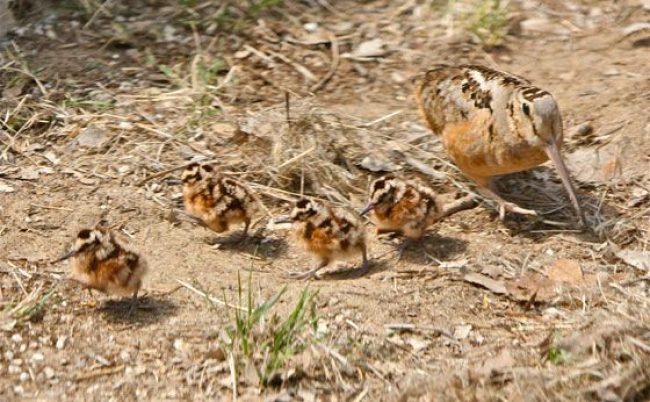
Female with four motley chicks
- The bird goes in search of food at night.
- Woodcock does not sing or chirp under normal conditions. However in mating season, in order to attract the female, the male makes whistling sounds and hoarse screams.
- Polygamous, mainly maintained throughout life one by one.
- Woodcock nests fly right on the ground, like bustard. Camouflaged in grass and fallen leaves eggs are very hard to find.
- In case of danger, the bird drags its chicks into a quiet a place. She holds them with her beak, moving on the ground. Carry over in case of danger, few birds are common.
- The eyes of individuals set high enough and laid back. Therefore, even if a woodcock is looking for food, it is capable of notice the approaching enemy.
- These birds are well oriented in the dark.
- When a nest is discovered by a potential adversary, the female pretending to be wounded and trying to lead him to another place.
- In the mating season, individuals make peculiar sounds – hoarse or whistling.
- Woodcock flies beautifully and is able to briskly move between branches.
An important advantage of birds is the ability to disguise themselves. In the forests they have many opponents.
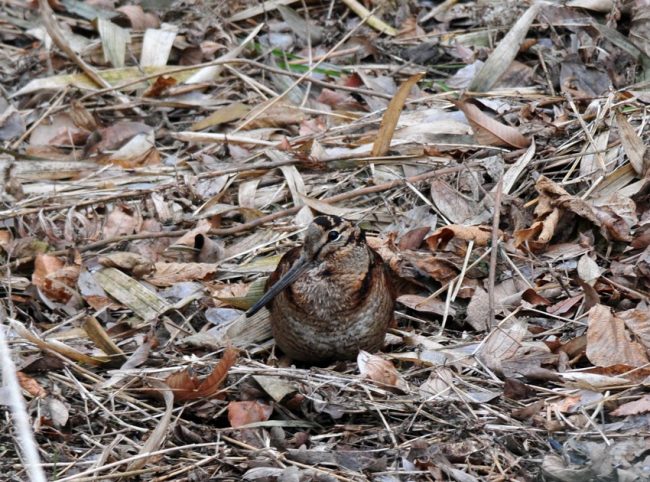
The colorful plumage, as seen in the photo, is mainly brown with dark and light interspersed – blurs the individual against the background of leaves and herbs. Even knowing what a woodcock looks like, you may not notice it in shelter.
The bird can not be seen due to its effective disguise
Faced with danger, the bird freezes. Then the enemy can pass by, taking her for a bunch of leaves.
The unique arrangement of the eyes allows her to see what is happening around without twisting his head. If the enemy is too close, a woodcock abruptly takes off and is lost sight of.
To do this, he needs only a couple of seconds.
Food
The bird menu includes:
- earthworms;
- insects like cicadas;
- mollusks and crustaceans;
- seeds, young shoots, roots, berries.
In the main diet of woodcock – insects and earthworms, which he finds in the clearings near the forest. Finding food bird uses his long beak.
Its flexible tip contains a huge amount of nerve endings. If a sandpiper lowers it into the ground, sensitive tissues capture the smallest vibrations emitted by worms and larvae.
When prey is found, the bird grabs it with its beak and pulls out from the soil. Woodcock prefers bugs and larvae from insects dipterans.
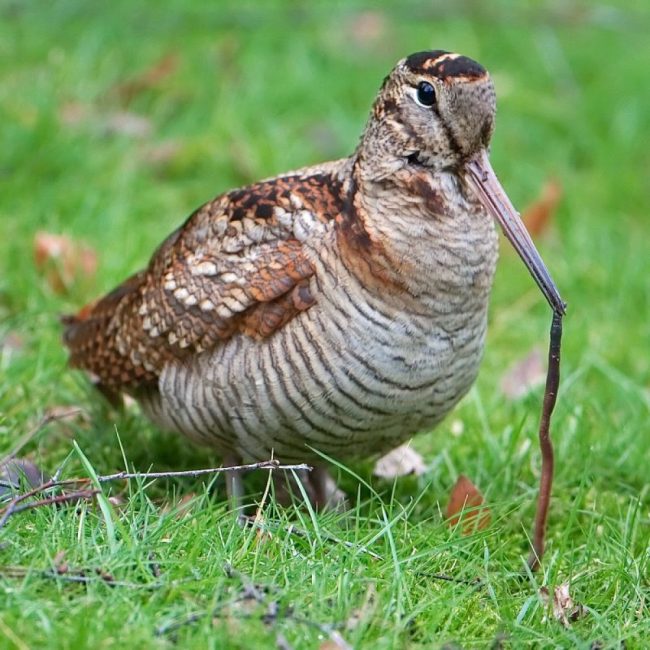
The main forage of woodcocks is earthworms
Woodcock also feeds on fresh seeds and plant roots shoots and berries. However they make up a small fraction of it diet.
Birds eat shellfish and crustaceans that have landed on shore high tide or wave time.
Sometimes woodcocks gather in the sand in search of food whole flocks. This picture can be observed during the migration period.
Interesting! Woodcock is looking for food at night time.
Breeding
Males reach puberty by two years, females – per year. Masonry occurs 1-2 times a year. The mating season lasts from the middle April to the very end of June.
A flying woodcock (the current in these birds is called traction) flies over forest near the treetops and makes hoarse and whistling sounds. The purpose of this song is to attract a female.
Woodcock thrust
Thrust-specific flights begin in about 15 minutes after sunset and continue until nightfall. They are cover the twilight time of day.
The second peak occurs at dawn, but lasts less and is observed not all individuals. Each male has his own plot, above with which he flies.
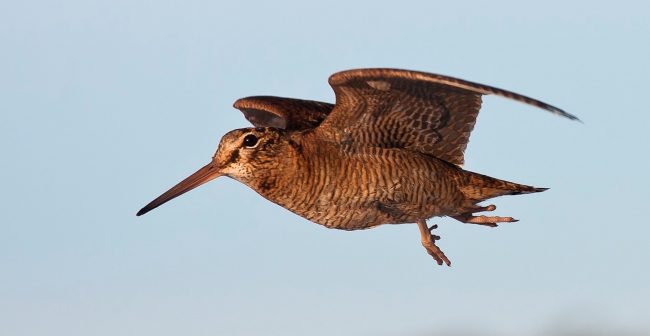
In clear weather, males rise higher
Interesting! In cloudy weather or when in light rain, males fly slower and at lower altitudes. Clear in the evening with a strong wind they rise higher and move with high speed.
Woodcock sounds can be heard from up to 300 m. Females also give sound signals.
Shrill cries are heard in the presence of males chasing rival. However, this behavior is characteristic of young individuals, reached the year.
Having found the female, the woodcock descends to her, after which it remains with her for several days, and then mates. These birds do not form steam for life.
During the mating season, the male mates with 3-4 females. Hatching eggs and caring for chicks is the concern of the latter.
Nesting
Woodcock arranges nest right on the ground. In a secluded place for example, near a bush, under an old rotten stump or in a thicket nettles, the bird tears a small hole with a diameter of 15 cm.
The enemy will not be able to get close to such a nest. To the bottom the bird lays grass, moss and leaves. Find the nest extremely not easy.
The female is tight to the eggs
In one clutch there are usually 4 eggs. Brownish shell or grayish shade with a splash. This coloring also serves to disguises.
During hatching, the female is closely adjacent to the eggs. Noticing the approach of danger, it lurks. So that the eye shine does not give out her, the female covers her eyelids.
If due to some circumstances the clutch dies, the bird again lays eggs.
Feeding chicks
Chicks develop in the following stages:
- 20-24 days – the incubation period;
- 10-14 days – the plumage appears in the chicks;
- after three weeks, the young stands on the wing;
- after six weeks, the chicks become completely independent.
Throughout the incubation period, the female is in the nest. She can leave eggs only in case of serious danger.
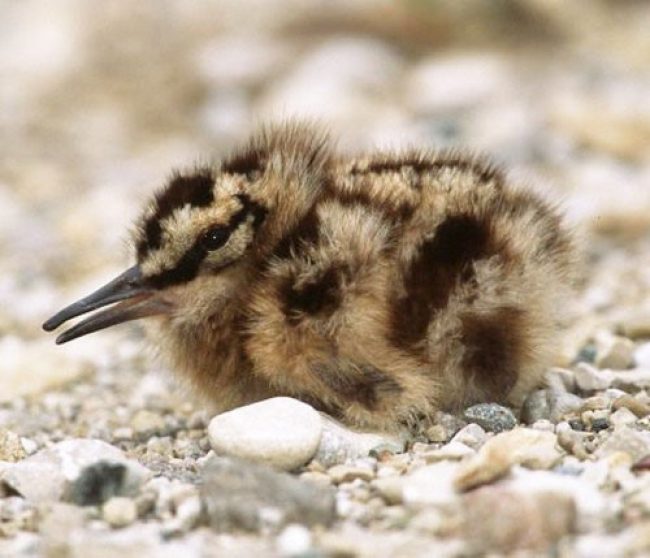
Camouflage camouflage coloring: yellowish fluff with black stripes
Hatched chicks are covered with yellowish fluff, passes on the back black strip. This color helps them mask in the foliage and branches.
By the end of two weeks, the chicks are fledging. In just a month and a half they leave the female.
In general, woodcocks lead a solitary lifestyle. Couples they form only during the mating season, moreover, only a few days.
Content
Woodcock is a forest bird. Although in theory they can be contained in captivity, in practice it is problematic.
Given the living conditions of woodcocks, for litter in cages use sphagnum, which is pre-moistened.
Woodcock – a quiet forest sandpiper, leading a secretive lifestyle. Unique motley coloring makes it almost invisible on foliage background.
Carefully disguises the bird and its nests, which are located right on the ground. Three weeks after dropping the shell, chicks are on the wing, and at 6 weeks they are ready for independent life.
Woodcock: Variegated Forest Dweller
Woodcock – representative of the Snipe family, habitat The species covers a vast territory of Europe and Asia. Leads predominantly solitary lifestyle, feeds on earthworms, insects, mollusks, restricted to plant foods – seeds, shoots and roots.