Spur frogs, constantly living in water, are one of the most popular types of amphibians for keeping at home conditions. They can live in an ordinary aquarium and eat simple fish food that is easy to buy at the pet store.
Content
- 1 Smooth Spur frog – a resident of African reservoirs
- 1.1 Appearance and lifestyle of the Spur frog
- 1.2 Spur frogs in nature
- 1.3 Spur frogs in a home aquarium
- 1.3.1 Aquarium equipment for Spur frogs
- 1.3.2 Temperature and water quality
- 1.3.3 Compatibility with aquarium plants, fish and other animals
- 1.3.4 Safety Rules for Spur frogs
- 1.3.5 Features of feeding
- 1.4 Breeding of Spur frogs
Smooth Spur Frog – African ponds
Most famous and common in nature and in aquariums smooth spur frog, often used as laboratory animal.
The appearance and lifestyle of the Spur frog
Spur frog is noticeably different from the usual frogs Russian fauna: she has a small flat head with located from above eyes and disproportionate paws: small front with thin fingers and very powerful back with large swimming eardrums. On the front legs, 4 fingers without claws, on the hind legs – 5 fingers each, of which 3 are equipped with sharp claws, for which this frog got its name shportsovoy. Adult specimens reach 10-12 centimeters in length. They breathe air rising to the surface of the water, and feed on small water animals.
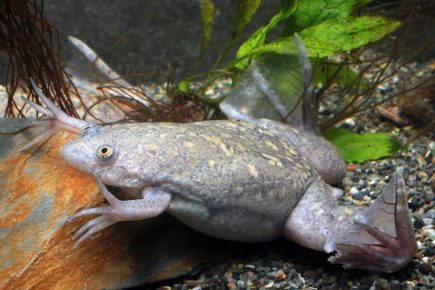
Wild spur frogs have camouflage camouflage
Spur frogs in nature
In the wild, a smooth Spur frog is found in rivers, ponds and lakes of tropical Africa. These frogs constantly live in water, and when the reservoirs dry, they are buried deep in the bottom silt and hibernate before the rainy season begins. Wild frogs gray-brown speckled back and light abdomen.
Today, Spur frogs come across in the waters of America and Southern Europe, where escaped and multiplied escaped from laboratory conditions or accidentally released by aquarists instances.
Spur frogs in a home aquarium
In home aquariums, frogs are equally often kept natural coloring, and artificially monotonous pinkish-cream albinos with red eyes.
I lived both varieties in one aquarium, requirements for their care and behavior are exactly the same.

Albino – Artificially Derived Form of Spur Frog
Aquarium equipment for Spur frogs
These frogs are suitable for the most ordinary aquarium with a volume of 10 liters per couple of adults. It is important to observe only 2 simple conditions:
- the aquarium should be covered with glass or a strong mesh so that the frogs could not escape from it;
- between the surface of the water and the lid of the aquarium you need several centimeters of airspace for breathing.
Temperature and water quality
Water temperature should be from +20 to +28 ° C, in more In the cool water frogs fall ill and die quickly. Plumbing water should be kept for at least 24 hours in an open container – the chlorine contained in it corrodes the skin and eyes of frogs. TO acidity and hardness of water they are unpretentious, do not need any filter, nor in air purge.
Compatible with aquarium plants, fish and others animals
Spur frogs – predators rushing at any moving object. They will gladly devour any living thing. the creature is smaller than itself, including small fish, own tadpoles and little frogs. They don’t eat plants, but tender species can suffer from the clumsy frog movements.
I have repeatedly observed my frogs trying to swallow randomly moving shoots of aquatic plants.
The joint maintenance of frogs is possible with large enough peaceful and unobtrusive species of fish without long veil tails and fins. Ordinary goldfish (just not veil tails and telescopes), large catfish, peaceful cichlids of sufficient size (cancers, non-aggressive cichlomas).
My frogs lived with young cichlids astronotuses, while at the time of the resettlement, both the fish and the frogs were the same size.
Safety Rules for Keeping Spur Frogs
Catching these frogs should only be a butterfly net: escaping a slippery frog can seriously scratch a person’s hand with sharp claws. We must take care of the safety of ourselves. frogs: accidentally escaping from an open aquarium or falling on when transported inaccurately, an animal without water dies through several hours.
Feeding Features
Spur frogs, like all amphibians, due to features only moving food notice their vision. More convenient just feed them with a live bloodworm or a tubeworm. If there is no living feed, you can take a slice of low-fat raw beef, cut into thin straws the size of bloodworms and gently feed with tweezers, with this each time you have to drive a piece of meat under the very nose at frogs so she can spot him.
These frogs are very prone to gluttony and obesity, therefore they need to be fed in small quantities.
The daily feed for an adult frog must not exceed the size of her head, actively growing young frogs need 1.5–2 times more feed. If live food remains malnourished after 10 minutes – the frogs are full and they better arrange a fasting day.
Reproduction of Spur frogs
In nature, these frogs breed in the fall with the start of the season rains, and in aquariums – at any time of the year. Breeding “concerts” are preceded by males. Females do not sing. It is possible to reliably distinguish males from females only by behavior during the breeding season.
My frogs in the common aquarium repeatedly began to “sing”, their quiet trills are quite pleasant and melodic, but beyond songs went on.
Caviar laying is preceded by paired “hugs” of the male with the female, which can last several hours and do not always end effectively. If the frog couple still successfully laid eggs, Adults should be transplanted immediately to another aquarium, otherwise they eat their own offspring. Water temperature for caviar and larvae should be between +20 and +25 ° C.

The translucent tadpole frogs look very exotic
Unusual semitransparent tadpoles hatch in 2–5 days. They need access to the surface of the water for breathing air and “blooming” water turned green from microscopic algae in feed quality. The growing tadpoles begin a little feed boiled nettle, mashed in gruel.
1.5–2 months after hatching, the tadpoles begin paws grow, and in 2-3 weeks they turn into small frogs. Since the appearance of the second pair of legs, the plant feed is replaced shallow live daphnia. As they grow, the daphnia frogs are replaced by bloodworm and pipe maker. Ability to breed in Spur frogs comes in 2-3 years, and they can live up to 10-15 years.
The content of Spur frogs in the home aquarium is available even newcomer, it is interesting to watch them and easy to care for, and their quiet “concerts” do not interfere with sleep at night.