
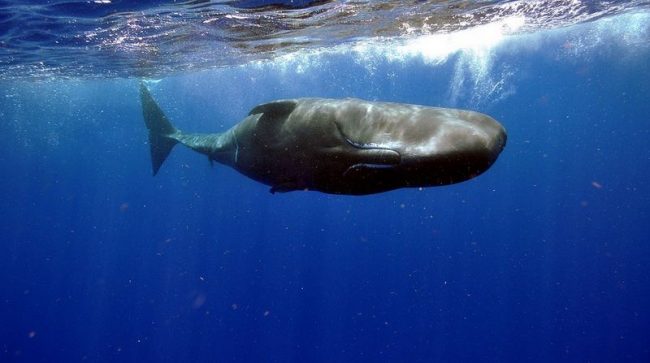
Classification
Type: Sperm whale
Family: Sperm Whale (Physeteridae Gray, 1821)
Order: Cetaceans
Class: Mammals
Type: Chordates
Sizes: Body length – 15 – 20 m; weight – 35 – 45 tons
Life span: 50 – 70 years
It’s not about aquarium inhabitants like axolotl or fish guppies, we’ll talk about one of the largest sea inhabitants – sperm whale.
Sperm whale is the largest of the toothed whales and can grow as long as until it reaches 20 meters in length.
The mass of his brain is 5 times greater than the mass of the human brain!
Some people think that this one has a big enough throat, to swallow a person.
However, because of his love of hunting in depth, the animal is rarely when faced with a person.
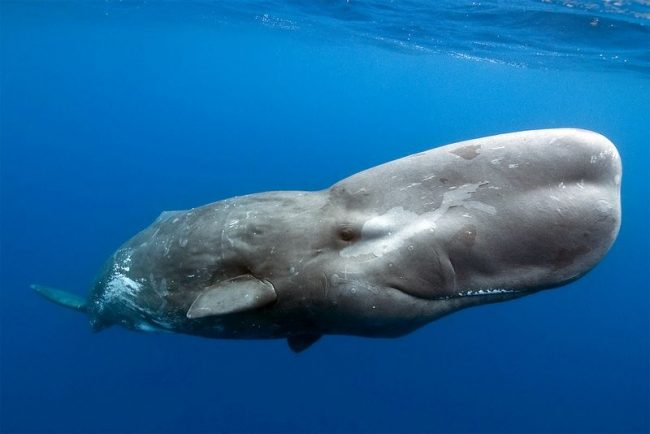
Sperm whales are divided into northern and southern populations and may be found in all oceans. Males migrate from the equator to polar regions, females and juveniles tend to spend more time in temperate regions
Content
- 1 Habitat
- 2 Characteristic
- 3 Appearance
- 4 Key Features
- 5 Nutrition
- 6 Lifestyle and reproduction
Habitat
Sperm whales are divided into northern and southern populations and may be found in all oceans.
Males migrate from the equator to the polar regions, females and juveniles tend to spend more time in regions with temperate climate.
Unlike other types of whales, they do not adhere to the set migration template.
Males roam the oceans for quite some time, returning to females only during the mating season, and some travel around the world in for 70 years of their life.
During the heyday of whaling in the 18-19 centuries the number of animals fell sharply.
They were hunted for by ambergris (a very valuable substance, used in perfumes), fat and meat.
Today, these whales are assigned in accordance with US law to endangered species.
Their numbers are difficult to estimate, mainly because of their ability stay under water for a long period, but she’s still pretty big.
Interesting! The mythical albino sperm whale was immortalized in Herman Melville’s classic Moby Dick novel, based on real life whalers.
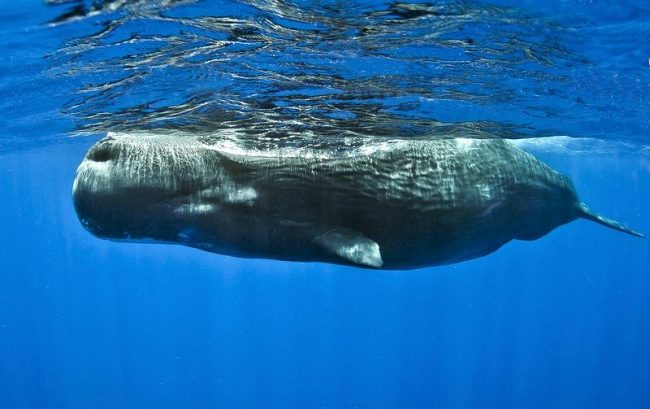
Sperm whale is able to hold your breath for up to 90 minutes when diving to great depth
Characteristic
The sperm whale in the photo is easily recognizable by its massive head and Outstanding rounded forehead.
His brain is larger than the brain of any creature that has ever lived on The earth.
In their head is also a large amount of substance, called spermaceti. Spermaceti sac equals 90% of head weight whale.
Scientists still do not understand the function of spermaceti. There are some theories.
Liquid hardening on cooling helps whale change its buoyancy, so it can sink up to 1,000 meters in looking for squid.
These giant mammals are able to hold their breath for up to 90 minutes for such dives.
It is believed that spermaceti plays an important role in echolocation of whales, and also the bag can serve to absorb shock during contractions in mating season.
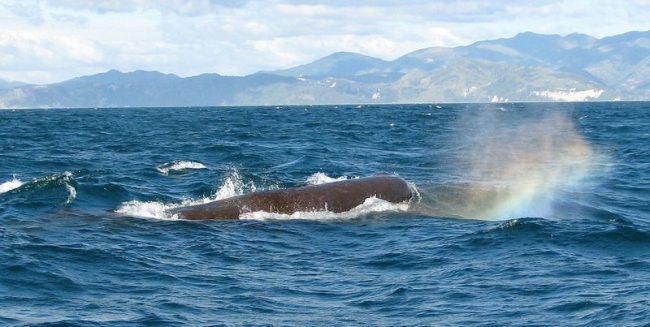
The sperm whale male grows to 18 – 20 m, and the female – about 13 – 15 m in length
Appearance
Compared to other whales, the sperm whale has a very unique body, and it can hardly be confused with other species of whales.
The sperm whale male grows to 18 – 20 m, and the female – about 13 – 15 m in length.
Whales have a huge square forehead, small inconspicuous eyes and a long narrow lower jaw.
They have one breather located on the left side of the forehead.
The lower jaw is filled with conical teeth that fit into the outlet of the upper jaw.
Their skin color ranges from light brown to gray blue, sometimes it can be black, the skin itself is corrugated on most of the body, especially on the back and sides.
To help with swimming, sperm whales have small side paddle-shaped fins and a large caudal fin.
Unlike other waterfowl giants, the sperm whale has no spinal cord. fin, but instead they have some small slides and one large hump, which together resembles the dorsal fin.
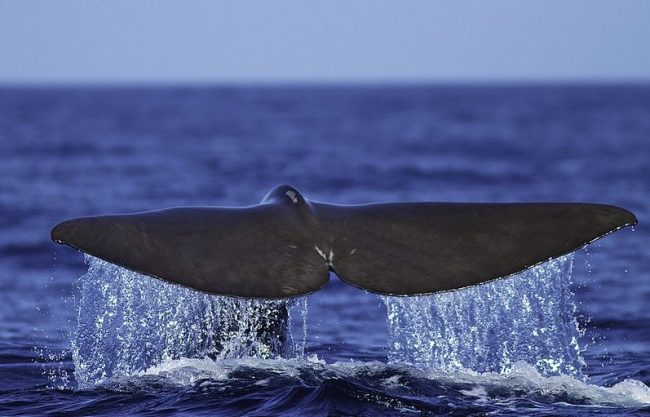
Sperm Whale Tail
Key Features
- Whale sperm whale, photo clearly demonstrates this fact, have disproportionately small eyes. Because they believed that they did not see especially good. And indeed, blind sperm whales were caught in full health with food in the stomach. Instead of looking, sperm whales like believed to use echolocation to search for their prey and navigate in their environment. The auditory abilities of the animal are not known.
- These whales produce intense clicks, sometimes whole series. These sounds can be used to communicate or echolocation.
- Sperm whales can live up to 50 – 70 years. They die more often from natural causes. They have no natural enemies. True, sometimes them attacking flocks of killer whales.
- Other threats: fishing nets, waste water pollution oil, collision with ships, global warming.
- Since the sperm whale is a marine mammal, he needs oxygen to breathe. Spout Fluid – Normal water that accumulates around the external breathing hit the lungs.
- These marine mammals inhale / exhale on average 3 to 7 times per minute, depending on activity. During deep diving, and he can reach the habitat trepang, sperm whale can hold your breath for 90 minutes!
- Representatives of this species are among the most deeply plunging marine mammals in the world.
Interesting! Sperm whales and giant squids – deadly enemies. There are many stories of terrible battles between these two massive animals. And even found the remains giant squid in the whale’s stomach.
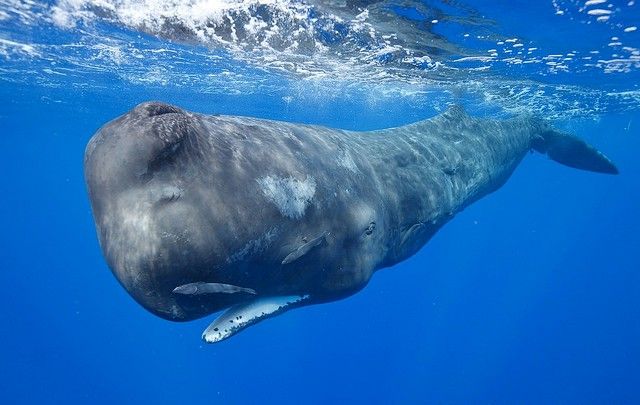
Giant squids make up about 80% of the diet of sperm whales and the remaining 20% consists of octopus, fish, shrimp, crabs and even small bottom sharks. Эти зубатые киты едят около одной тонны (907kg) per day of fish and squid or about 3% of body weight
Food
The standard diet for sperm whales, as a rule, consists of medium and large squids, octopuses and fish.
Due to the love of such whale diving, it is difficult to assemble information on their specific hunting methods or exact products, which they consume.
Therefore, most of what is known about their nutrition will be recognized. when studying the stomachs and intestines of these marine mammals.
Males dive for 1,200 m, and females for 1 000 m.
Гигантские кальмары составляют около 80% рациона кашалотов иоставшиеся 20% состоит из осьминогов, рыбы, креветок, крабов и даженебольших донных акул.
These toothed whales eat about one ton (907 kg) per day of fish and squid or about 3% of body weight.
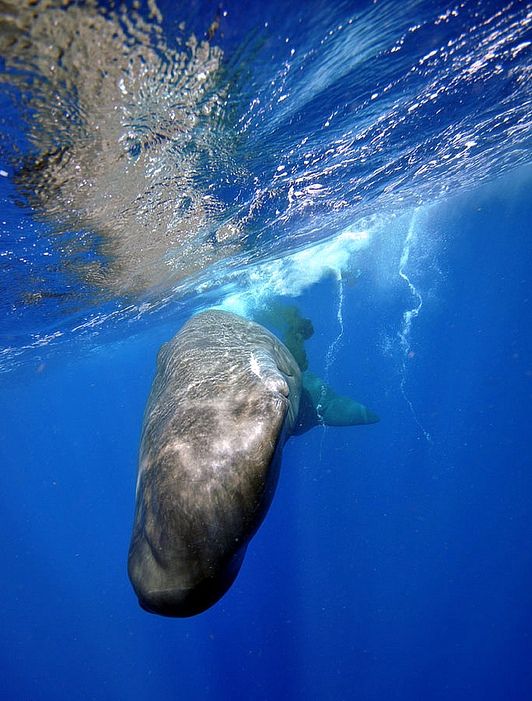
Sperm whale loves diving. Males dive 1,200 m, and females 1 dive 000 m
Sperm whales are known to have 20 to 26 teeth on each side the lower jaw. The teeth on the upper jaw are not used for hunting. or eating food.
While the lower ones help with the capture of prey. Even with teeth these whales usually swallow food without biting or tearing the flesh of their prey.
It is assumed that sperm whale teeth, the photo shows them, do not are necessary for survival.
In fact, sperm whales that have completely lost their teeth, were completely healthy and ate well despite circumstances.
There is a theory why sperm whales have teeth, but do not use them for food and hunting.
While the sperm whales developed, they developed various hunting survival techniques that do not require the use of teeth.
Thus, for millions of years, their teeth have practically not developed, and other physiological components continued evolve and thrive that helped these marine mammals survive.
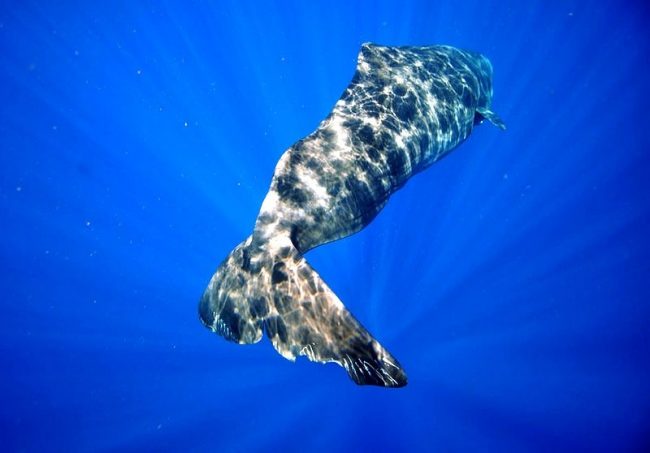
Sperm whales are often seen in groups (called modules) some of them include 15 to 20 animals. Mainly females and young
Lifestyle & Reproduction
Sperm whales are often seen in groups (called modules) some of them include 15 to 20 animals. Mainly females and young.
While males can roam alone or move from one group to another.
Females and calves remain in tropical or subtropical waters throughout the year, and apparently practice general care children.
Males migrate at higher latitudes, alone or in groups, and return to the equator to breed.
Driven by the joy of a happy meeting, they can develop speed up to 37 kilometers per hour.
Interesting! Herds of sperm whales organized by the harem system, like herds of elephants, where a lone male sperm whale has 10 to 40 adult females plus their young (both sexes). Males sometimes fight to gain control of the harem, biting and pushing the enemy. Females can help this process by driving away old males.
A group may also consist of 2 to 6 adult males, which formed a temporary connection.
Communication between individuals includes a series of clicking sounds, extremely loud and clear.
They can be heard over long distances. These clicks are one of the loudest sounds known among animals.
Unfortunately, not much is known about their meaning.
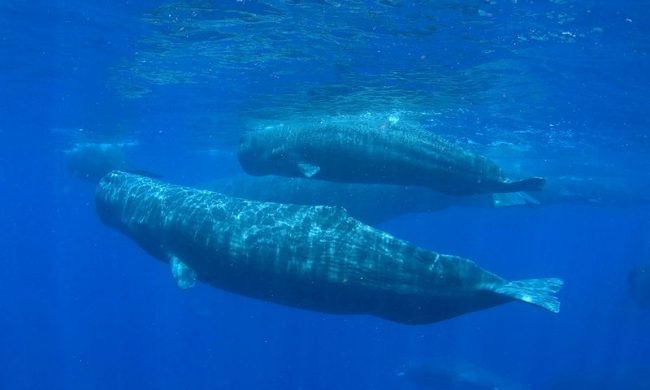
Communication between individuals includes a series of clicking sounds, extremely loud and clear. They can be heard on large distances. These clicks are some of the loudest sounds famous among animals
The breeding season is in the middle of summer.
Females are able to conceive when they reach approximately 8.5 m in length, what happens at the age of 7-14 years.
While male sperm whales are not able to mate until rose to 11.9 m, that is, up to 18 years.
The gestation period usually lasts 14 to 16 months.
After the birth of the baby, the female feeds him with milk from dairy glands, which shoots in the water.
Interesting! Unlike other types of whales, the sperm whale cub is not tied strictly to his feeding biological mother and can be fed from other females in the group. Females feed their calves for two years or longer.
Young animals remain in the mother flock until they are reached age 5 to 20 years, after which they can separate and migrate on their own.
A healthy sperm whale can survive for more than 70 years.
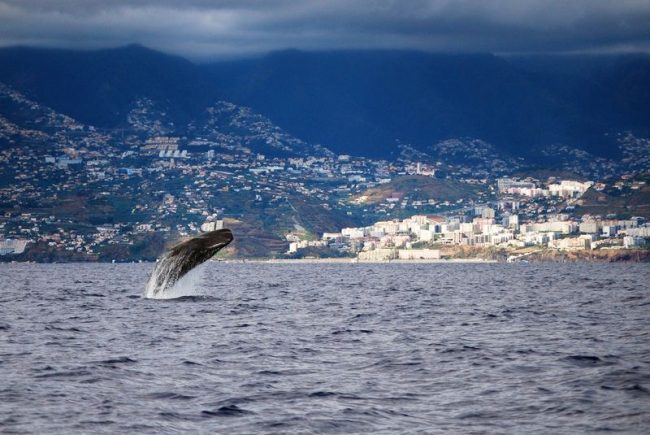
The sperm whale spends most of the time underwater, but sometimes he pleases the human eye with graceful jumps from the water
Despite huge population losses due to previous hunting and whaling for many years, sperm whales are pretty numerous today.
However, due to the large size and characteristics of their marine life these whales are not kept in captivity.
Sperm whale: huge monster from the bottom of the ocean
Did you know that the sperm whale has its own harem, and its brain is 5 times more human brain? Description, specifications and many entertaining details about these animals.