Classification
Type: Rook
Family: Corvids
Order: Passeriformes
Class: birds
Type: Chordates
Subtype: Vertebrates
Dimensions: body length about 45-50 cm; weight – from 300 to 500 gr.
Life expectancy: an average of 3.5 years
Rook is a bird that many have heard of, but few have seen, and less – they know her habits and lifestyle. Slender, graceful messenger spring, a relative of the raven, but different from her habits.
Rook is a very beautiful, stately and smart bird. In size he corresponds to peregrine falcon. In the northern regions the bird leads a migratory lifestyle, therefore its appearance has long been used to associate with the onset of spring heat.
This phenomenon is depicted in the famous painting of Savrasov. If you carefully consider the photo of the bird, you will see slight differences from the crow, and not only in color. But let’s in more detail.
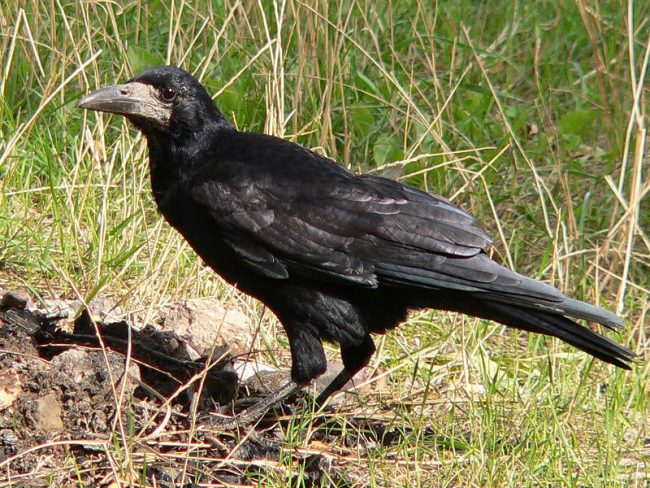
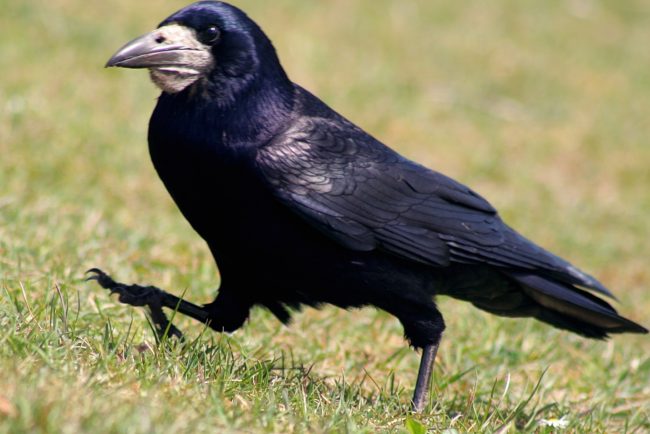
The main signs of a rook are clearly visible in the photo: a large beak without plumage at the base, “panties” of feathers on the legs, black with metallic sheen coloring.
Content
- 1 Habitat
- 2 Characteristic
- 3 Appearance
- 4 Key Features
- 5 Nutrition
- 6 Behavior, reproduction
- 7 Relations with people
Habitat
Rook is a free bird, but prefers to live in colonies, which it is very different from many other related species. Distributed everywhere, including among birds Moscow region, but in different parts of Eurasia behaves differently.
In warmer climates (southern regions), the rook remains to winter, and therefore, it becomes an ordinary bird, settling close to humans and meeting all year round.
Another thing is if he settles closer to the north. In these parts the black handsome is forced, like swallows and swifts, fly away for the winter, so they meet him only in warm time.
Interesting. The Latin name for the species Corvus frugilegus, translated sounds like a “raven collecting food.” Appeared due to the fact that the bird, like a robin, loves to walk around fresh arable land, pecking various insects.
By the way, thanks to this very habit, rook is considered excellent Agricultural Assistant: A flock is capable in minutes to deal with a huge number of larvae of May Khrushchev – some of the most dangerous pests.
If we talk about Russia, then the spring messenger can be found in forest and forest-steppe zones, in their southern parts, throughout from the western border to Primorye.
Rook lives in other areas, but not in large numbers. In the world its range spread to Europe and most of Eurasia. But in the South and You will not see a bird in Central Asia.
As mentioned above, this is a very smart look. In the summer he prefers to nest in the forests, but in winter he goes to the city to to feed. Often combined in huge, noisy flocks with crows, jackdaws.
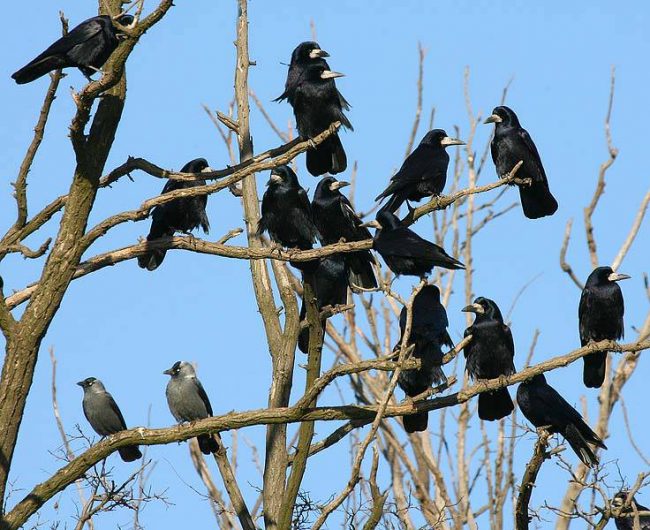
A flock of rooks with jackdaws
Characteristic
You can already see from the photo of the bird that it is very similar to the most common crow, however, has some differences. Indeed rook more elegant, thinner, although the size is about the same. More tends to live in packs.
Interesting! Many scientists compare Rook with chimpanzees in terms of intelligence. It is noteworthy that this bird is also willingly uses primitive tools for fodder extraction in other situations, like the named species of primates.
He prefers to live in the colonies, and tries to settle certainly closer to agricultural land.
Often you can see a picture near the arable land: separately located strip of trees and numerous nests on them. Such colonies are called “rookery.”
Being near them is quite problematic: the birds are noisy, and their “talk” is very similar to the familiar croak.
Nature itself allows individuals of this species to live about two decades, but in harsh reality this rarely happens.
A lot of birds die at a young age, about two years. Rooks scourge – gastrointestinal diseases, as well as some groups of parasites. It is because of them that a huge number of rook chicks die.
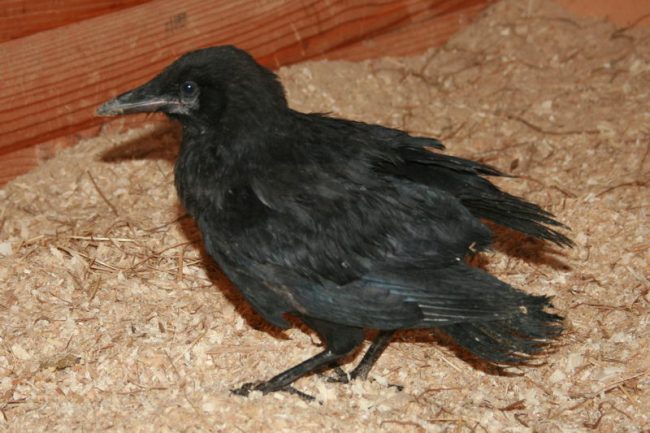
A rook chick, still without a characteristic adult whiteness around the beak
Appearance
And yet, what does a rook look like? For a bird it is characteristic:
- Absolutely black (the same “black”) plumage with a classic metal tint;
- Powerful, large beak, slightly bent down and lack plumage at its base;
- Naughty “panties” formed from elongated feathers in upper legs;
- Clawed, long legs.
There are no sexual distinctive features, but a young individual can be determined. She has no characteristic whitish tint in the base of the beak.
Interesting! Rook is very similar to black crow, although in reality these are different species. It’s easy to distinguish them: the black crow has feathers around its beak and is not observed whiteness in this part of the body.
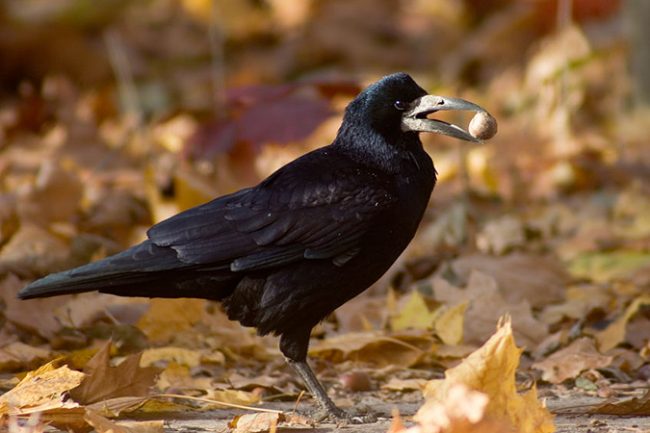
Rook preparing for a meal
Key Features
Before you is a handsome rook. Its silhouette catches the eye harmonious proportions of the body, fighting appearance. Long legs, powerful beak, slender outlines.
Now that you know what a rook looks like, it’s never confuse even with a black crow, although the species are very similar between by myself.
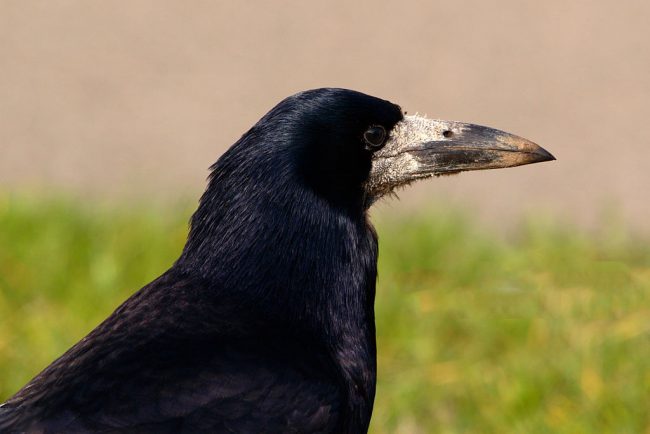
By the beak of a rook, it is very easy to distinguish from its nearest “relatives” raven
The bird has several interesting features and unusual habits.
Firstly, you can always distinguish representatives of urban clusters from village relatives.
The latter, although not afraid of man, but prefer to live more apart, do not settle in the immediate vicinity of housing, creating their individual rookers.
Individuals living in large cities or even megacities. Sometimes it seems that they take people for granted.
Build nests on human structures, especially like lines power lines and high, most often industrial buildings.
Although rook prefers animal food, eating mainly larvae and worms, he does not refuse from vegetable.
Recently, they, along with ravens, can be found around garbage cans. By the way, it is with the increase in food waste and link the migration of these birds from forests closer to human housing.
Scientists also believe that this circumstance led to the transition of many flocks to a settled lifestyle, even in those regions where rooks used to be migratory.
Interesting! It was said above that many individuals die at the age of 3.5-4 years. However in the UK there was an individual who lived until almost 23 years old. The rook chick was ringed at an early age, but they found him dead already old.
By themselves, these birds are very cunning, smart, quick-witted. Like all corvids, they are good mockingbirds. But intelligence manifested in other features of behavior.
Rooks often show an enviable savvy, letting go handlers means for solving immediate problems (sticks or small stones, to dig the ground, if you can’t do it with your beak).
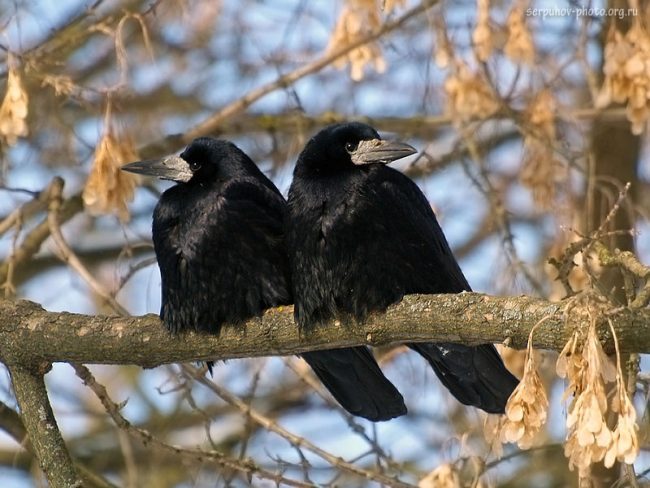
A pair of rooks resting after the flight
Food
In essence, the rook diet consists of the following “dishes”:
- Small (and not very small) invertebrates, such as worms or larvae, a special treat – the chafer;
- Mouse-like rodents like voles or lemmings;
- Cereal grains;
- Various fruits and seeds of vegetables, berries, fruits;
- Food waste.
Chicks can eat on their own, starting from a month age, after they fly out of the nest. However, they are often parents feed about another 3-4 weeks.
Then the bird becomes completely adult and with the rest roams in fields, forests, parks.
Behavior, reproduction
Description of the rook’s behavior is not an easy task. That’s pretty a multifaceted bird that can amaze its amazingly accurate, correct reactions.
She is very active, inquisitive, understanding. Rooks are capable remember a situation, a place, build some similarities of logical chains.
That is why before they were often kept at home conditions and even trained. But more about that below.
The breeding season at the rooks begins when the snow is actively melting, most often in mid-late March. Generally, on the nesting bird arrive already in February, when the sun begins to warm.
But this only applies to the southern borders of their range, in in the central part, the construction of a home for themselves and future chicks happening closer to April.
Rooks live in colonies, moreover, they can take more than one year return to the place where they were born to reproduce progeny.
The nests are large, noticeable, in diameter up to 65 cm, height from 25 to 70 cm. Both male and male are equally actively involved in the construction. female.
The outer layer is usually made of branches, the inner is different soft material, from last year’s dried grass and leaves to tow, fluff, cotton wool, etc.
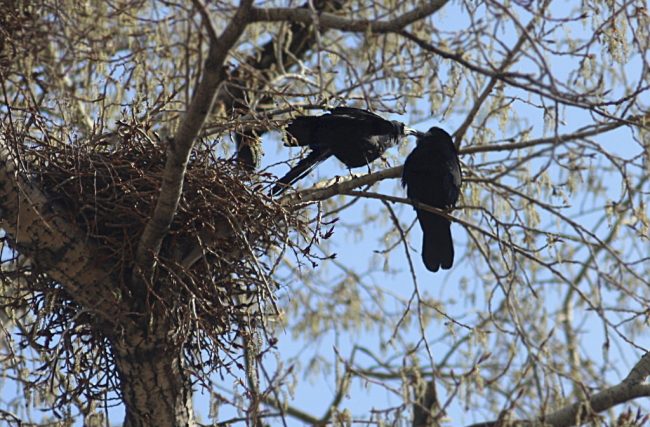
A rook nest that can be seen from afar
Interesting. Rooks can use the same nest in for several years in a row. Moreover, they will never be confused, their is it a dwelling or not.
Every year, the construction grows, and, in the end, becomes a multi-tiered, complex design.
There is only one masonry, but in very rare cases, steam can remove chicks twice during the summer. As a rule, the female lays from 3 to 6 large enough eggs (about 30 mm in diameter).
Shell color can vary from greenish blue to blue with brown spots. A rook chick is born about after 3 weeks, he is completely helpless and completely naked.
The female warms the babies for a long time with her warmth, and during this period everything only the male feeds the family. When the chicks begin to fledge, their both father and mother are already feeding.
Departure from the nest at the age of 30 days, but independent chicks rooks become later. They are fed by both for an additional 3 weeks. the parent.
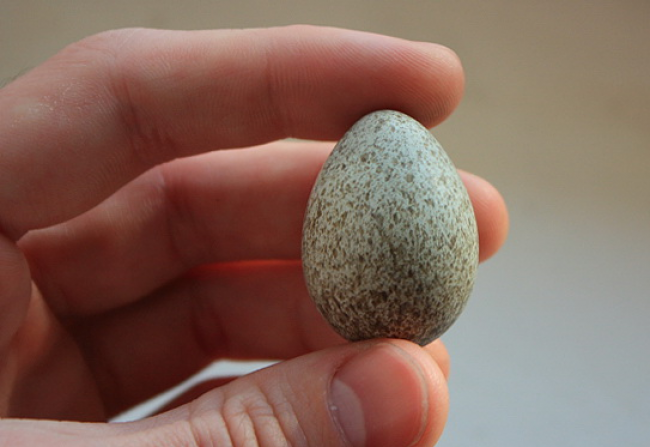
A rook egg reaches 3 mm in diameter
Birds of this species are very caring parents, and in parenting both adults are equally important a place.
Subsequently, many chicks return to the place where they were born to continue their race. But also some and fly away to other areas, gathering in new colonies.
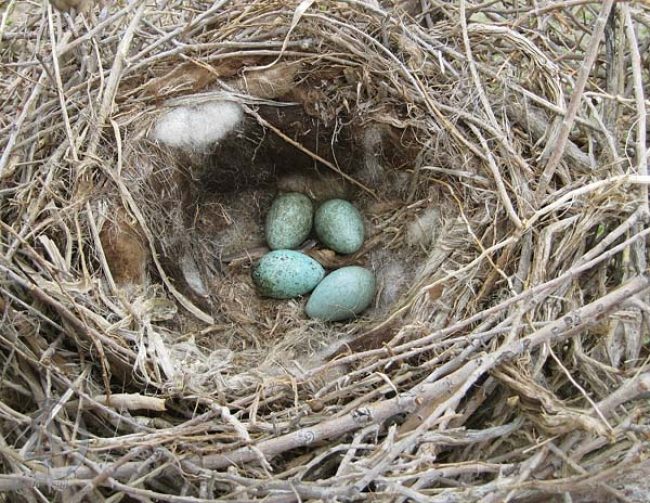
Rooking eggs in the nest
Relationship with people
Surprisingly, so interesting and quite close to a person the bird for a very long time was not fully studied.
The fact is that earlier the rook led a more secretive life, preferring to stay away from human habitation.
Now, many individuals are not at all afraid of people, existing with us side by side. And it provides many opportunities for close study and observation.
Despite the ever closer approach to human housing, the rook still more common in rural settlements than large cities.
This is due to his special love for the newly plowed a field where you can enjoy plenty dug into the light insects. This bird is not afraid of man, refers to him calmly.
Since the black beauties are very smart, they are quite possible keep as pets. With the right approach, can be taught to speak.
Moreover, the dictionary will be quite extensive. However, it is important to consider some content rules:
- The rook is very quickly and easily tamed, so do not be afraid contact with the pet;
- This is a flock of birds, it needs constant communication and Attention;
- The house does not work because of the large size of the animal and freedom. Many experienced breeders recommend a spacious aviary, and best of all on the street;
- Follow the correct feeding schedule, make sure to always there was fresh and clear water.
With proper care, a rook may very well become a good friend, with which you can even “talk heart to heart.” But still it’s free bird, and it’s better to watch it in nature, and not plant, even and in a golden, but still a cage.
Interesting! Residents of Germany and Ukraine, belonging to the so-called “poor”, rook meat was eaten. Such a dish was wide distributed until the end of the XIX century.
Having seen a bird at least once, you cannot help but feel an interest in it, the desire to touch her lifestyle with at least one hand. And this perhaps you just need to watch carefully.
Rook: A bird that brings spring on its wings
Rook is a bird that many have heard of, but few have seen, and less – they know her habits and lifestyle. Slender, graceful messenger spring, a relative of the raven, but different from her habits.