Classification
Species: European Viper – Pelias berus
Rod: Real Vipers – Vipera
Family: Vipers
Order: Scaly
Class: Reptiles
Type: Chordates
Subtype: Vertebrates
Dimensions: The length of the snake is about 60 cm; weight – from 50 up to 180 grams
Life span: up to 15 years
Dislike for snakes was cultivated in human society on throughout its history.
Some nations deified snakes, others considered them fiends hell, but all cultures are united in one thing – in fear of these legless creatures.
Northern countries are not very rich in snake representatives. community, but the viper, unlike, for example, exotic python, you can meet almost everywhere, even in the Arctic Circle.
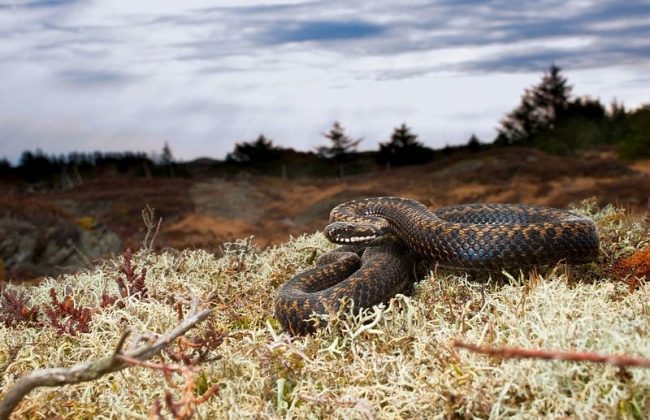
The genus Vipera, or real vipers, has about 30 species, from of which 8 are common in Russia and Ukraine
Content
- 1 Habitat
- 2 Characteristic
- 3 Appearance
- 4 Key Features
- 5 Nutrition
- 6 Reproduction
- 7 Content and breeding
Habitat
Snakes are reptiles, so they prefer warm climate. This does not apply to the viper.
Its distribution range extends from the UK and France in the west to Sakhalin and Korea in the east.
In Europe, the viper can be found, as in the high forests of Italy and southern France and the Scandinavian peninsula.
In the taiga of Eastern Siberia, it lives up to the border permafrost.
To get a viper in the camera’s frame, you need to take a snake photo only in the forest. This species is adapted for life in the forest zone.
The southern border of its range in Russia and Ukraine coincides with the border forest steppes and steppes. South of the viper can only be seen in the mountains forests.
The reason for this is the reptile’s adaptation to life in cool conditions.
Interesting! Of the many species of poisonous snakes on Earth, the viper is the most common and numerous. Viper – the only poisonous snake that lives in the northern latitudes Eurasia.
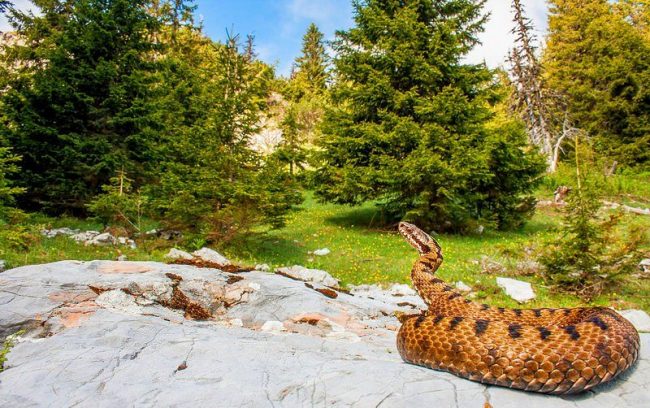
Viper is a small, up to 60 centimeters in length, a snake. Males have a shorter and thinner body, but their tail is longer. Females are found even up to 90 centimeters in length
Characteristic
The genus Vipera, or real vipers, has about 30 species, from of which 8 are common in Russia and Ukraine.
It is noteworthy that 5 species of this genus are listed in Red book:
- Dinnika
- Kaznakova
- Nikolsky
- Steppe
- Gyurza
The common viper that can be found in our forests, belongs to a separate genus Pelias berus.
From the rest of her relatives she differs in that her a triangular head with a rounded muzzle is covered with three shields: one frontal and two parietal.
Interesting! During the mating season, males vipers are usually measured by forces. By doing this, they get the location females. Entwined by bodies, rivals rise and beat with fury each other’s heads until they fall from powerlessness. In doing so, they try to injure the opponent as little as possible. Sometimes such a duel lasts more than 30 minutes, but always ends with one from males yields to another and crawls away.
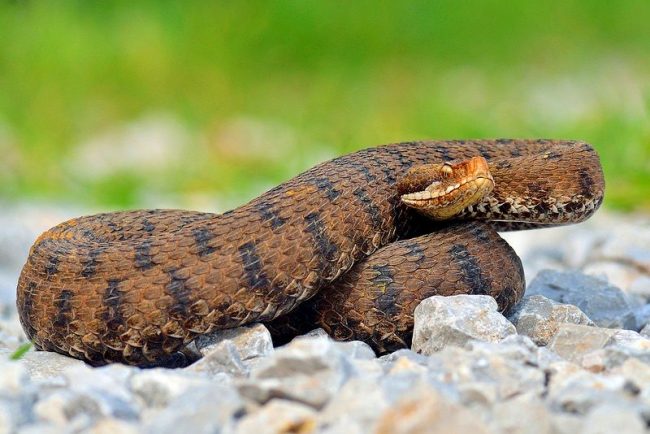
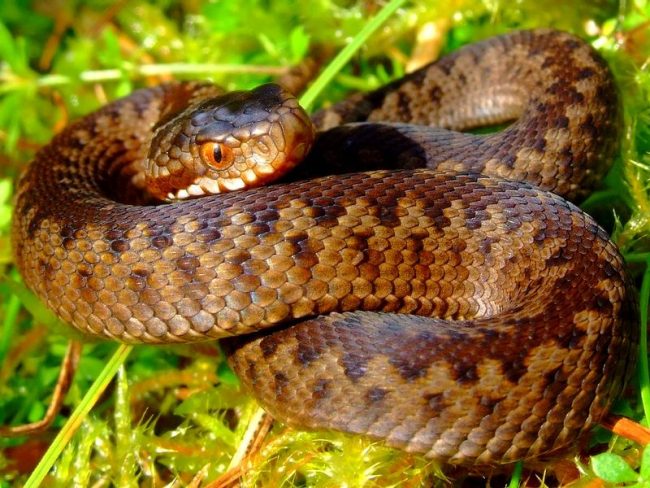
The color of the snake varies from light brown to black. On there is a winding strip of dark spots on the back
Appearance
Viper is a small, up to 60 centimeters in length, a snake.
Males have a shorter and thinner body, but their tail is longer. Females are found even up to 90 centimeters in length.
The color of the snake varies from light brown to black. On on the back there is a winding strip of dark spots.
Here’s what an overwhelming snake viper looks like in the photo cases.
A distinctive feature is the sinister fiery red color of the eyes with a vertical pupil that looks like a narrow gap.
Big outgrowths hanging over the eyes also add ferocity reminiscent of the superciliary arches.
The belly of the snake has a gray tint, dun or black, sometimes there are white spots.
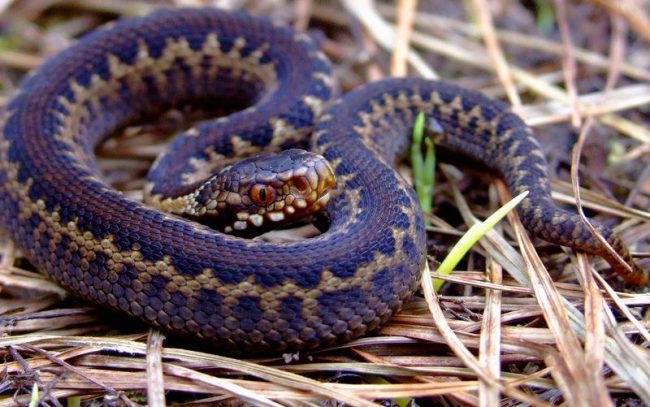
A distinctive feature is the sinister fiery red color of the eyes with a vertical pupil that looks like a narrow gap
Key Features
A feature of all vipers is the presence of poisonous glands, located in the sinuses behind the upper jaw.
The venom of them enters the site of the bite through two empty teeth inside. These teeth are attached to the rotating maxillary bone.
Usually these fangs are not visible, as they are folded condition and closed with a special film.
At the time of the attack, the jaw of the reptile opens 180 degrees, and the fangs are turning in the direction of impact.
To photograph a snake bite, a viper photo must be taken at the moment throw. This is not within the power of man, but with the help of slow motion on a camcorder this is possible.
Due to the fact that the bite of this snake is very dangerous and can lead to even to death, you need to know the following measures precautions:
- You should never touch the viper.
- In the forest where these snakes live, you need to wear high durable boots and tight pants.
- Before you enter the thick grass or step into the pit, you need make sure there are no reptiles there.
- When picking mushrooms or berries, you must first fumble with a stick grass around you. The snake will creep away or hiss.
- You should not move if there is a viper crawling nearby. Most likely she creeps by.
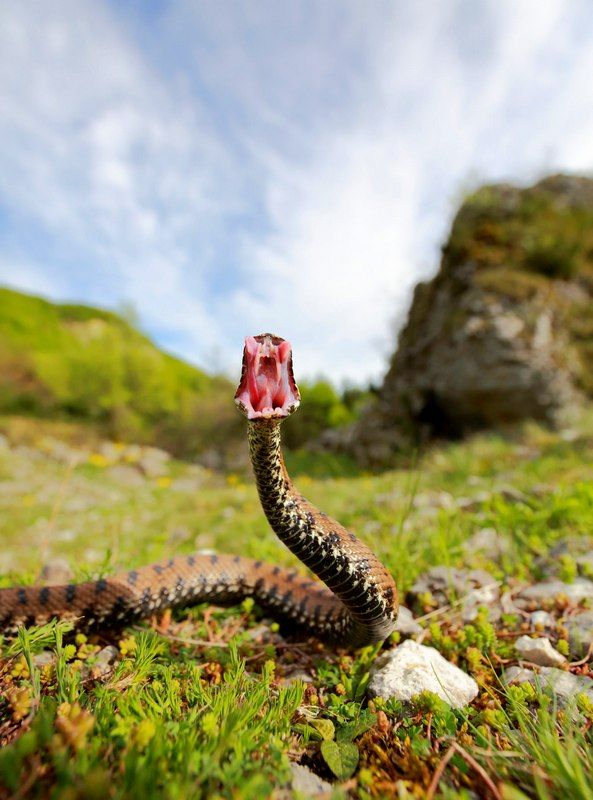
A feature of all vipers is the presence of poisonous glands, located in the sinuses behind the upper jaw. The poison of them enters place the bite on two empty teeth inside. These teeth are attached to rotating maxillary bone
Another feature is the pupil’s ability to respond. on illumination by changing its size.
This property is very rare for reptiles and is associated with mostly nocturnal.
Interesting! Not every bite is accompanied poisoning, 25% of attacks occur “idle”. Believed that the horned African killed the Egyptian Queen Cleopatra viper.
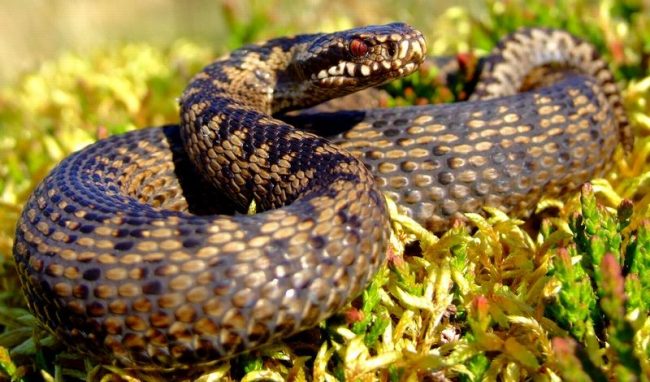
Like all reptiles, the viper loves warmth and light. Happy she prefers to bask in the sun and stays relatively slow. However, at night, all her energy is directed to the extraction food
Food
Like all reptiles, the viper loves warmth and light. Happy she prefers to bask in the sun and stays relatively slow.
However, at night, all her energy is directed to the extraction of food.
At dusk, she sees perfectly, not only in the visible range, but and using infrared (thermal) radiation from heated items.
She hunts mammals and small birds. This is due to ability to better see warm-blooded animals thanks features of vision.
Most of all she prefers mice and other small rodents. such as lemmings and jerboas. She catches them both on the ground and underground.
Frogs and lizards like geckos become viper prey is very rare, as their body temperature is not different from the environment.
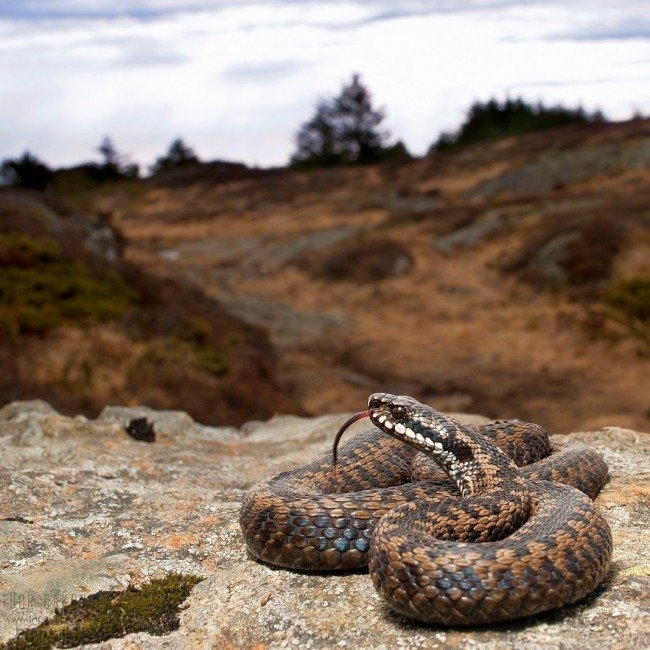
In order to survive the winter, the viper makes itself a refuge under driftwood or in abandoned animal burrows. In such a nest can winter up to a dozen individuals. Reptiles hibernate. At that time their metabolism is so slow that the body does not require food
Breeding
In order to survive the winter, vipers make a refuge for themselves under driftwood or in abandoned animal burrows.
In such a nest, up to a dozen individuals can winter. Reptiles hibernate.
At this time, their metabolism is so slow that the body does not requires food.
Snakes sleep restlessly and at the slightest danger are capable of wake up and move, albeit slowly.
Upon leaving hibernation, in April, they begin the mating season. They mate when warm weather sets.
It is at this time that males arrange their tournaments on endurance. The birth of vipers occurs after 3 months pregnancy.
The female brings from 5 to 12 cubs. Their length does not exceed 18 centimeters.
Interesting! An interesting feature in viper breeding is the presence of combined nutrition embryos. They eat not only substances from egg yolk, but and by means of obtaining nutrients from the circulatory mother systems.
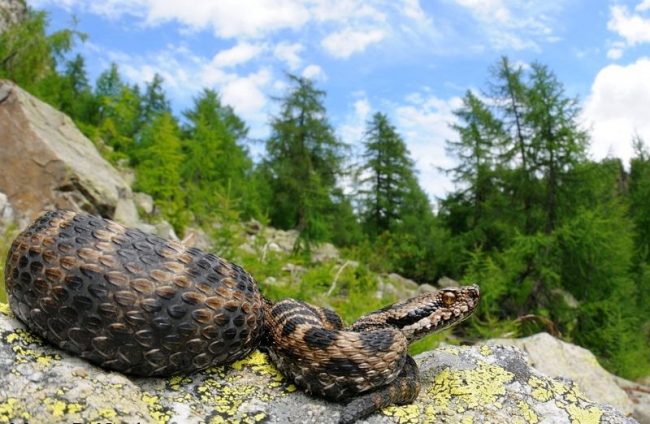
Viper is not the best option as a pet
Content and breeding
Many zoos in the world have terrariums in which contains vipers.
They are kept in terrariums in order to maintain certain microclimate and humidity.
Similar conditions are created when the content chameleons, salamander and even giant scolopendras.
They prefer narrow and long compartments, which are good illuminated by lamps. Daylight hours for them should be from 9 to 12 hours.
For southern species of snakes, including black ones mamb, it is necessary to maintain the air temperature in limits 22 – 28 ° C, and an ordinary viper does not need this features.
In addition, in winter conditions should be created for hibernation. Adults need to be fed laboratory with mice.
Important! Please note – start and keep a viper at home is strongly not recommended. She can Escape from the terrarium and harm people.
Photo of a viper snake: a poisonous resident of the forests
Description and habits of the viper. Photos and Appearance Information and the character of the viper snake. Precautions When Meeting With the viper. Features of the viper.