Classification
Latin name: Dipodidae
Top Classification: Dipodoidea
Rank: Family
Class: Mammals
Order: Rodents
Kingdom: Animals
Type: Chordates
Suborder: Mice
Jerboa are the only rodents that move exclusively on the hind legs. Amazing but these mammals walk like people, alternately leaning on each leg.
About how other animals adapt to the environment, written in articlehttps: //kot-pes.com/adaptaciya-zhivotnyh-7/
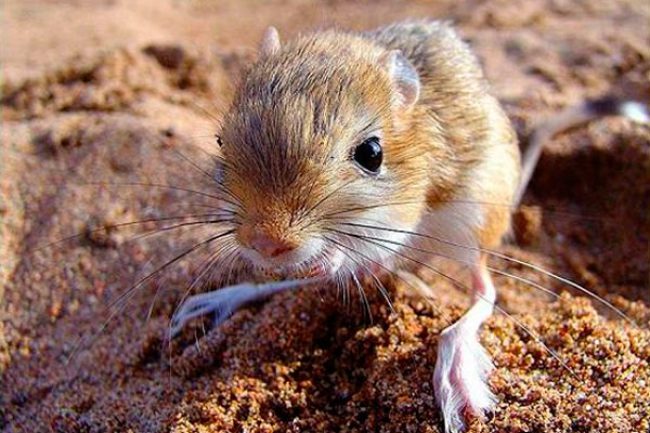
Jerboa are capable of speeds up to 40 km / h. Them running is accompanied by three-meter jumps, and this distance exceeds the length of the body of the animal by 20 times. Paws of these animals double hind limbs are also quite remarkable more than the length of their spine
Content
- 1 Habitat
- 2 Characteristic
- 3 Key Features
- 4 Power
- 5 Reproduction
- 6 Keeping and breeding
Habitat
Jerboa is common in areas with a hot and temperate climate. Their habitat covers Mongolia and North Africa, Middle, Asia Minor and Western Asia, Kazakhstan and the south of Eastern Europe, as well as territory stretching from northeast China to the south Siberia.
Most species of jerboas are adapted to the conditions. living in the desert and semi-desert and only a few can dwell in the steppe, like lemmings, in a forest zone and in the mountains located at a distance of 2 km above the level seas.
Like meerkat or mongoose, most often this animal is found on desert and semi-desert landscapes with clay and gravel soils.
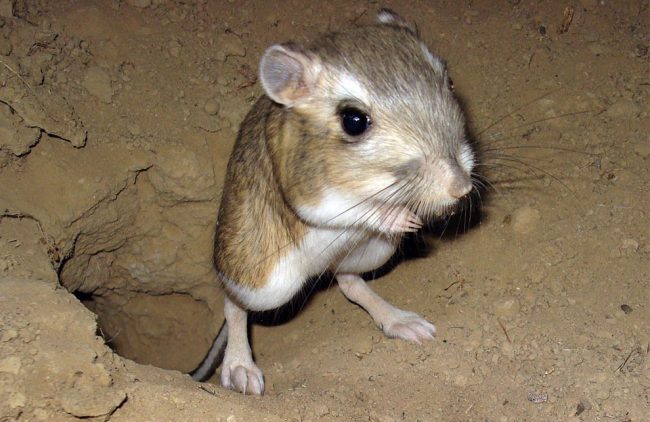
In the sand, the jerboa digs its hole, the entrance to which is mandatory clogging with earth plug
Characteristic
Jerboa, no matter what species it belongs to, looks like mouse.
Only legs differ from the latter: the front legs are very short and they are practically not used by the rodent during overcoming distances, and the rear ones are very elongated.
Appearance
All jerboas are small in size. Consider the detailed Description of this animal:
- depending on the species, the body length of the animal can be from 6 to 26 cm;
- the mass ranges from 25 to 300 g;
- the tail of this steppe rodent is always longer than the body – from 7 to 30 cm;
- the tip of the tail is decorated with a brush painted in black and white colors;
Interesting! Tail for jerboa is a kind of steering wheel and balancer. In some cases, it is visually signals the approach of danger!
- the body is short;
- hind limbs are strong, and their length can be several times exceed the length of the front;
- there are claws on the legs, they are well developed and on the front the limbs are shorter than on the hind;
- the head is round, the muzzle is slightly dull;
- the shape of the ears is rounded, in some species they are at the base fused to the tube; depending on species rodent ear length will be different – in a large jerboa ears very large, in the bipedal – they are small;
- eyes are big;
- the neck is short and almost invisible from the outside;
- the body is usually covered in plain sand-colored fur either light brown;
- the jaw consists of 16-18 teeth; fangs can be white either yellow – jerboa chews food on them and loosens the soil.
The most recognizable species of jerboas: large jerboa, or steppe, long-eared, or Chinese, and jerboa bore feet.
Big jerboa
The largest member of the family is a large jerboa. This rodent looks like a miniature hare.
The description of this animal will be as follows: its mass is about 300 g, and the body length reaches 20-26 cm. The tail of a large jerboa is long – about 30 cm, with a fluffy “brush” on the end.
You can meet him in Eurasia in the most arid regions – in the desert or in the steppe. This rodent moves very fast, making long jumps. Sometimes his speed reaches 50 km / h
With the onset of cold weather, a large jerboa goes into hibernation. At this time, it accumulates fat and increases the mass your body twice.
He is able to dig his holes for a long time, and even with dense soils lazy to equip the nest. Large jerboa demonstrated in the next photo.
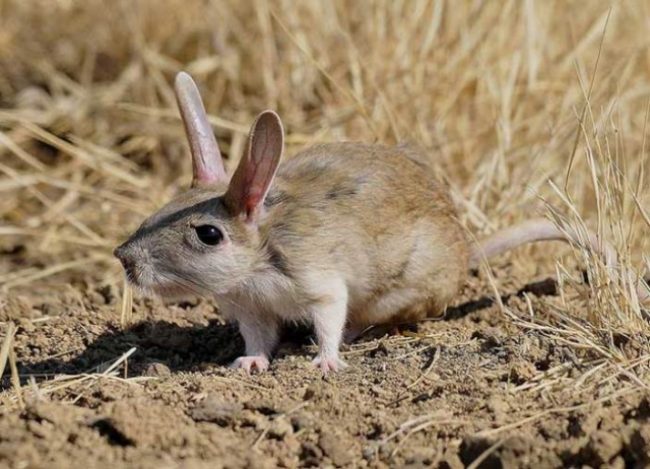
This animal has a wide, slightly elongated muzzle and three-toed feet on hind legs
Long-eared jerboa
Long-eared, or Chinese jerboa, lives in China and Mongolia, prefers to live in the desert.
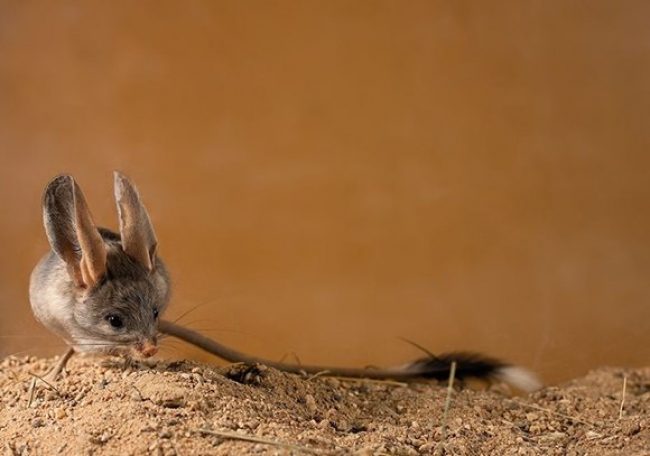
The body length of this small rodent is not more than 9 cm, the tail is long – about 16 cm, and the ears are huge compared to the body – in length, they can reach up to 5 cm.
The length of the hind limbs of the Chinese jerboa, which allow him to jump far in length, about 4.5 cm. Body weight varies from 24 to 38 g.
On a note! Chinese jerboa protected by law, as it relates to an endangered species!
A characteristic feature of this variety of jerboas are paws that are covered with tufts of wool.
The jaw includes thin incisors and small premolars – one at a time from each side.
The body of a long-eared jerboa is covered with light brown hair on back and white – on the stomach.
As you can see in the photo below, the tail is thin and has the same shade like fur on the back. “Tassel” with a black and white crest.
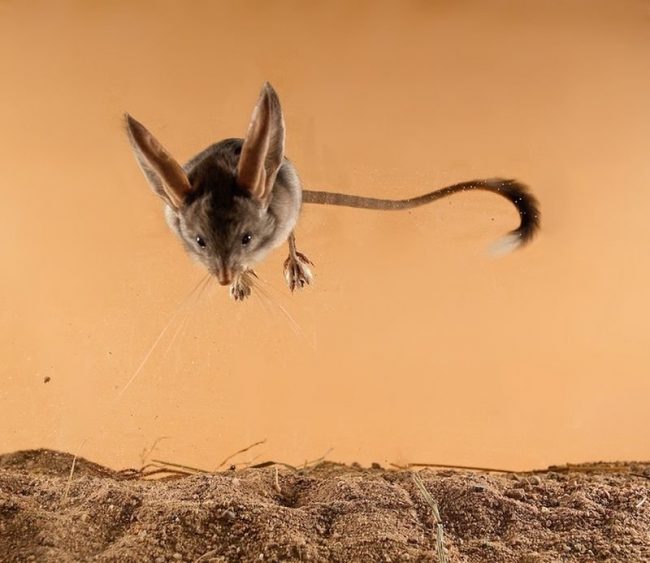
Long-eared jerboa is nimble, small and very fast
Boreal jerboa
The boreal jerboa lives not only in the desert, but also He is a resident of Tuva, the Lower Volga region and the Caspian region.
His description: a body with a length of 10 to 14.5 cm, the size of the tail is about 15 cm, the back foot in length reaches 6.5 cm.
The head is rounded, relatively small ears – about 1.5-2 cm, and such sizes compared to the ears of others species of jerboas are very small.
Three fingers on the legs, they are covered with hard hairs, and on the bottom of the hind limbs is a thick stubble.
The fingers of the birch jerboa are approximately equal in length and only the middle protrudes quite a bit forward. If this steppe the animal will put a foot on the sand, then its imprint will take the form trapezoid.
And when moving, the distance between the left and right paws is about 5 cm. Yellow incisors on the jaw. Next photo demonstrates a typical representative of this species jerboas.
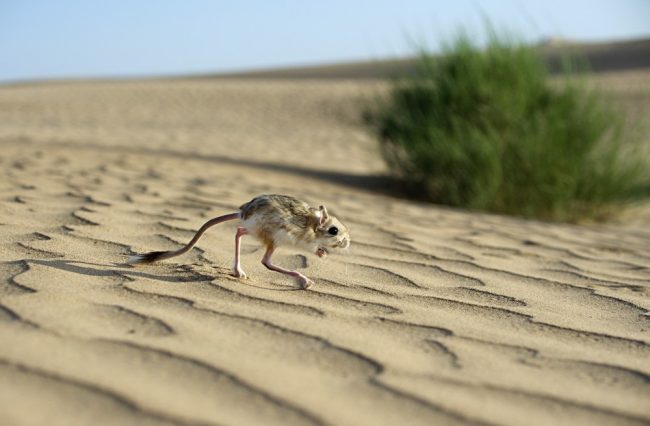
Boreal jerboa is able to jump long distances
Key Features
Well-developed hind limbs allow jerboa move with incredible speed.
And if the distance is too big, then the animal will be Overcome it by jumping. Front paws only a few individuals use it.
The jerboa tail performs several functions at once – it helps make sharp turns when moving at high speed, which very important in the conditions of the steppe and desert, thanks to him the animal can keep balance and jump far.
In addition, the tail is an indicator of the health of the steppe. the beast. Depending on how it looks, you can determine how favorable are the living conditions of jerboa.
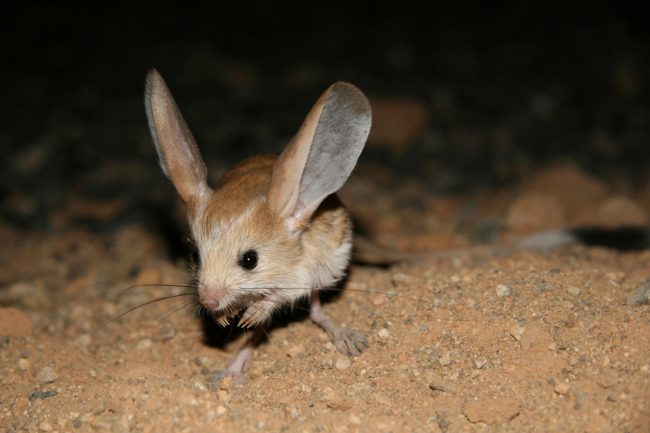
This rodent prefers to have a twilight and night look. of life
Most jerboas hide in their hole during the day and go out. only after dark, as can be seen in the photo above.
Interesting! In the steppes there are individuals who are daily. Such jerboas live in Kazakhstan. FROM they leave their shelters by sunrise and spend all day outside burrows. And disappear only with the advent of twilight!
Other unusual facts about animals can be found in articlehttps: //kot-pes.com/fakty-o-zhivotnyh-13/
Burrow device
And the borefoot, and the long-eared, and the big jerboa – all of them are tireless toilers. They constantly dig holes that can conditionally be divided into 4 main types:
- rescue, the depth of which reaches 20 cm;
- daytime – up to half a meter long;
- permanent – with the main inclined course and spare, which are blind, their animal lays very close to surface;
- wintering facilities are equipped in a special way – they have pantries, where a steppe animal hides supplies, and a wintering chamber, which located at a depth of about 2 meters.
Interesting! When someone starts digging permanent hole, jerboa immediately disappears into one of the spare, tightly closing her roof!
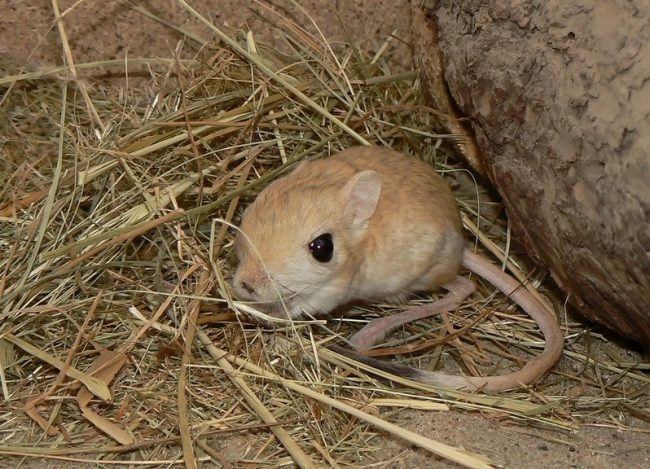
The jerboa lives in a separate chamber, which is located in the far parts of the hole. He lays his nest with fine grass
The value of jerboa
For desert biocenosis, jerboas have a very large value. In the course of their life, these rodents affect vegetation and soil in its habitat.
These animals have many natural enemies, middle ferrets for which they are a source of food.
But the role of jerboa is not always exclusively positive. They are able to do harm by destroying vegetation that strengthens sands, and damaging crops.
Since jerboa looks pretty cute, it’s hard suggest that he is able to become the causative agent of such a dangerous diseases like the plague.
And this is not the only disease whose carrier is this steppe animal.
Food
Jerboas feed mainly on vegetation. They are use seeds and rhizomes that are previously dug up from the soil, leaving noticeable holes in their place.
Depending on the place of residence and conditions, this animal may eat insects and their larvae.
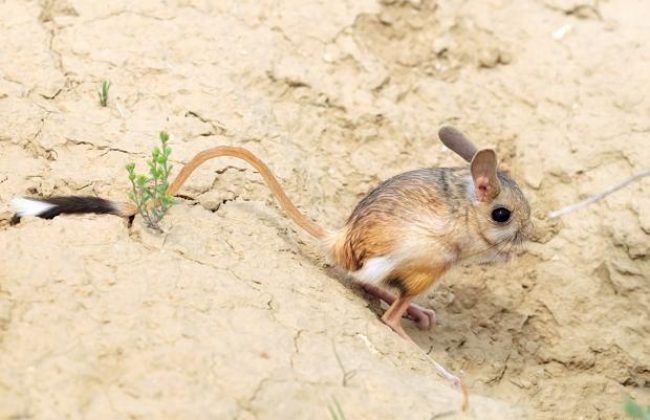
A jerboa eats about 60 g of various foods per day
It is noteworthy that he does not drink water, liquid animal gets from plants. The rodent is laying very long feed passages and overnight in order to saturate can overcome distance of 11 km.
Breeding
In spring and summer, jerboas breed. In one year the female able to bring from 1 to 3 litters, each of which There are 1 to 8 babies.
The gestation period lasts about 25-42 days. The female always gives birth in a hole in an individual nest.
Cubs are born blind and look like newborns baby rats.
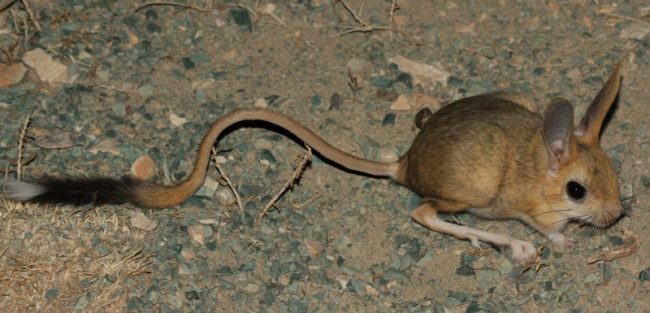
When the body mass of a small jerboa reaches 200 g, he begins to gradually move to an independent life
Under the care of the mother, the kids are quite a long time – about 1.5 months. During this period, they grow and gain mass up to 125 g. burrows cubs emerge fully formed, but still move somewhat awkwardly.
Young jerboas are quite friendly and get along well together together. But upon reaching three months in their behavior aggression begins to be traced. It pushes the youngsters on resettlement.
Content and breeding
Unlike, for example, degu proteins, Domestication for jerboa is stress. They are very long and hard get used to the conditions of bondage and man.
These animals are very difficult to make contact. This is connected behavior so that such a rodent prefers to conduct nocturnal lifestyle, and becoming a pet, he has to be active day.
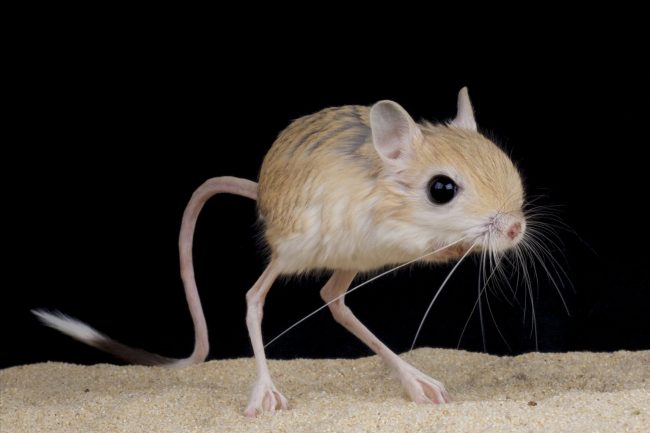
And even in the case when between human and animal connection, the latter still remains wild
Home jerboa needs room where he can stay active. For him, physical activity is also important for a person this must be taken into account. If this condition is neglected, then the animal will experience discomfort, which will lead to physical inactivity and even death.
Home jerboa should prepare a large aviary, and not only long and wide enough, but also tall so that was able to jump.
It is extremely undesirable to put plastic objects into the nest, the same the same goes for the pallet. Otherwise, with my sharp teeth the animal will gnaw and run away.
It is impossible to contain several individuals in one cell at once, since between them there will certainly be a conflict. At the bottom of the aviary is desirable lay litter of turf and sand. A hard bottom can become cause injuries.
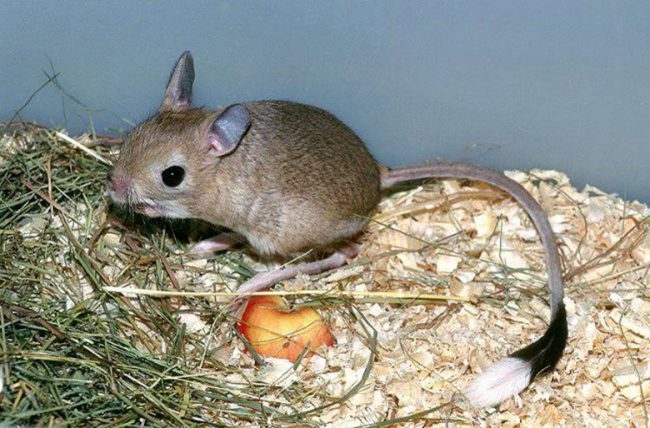
In the cage of a home jerboa should always be vegetation: dry grass, roots, fine brushwood. Of them he will build your nest, as is usually the case in the wild of nature
The turf litter in the aviary is needed for the jerboa so that it could dig holes, even small ones. Otherwise, the animal stress can happen that will develop into a nervous breakdown.
Domestic jerboa is not allowed to be released from the cage – with the slightest opportunity he will certainly escape.
In the diet of this steppe animal must be present special cereal mash, cereals, fruits and vegetables: seeds sunflowers, potatoes, dandelion roots and leaves, apples, pears, melon seeds, beets.
In winter, thin shoots of maple, willow, and aspens. Insects will supplement the diet: butterflies, cicadas, crickets and flour worms.
Jerboas: Frisky long-tailed jumpers
Jerboa are the only rodents that move exclusively on the hind legs. Amazing but these mammals walk like people, alternately leaning on each leg.