Classification
Top Classification: Jays
Type: Jay
Domain: Eukaryotes
Kingdom: Animals
Subdomain: Eumetazoi
Type: Chordates
Subtype: Vertebrates
Class: Birds
Subclass: Newborn
Order: Passeriformes
Suborder: Songbirds
Infrastructure: Corvida
Family: Cranes
Superfamily: Corvoidea
Conservation Status: Least Defiant Concerns (Stable)
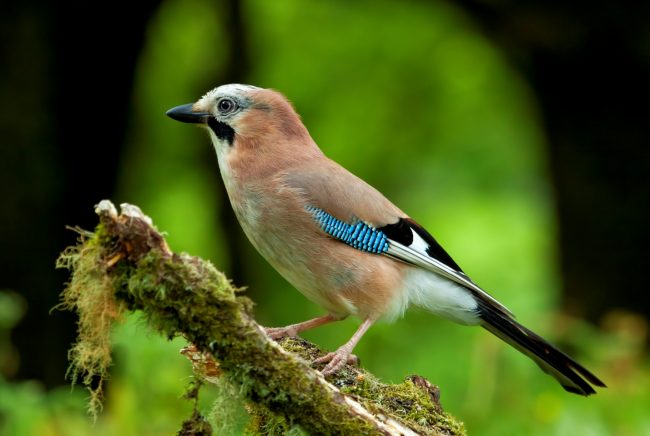
Jay – an inhabitant of forest zones, which is able to mimic the most various sounds.
Jay is a small bird with a very unusual behavior. Take her photo in the wild almost impossible, as she is very careful and prefers to hide in middle and upper tiers of trees.
Her song is amazing – the jay meows like a kitten, now goes on a goat bleating, and sensing the approach of danger, begins to make sharp cries. “РРахх – Ррахх – Ррахх” – so she warns all forest dwellers of an imminent threat.
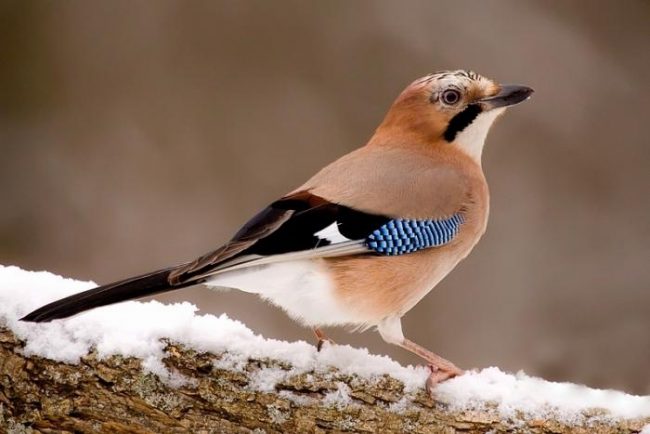
A brisk and vocal jay is easier to hear than to see
Content
- 1 Habitat
- 2 Characteristic
- 3 Appearance
- 4 Key Features
- 5 Nutrition
- 6 Behavior
- 7 Reproduction
- 8 Relations with people
Habitat
The distribution area of jays is very extensive. You can meet her as among birds near Moscow, and practically throughout Russia, Europe, as well as in countries Asia Minor and North Africa. This bird lives in Korea and Japan, nests in the Crimea and the Caucasus, occurs on Sakhalin, in the southern regions of Siberia and Korea.
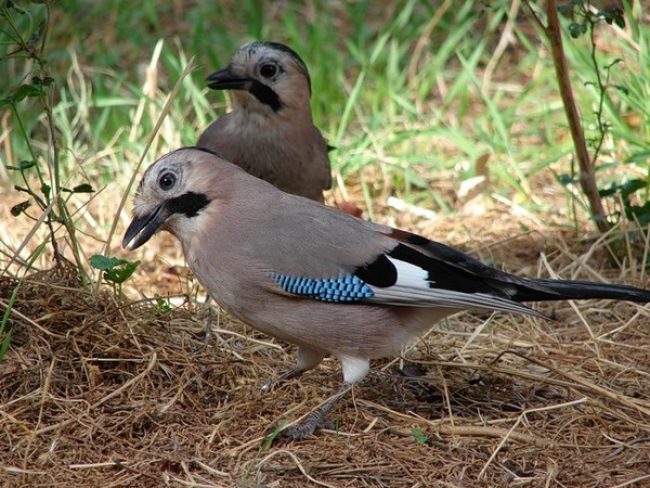
Habitats are coniferous, mixed and broad-leaved forests, where the jay stockpiles food, creates a family and hatches
Characteristic
Jay is twice the size of a starling, has a bright paint. When looking at her, created the impression that an experienced artist worked here – a mirror the wings are decorated with blue feathers, with clear black stripes, there is a careless black blot near the beak, and gray-white on the top of the head blurry patterns.
Jay attracts almost everything – she pays attention to the slightest rustle; not a single movement or stirring in the forest will remain unnoticed. At the same time, she always tries to maintain the utmost caution, especially during the nesting period.
A jay transfers to a flocking lifestyle only after chicks will leave their native “house”.
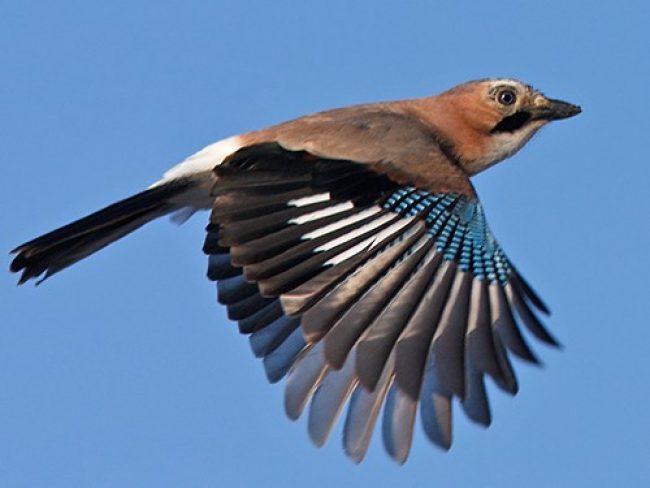
In the fall, jays change their habitat, flying one at a time in another oak grove
Appearance
The description of the jay will be as follows:
- plumage looks loose;
- a wide black crest flaunts on the head, on the forehead and crown motley grayish-white pattern with black strokes;
- plumage on the neck and occipital region light wine-brown shade, and on the chest and abdomen the color is similar, but darker;
- throat whitish with black spots on the sides;
- the tail is rather long, the feathers on it are black, in the area nadvostya – white;
- covering wings, large, shoulders are most noteworthy – intense blue tint and as if crossed out by black strokes;
- the body of the bird is painted in brown-red color.
On a note! However, a description of the various subspecies will be slightly different. For example, for Siberian jays red plumage on the head is characteristic, and for European it is motley, where white stripes intertwine with brown.
The height of an adult jay is about 15 cm, and the length of her body together with the tail can reach 40 cm. This bird weighs about 160-200 g
Young individuals are slightly different in description – the chick on the back and the abdomen has feathers of a red tint, but on the crown of the head and tuft they do not as colorful as in mature birds.
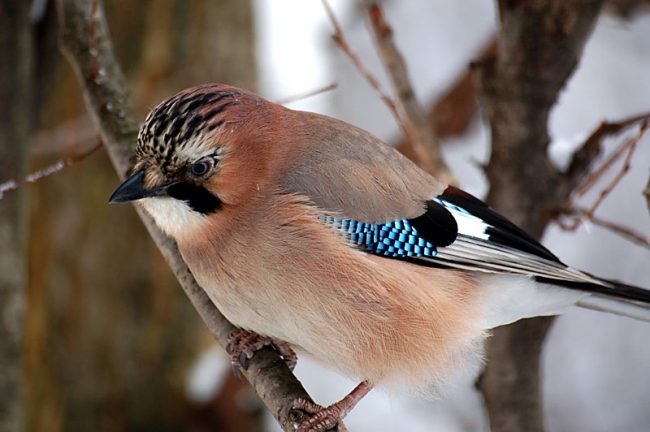
Jay has a very beautiful iris – pale blue
Key Features
But not only the description of the jay is worthy of attention, very unusual and notable are its main features.
- Depending on the subspecies and habitat, this bird may lead a nomadic and sedentary lifestyle. In some places it is a migratory one. IN small flocks of jays hatch mainly in winter, and in them may be from 20 to 30 individuals.
- The jay builds its nest on one of the side branches of the selected tree and at the same time at a fairly large distance from the ground – sometimes at a height of about 5 m. In diameter it is about 25 cm and consists of thin twigs and branches. Sometimes a jay nest can detect in the hollow.
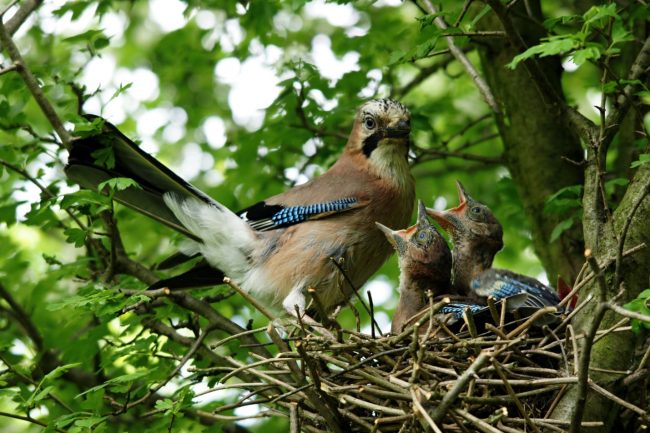
The inner wall of the bird is lined with dry grass and its stems, and “floor” – with elastic roots, nap and wool
- Jay is able to do not the best deeds – her prey can become a chick, or eggs of small insectivorous birds that make their nests on the ground. Some consider jay a pest as a cuckoo because busting nests. For this reason, in the eyes of hunters and foresters, who know about this feature, the jay looks like prey and often under their guns.
- Jay is very storey – it adds up found acorns and nuts to a secluded place that looks like a small pantry. She may be under foliage, tree bark or under moss. However, often these caches do not fulfill their destination – birds simply forget about them or cannot them find if necessary. Caches sometimes hold up to 4 kilos of various food. They are often found by other forest inhabitants. The jays themselves, in their turn, busting protein pantries.
Interesting! Forgotten pantries immediately begin perform another, no less useful function – acorns and nuts sprout and give rise to new groves!
- Of particular note is the description of the hyoid sac. IN Jay stacks several nuts and acorns at once, sometimes about 7 pieces. This allows the bird to transfer stocks to the pantry. pretty fast.
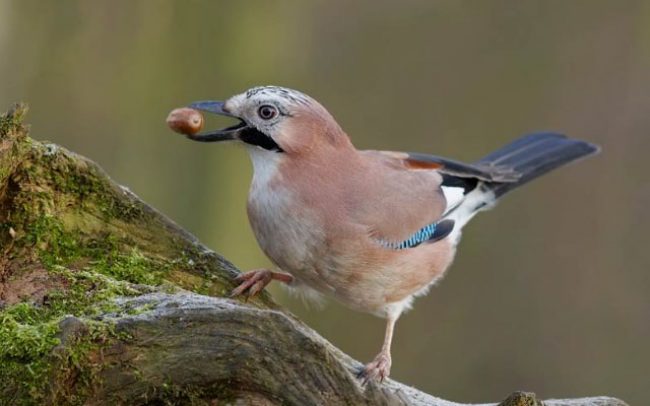
Small hiding places with reserves for winter mainly in coniferous forests
- These birds, like thrushes and nightingales have a very diverse repertoire, but besides this, they imitate the various sounds. We can say that she has a real talent. Back in forest, after a short stay at a person’s home, she’s here but reproduces the sounds that she heard. And if in a grove you suddenly hear the kitten meow, then do not rush to look for it – for sure it Jay trains in the backwoods acquired skills.
Food
The basis of the diet of poultry is plant food. Often it’s acorns.
Interesting! In the description and structure of the beak and limbs of the jay several morphological features. The sharp edges of the beak and its straight lower edge, and also tenacious claws on small paws allow cleverly collecting acorns and disassemble them into small pieces.
In addition to acorns, jay can also eat various berries. – raspberries, strawberries, lingonberries and mountain ash. She feeds on seeds – oat, wheat, spruce, sunflower, cucumber and pea.
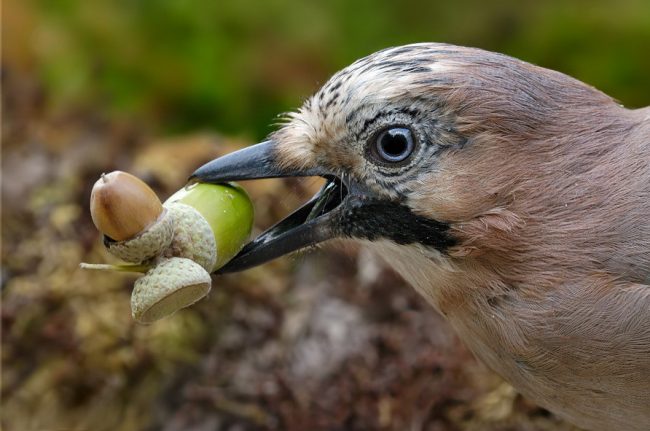
However, this bird chooses such food very rarely, mainly when can’t find acorns
These birds collect food both in the forest and in the areas around it. The jay feeds most intensively in autumn and winter.
From the end of April to November, new ones appear in the jay menu “food” – she begins to eat insects. Notable is that mainly pests – May beetles, leaf gnaws, golden bronze, barbel, weevils, and bugs silkworm caterpillars.
Useful bugs and ants get into the diet much less often and make up about 2% of the total mass of insects.
On occasion, shrews, small rodents, frogs, lizards, small birds and their offspring. But this only for certain subspecies, European jays only acorns are preferred.
Behavior
Jay is active during daylight hours. At night same as and most of the other flattering inhabitants, she sleeps. This Bird’s Day filled with worries. It rarely sinks to the ground, preferring stay on top.
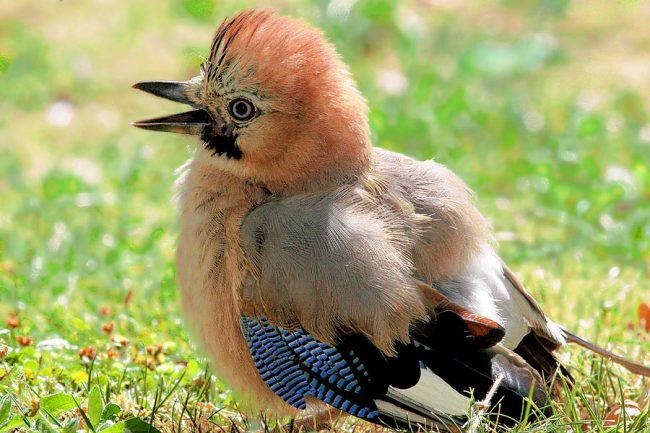
The jay makes frequent jumps
- If the jay notices a predator or an approaching person, then will certainly notify everyone of the danger. She will start to make loud sounds accompanying a dangerous object as it moves. By this reason, a jay is often called a forest watchman.
- This bird is very shy, but such a trait is only for her favor. In fact, the life of a small mockingbird is crowded dangers, and the ability to hide quickly helps adapt in almost any habitat.
- The rhythm of life and the behavior of active and free jays dramatically change with the advent of offspring. During this period, she behaves secretive and very quiet. In autumn, when the chicks get stronger, adults again become quite sociable and noticeable. Their flocks begin to migrate to the neighboring forest and at the same time, until the first bird will not gain height, the next will not fly.
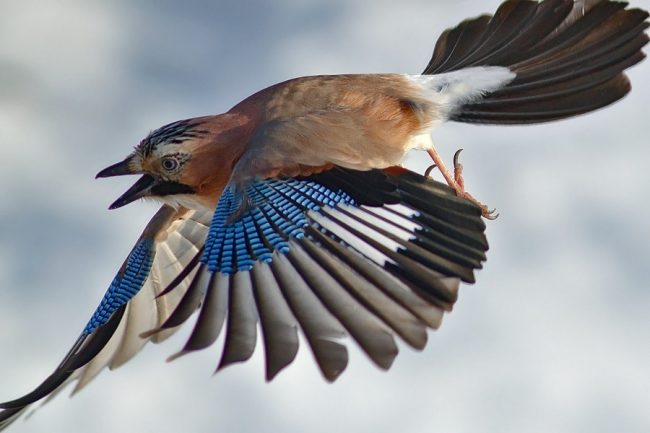
And if you watch the flight in open space, then the movement of the jays will look rather slow and awkward
- But the most entertaining feature of bird behavior is relationship with ants. Finding an anthill, the bird smacks and starts jumping around him. Discouraged insects come out of their shelters, they attack the enemy and spray him with their acid. Jay, in turn, immediately picks up ants in its beak and intensively shakes them.
On a note! It is believed that in this way acid gets on feathers and destroys parasites living on body!
Breeding
Upon reaching one year of age, the jay enters the period puberty. In the early spring, the mating season begins. In it while birds make current flights over trees, males loudly sing, filling the forest with a variety of sounds.
In April, nesting begins. Newly made family equips its nest and violently protects a small area around him from other representatives of his species.
Moreover, it can be almost any part of the forest – an area with dense plantations, edges, sometimes – small thickets shrubs. At this point, the family of jays may linger on some years.
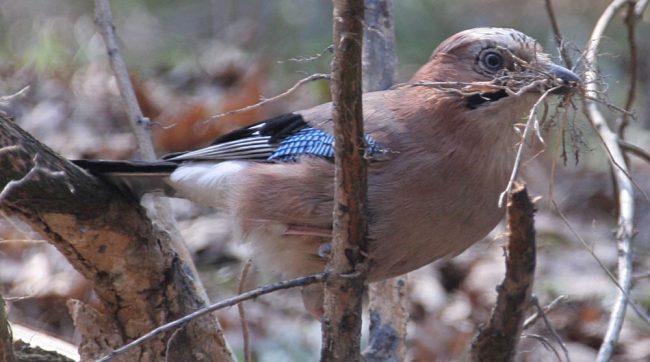
In the construction of the nest, both the female and male
The nest is small and is a tray of twigs, with a depth of not more than 10 cm. But it is being built quite skillfully here too everything is thought out – from strong walls to a soft laying. On home improvement a bird family spends about a week.
The female lays eggs in late spring – early summer. In the masonry usually 5 to 7 eggs. Their color is greenish with brown spots. By they are small in size – about 30 mm in length. Jay hatches eggs for 16 days, after which chicks appear from them.
Feeding lasts about 3 weeks. In breeding both parents take part – they hatch eggs one by one and also feed the chicks together.
Jay chick looks like a miniature copy of an adult bird. The departure of offspring from the nest begins in June and is accompanied by piercing trills. But at the same time, a strong chick continues be under the care of their parents until the fall.
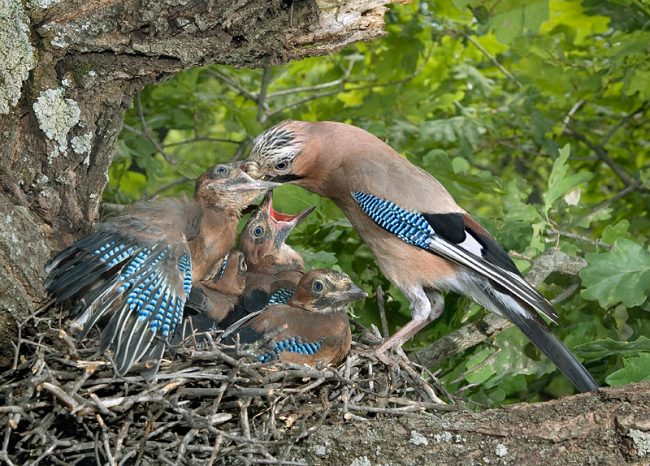
The chick feeds directly from the goiter of the parent, and it happens so, that to see the food that was brought is impossible
Relationship with people
The fact that jay eats harmful insects makes it a useful inhabitant of oak forests. But at the same time, she is a nest destroyer of small birds, many of which are useful insectivores, and this significantly spoils its reputation.
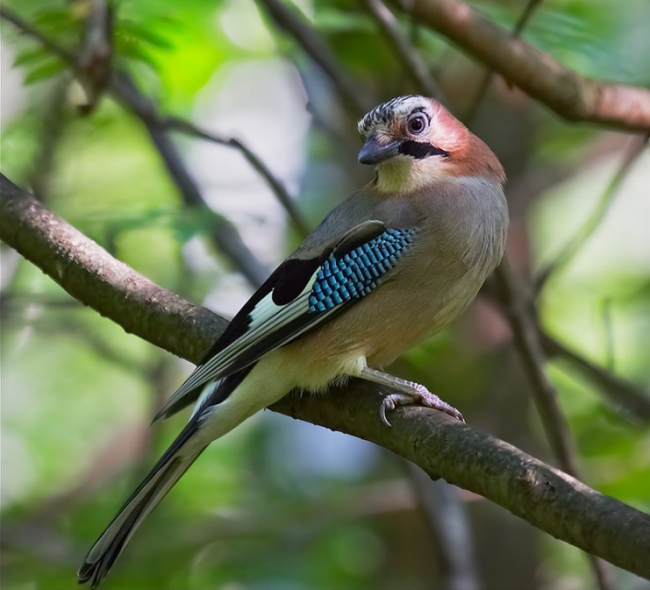
Jay preys on warblers, gray flycatchers and whitebrow thrushes, which makes it more negative than positive character of forest fauna
Plus, this bird harms the grape harvest and harms orchards. Such her activity was discovered in the Crimea. IN at the end of autumn, a jay flies to potato plantations and picks small tubers from the ground. Small flocks are also often They work on stubs, eating cereals.
But there is evidence that can act in defense jays. For example, she plays a very useful role in resettlement oak groves.
The bird collects acorns throughout the forest and stacks them into various places. Those storerooms that were not found give life to new the trees.
Jay – a bird striking in its repertoire
Jay is curious, but at the same time quite shy a daw-sized bird. You can recognize it by expressive plumage: bright blue spots with a clear framing of black on wings, dark “antennae” and black, or grayish-whitish “hat” on the head.