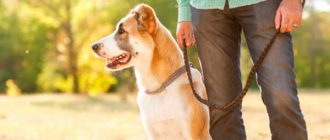
Aporting is not just a stick game, but a difficult skill, included in the compulsory training course. Most dogs are pretty quickly and without any problems master the team. And those are the owners who claim the opposite – did not put enough patience or had no knowledge of how to teach a dog to the Aport team.
Content
- 1. What does aporting skill mean?
- 2. What gives the animal mastery of the skill
- 3. Step-by-step training methodology
- 4. The choice of aporting item
- 5. Training in tracking and lifting an item from the ground
- 6. General recommendations
- 7. Video how to teach a dog to the Aport team
- 8. Benefits of self-training
What does aporting skill mean
The requirements of the OKD tests indicate that the execution of the command Aport includes:
- the initial position of the pet at the owner’s left foot, which the dog takes on the command “Sit”;
- the owner shows the item to the pet and throws it no closer 10 m;
- time interval between the throw and the team itself “Aport” is 10-15 s;
- simultaneously with a voice command, the host extends to the direction of the subject is the right hand, turned down with the palm of the hand;
- on command, the dog runs after an abandoned object, picks it up with of the place where he landed, returns to its owner and takes the starting position;
- the dog holds the item in its mouth 10-15 s and after the command “Give” lets the trainer take it.
A team is considered executed correctly provided that dog:
- Do not rush in searches earlier;
- calmly refers to the found object – does not gnaw and does not tormenting him;
- waiting for the owner to pick up the item without dropping it.
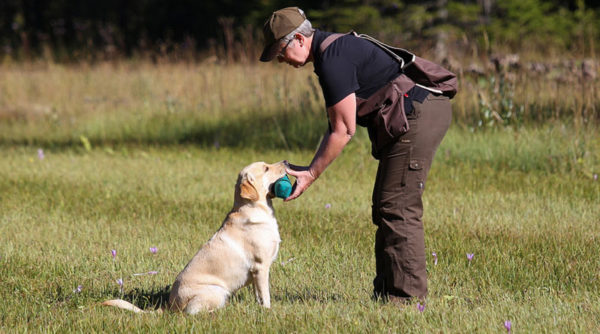
So that the dog can learn this skill, it is at the time of training already should know and execute the commands “Sit”, “Nearby”, “To me”. If you train a dog to follow the command standard, it’s a complicated, lengthy business. But in everyday life it is enough to teach the dog to simply bring the item and give it away.
What gives the animal mastery of the skill
Search and bring “prey” to the owner – genetically program. Dogs were most often used for hunting. They have to were to deliver the game shot down by the hunter. When breeding a breed those instances that possessed this instinct were selected. Training in the implementation of the Aport command consolidates, hones how innate instincts, and trains skills:
- orientation in space;
- use of the senses – scent, hearing and vision;
- creating a kind of “language” between the owner and the dog;
- building logical relationships between gesture, voice team and action;
- obedience and endurance training.
In addition to the development of psychoemotional, cognitive and physical abilities of the animal, aporting makes it possible for limited time to give the animal the opportunity to “splash out” the excess energy.
Step-by-step training methodology
Learning any, even the simplest skill is a phased a process that includes:
- mutual explanations;
- achievement of automatism in the performance of the task;
- full and long-term consolidation of skills.
The initial phase consists of sub-steps that help you step by step. achieve the result:
- Training should be carried out in special conditions – at home or on the site should not be irritating to the attention of the dog (factors affecting basic instincts – sexual, defensive, hunting).
- The right motivation must be chosen – encouragement snacks, stroking, praise. As a result, positive emotional relationship between the pet and the owner. Trying to earn a treat, the dog will try as fully as possible understand and execute commands.
- Mutual explanations include the interaction between man and dog by creating your own “language”. Owner must to represent the stages, their implementation and the final result, so as to accurately and it’s easy to explain to the pet.
- Outlining the boundaries of skill formation. The trainer should know exactly what it reinforces with delicacy and affection, and the animal must understand what is required of him, and how to get approval trainer. This sub-step also applies contrast impact – the dog is punished for improper execution of the command (leash, pushing with hands, threatening intonation), but as soon as the animal corrects the mistake, it is encouraged by affection or a treat.
- Learning how to execute authorizing teams that run a team “Aport” – “Sit”, “To me,” “Give.”
- Training abolition teams, for example, “Walk.” Without her dog should not stop training.
- Training mode training – class time should alternate with a period of rest, which should also be active, to maintain physical and mental readiness for work.
At the second stage, bringing the execution of the Aport command to Automation also needs to adhere to certain sub-steps:
- At this stage, the dog must clearly and quickly execute commands. If at the first stage the animal can bring an object with different speed, then on the second the dog should bring it with their run, not distracted by extraneous stimuli.
- The number of punishments prevails over incentive so that form a persistent desire in the dog to avoid them, accurately performing the task. But the trainer must properly support the execution teams encouraging the overall emotional background of training remained positive.
- The owner must maintain intensity in the execution exercises the entire allotted period of time.
In the initial stages of training, a leash or the rope with which the trainer exercises control and implementation of negative reinforcing effects. On the third stage, the number of rewards at each stage is reduced. Dog quickly, without being distracted, accurately executes a command and receives encouragement in the form of affection or goodies after properly performed team.
Stage of decision making and development of an optimal action plan replaced by ultimate skill automation. Toughened up requirements for the number of correctly executed commands – the third their stage should be the vast majority.
Selection of aport item
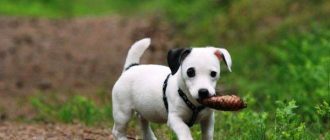
For training, you can choose any item that is convenient grab the animal with its teeth and quickly bring it to the trainer. It can be a tennis ball, a frisbee plate, a plastic bottle, filled with sand or cereal, stick. Dogs are not willing to take in fall in hairy objects. Therefore, the selected item must be smooth, firm, moderately heavy. 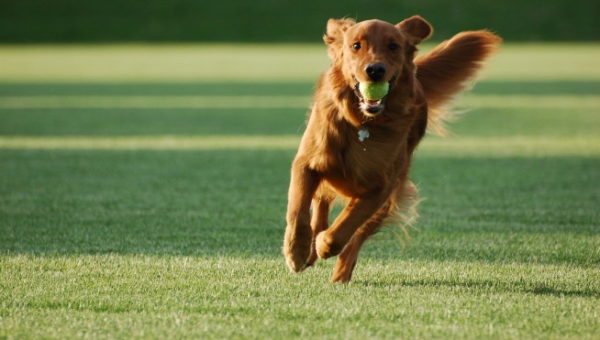
The subject should serve for a long time, it is easy to disinfect, injure the pet’s oral cavity. For the development of cognitive dog’s abilities can be taught to bring a certain subject, choosing it from several abandoned.
The subject should be attractive to the dog. She must confidently hold it and give it on command “Give”. If the dog is on the initial stage is not interested in the subject or holds it not strong enough, then you need to interest him, teasing and pretending to want a thing. It will force a pet significantly strengthen the grip.
At the initial stage of training, the Aport teams and “Give”. Some animals with a choleric character warehouse are too addicted to the subject. In this case, you should hide it so that the dog calmed down and learned to respond more adequately to subject.
Training for tracking and lifting an item from the ground
At the initial stage, when the dog will establish a logical connection between the Aport team and the item, you need to drop it on a distance of 1-2 meters, making movement from the bottom up. If the dog refuses to go or cannot find the item and “scours”, it is possible approach him, leading the pet on a leash and point to it. After of how the dog raised the item, you need to encourage the pet with words “Good” and stroking.
General recommendations
The trainer must take into account temperament, ability to trained, natural instincts of a dog. Classes must take place regularly and consistently. The coach must not exercise nervousness, aggression or inconsistency, breaking their requirements.
Depending on the size and muscle strength of the animal, the period training should be at least an hour. In the first 30 minutes the dog interested, longing for goodies. In the second half he gets tired distracted and satiated. The trainer must save the health of the animal, making it clear that the command to him must be done if you don’t even want to.
Do not confuse physical impact and physical punishment. The effect is carried out with a steady mood, without irritation and scream. The trainer adjusts the execution of the command by tension a leash, jerk or push of hands, but not blows.
In between training, you need periods of outdoor activity, when the owner praises for the lesson completed, plays with the pet to maintain physical activity, create long-lasting emotional mood and prevent mental overload.
Video how to teach a dog to the Aport team
Benefits of Self-Training
Of course, you can entrust the training of a pet to an experienced dog handler that reduce time and achieve excellent results. But self-training is important for:
- establishing emotional contact with the pet;
- asserting leadership in the dog-man tandem;
- identification and study of positive and negative traits character;
- elucidation of the main motivator – nutritional, emotional, game promotion.
The trainer must know the main element of the team. IN aporting is holding the item in its mouth and the ability to pick it up from the ground. In the process of training, the owner also learns. He is studying act gently but persistently, note the manifestations of emotions pet. Self-training allows you to create your own “language” and establish a connection that allows the animal to understand host at a glance. Training disciplines not only the dog, but also her master.
Training the Aport team is very important for business and hunting dogs. But no less important for companion dogs, as for maintaining physical fitness, and for the development of intelligence.