Classification
Class: Birds
Family: Chicken
Rod: Guinea fowl
Adult Size: 40 – 70 cm
Life span: 10 years
An unusual pockmarked bird appeared on the bird farms of our country: body like turkey, and a sharp voice makes you startle from the surprises of everyone who first saw this creature.
Guinea fowl – this is the name of the original beauty. About her is ours story.
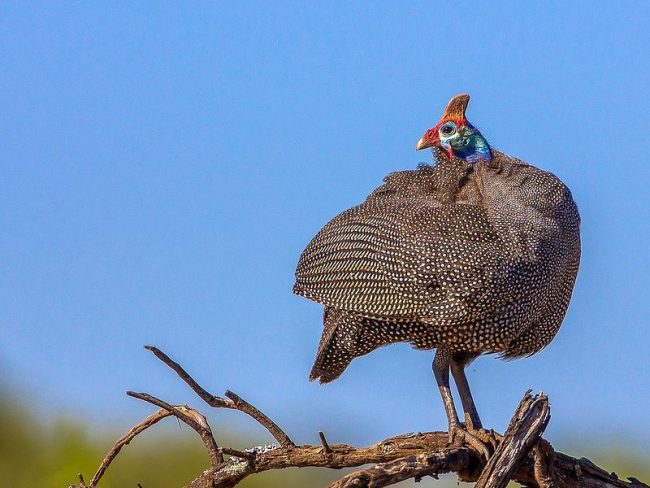
Guinea fowl lead a terrestrial lifestyle. Live in packs (up to 50 individuals), and in the mating season are divided into pairs
Content
- 1 Habitat
- 2 Characteristic
- 3 Appearance
- 4 Power
- 5 Nesting
- 6 Content at home
Habitat
Wild guinea fowl – a native of Africa, a close relative of turkeys, chickens and quail live like a black grouse and bustard, in forests, forest-steppe and steppe zones.
Some species live on the island of Madagascar.
Interesting! The scientific name for guinea fowl is Numida meleagris is very symbolic. The name is borrowed from a country from which bird was introduced – Numidia (modern Algeria and Tunisia). BUT the bird got its patronymic thanks to the Greek hero Meleager, whose legendary feats and courage were honored by ancient people.
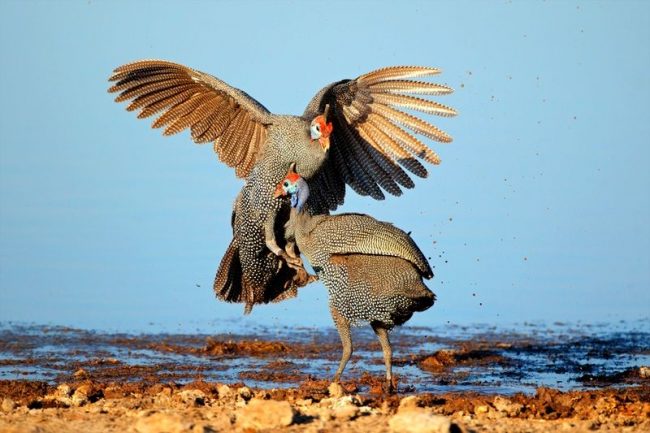
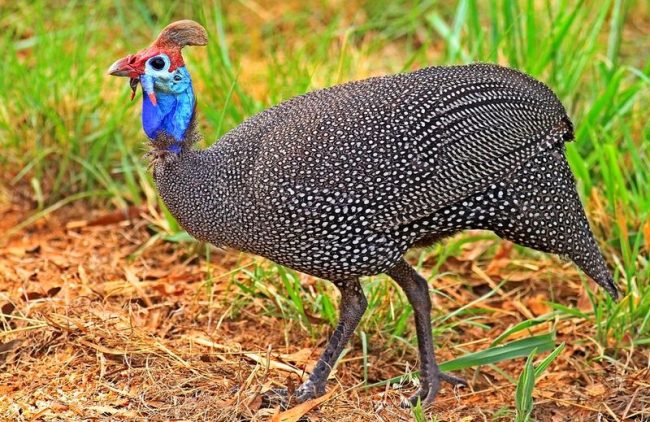
The largest species is the vulture guinea fowl. Its weight reaches 6 kg and, due to its long elongated neck, it resembles a neck
Characteristic
Guinea fowl lead a terrestrial lifestyle. Live in packs (up to 50 individuals), and in the mating season are divided into pairs.
A stocky bird with strong legs is very fearful.
Frightened, she can easily run 20 km, and with the onset of darkness takes off on a tree and sleeps on the branches.
Wild guinea fowls have four varieties:
- Turkey
- Curly
- Crested
- Vulture
The largest species is the vulture guinea fowl, photos show it during all the glory.
Its weight reaches 6 kg and, thanks to its long elongated neck, it resembles a fingerboard.
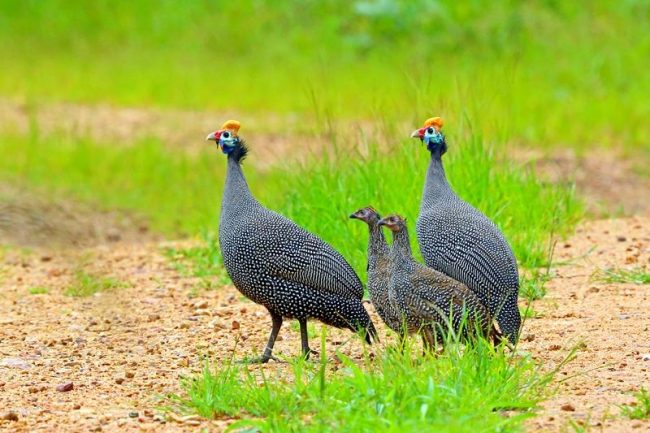
Guinea fowl always likes to be in a society of their own kind
Appearance
The size of a guinea fowl is not larger than chicken (40 – 70 cm).
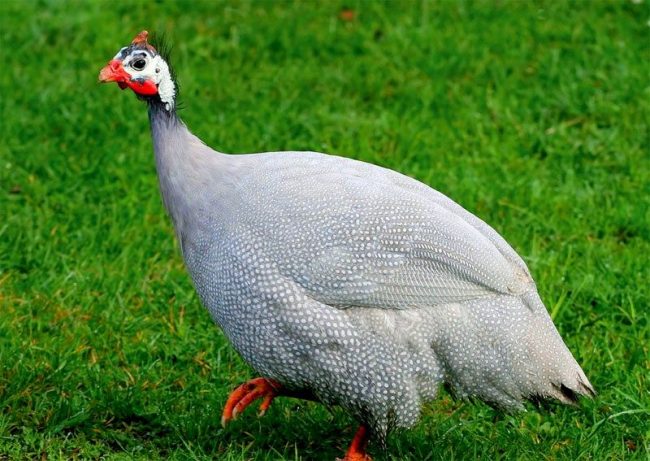
She has a large, horizontal body with a dense plumage, short, directed down, tail and long by the neck.
The upper part of the neck, bordering the head, has almost no feathers and is covered with leathery growths.
At the very head of some breeds there is a reddish-gray collar.
The male has a large bent crest on his head and a beak with large outgrowths called earrings.
These characteristics determine the gender of the bird.
The color of the plumage is diverse: cream, yellow, gray, but with indispensable white specks.
Very beautiful species, painted in dark shades with small bright spots.
Because of these spots, the bird got the name – pearl barley or pearl chicken.
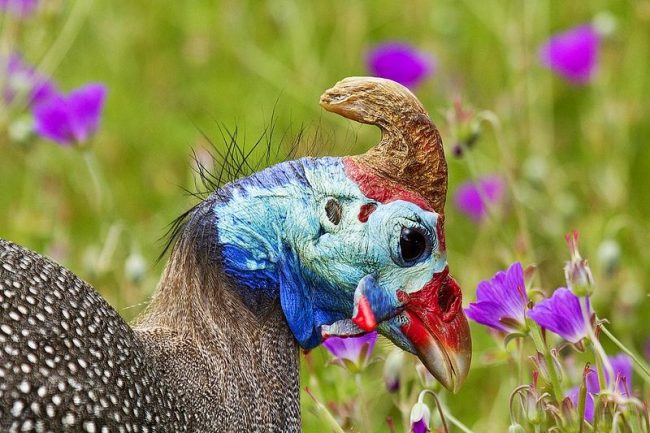
The male has a large bent crest on his head and a beak with large outgrowths called earrings. These signs determine guinea fowl floor
Each type of guinea fowl has distinctive features:
- The crested guinea fowl has a shaggy crest-cap of black and velvet feathers sticking up.
- Soft “guinea fowl” headdress wide feathers resembling a female hat.
- Amazing plumage coloring – a mixture of deep blue, black and snow-white feathers – distinguishes a vulture guinea fowl among congeners. Long feathers are not comfortable in flight (500 m is the maximum that a bird able to fly), but in the mating season become the main tool to win the favor of the obstinate female.
- The eyes of almost all birds of this species are blue. The standard weight of the bird is up to 2 kg.
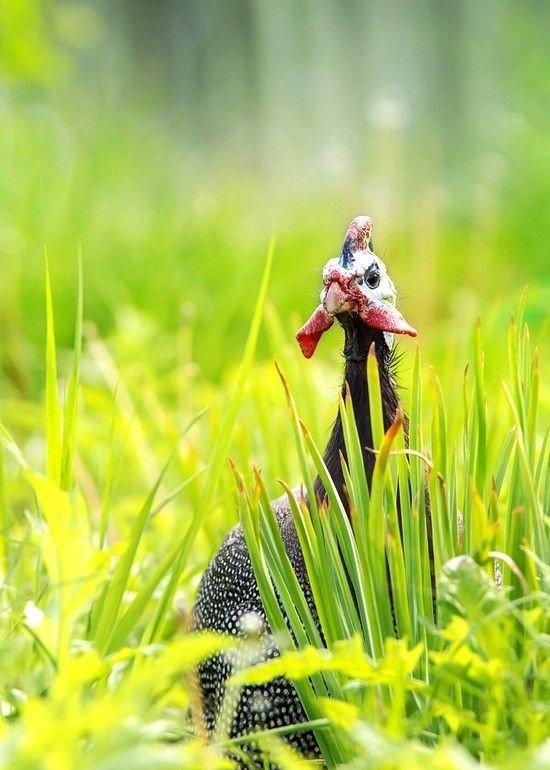
Guinea fowl feeds mainly on plant foods. Berries, seeds, shrub leaves, grass is the favorite food of these birds
Food
Guinea fowl feeds mainly on plant foods.
Berries, seeds, shrubs, grass – these are favorite foods feathered.
Bird easily finds termites in decayed wood, seeks out larvae of beetles, can eat an insect like cicadas.
Some species like to enjoy the meat of small rodents (mice, lemmings).
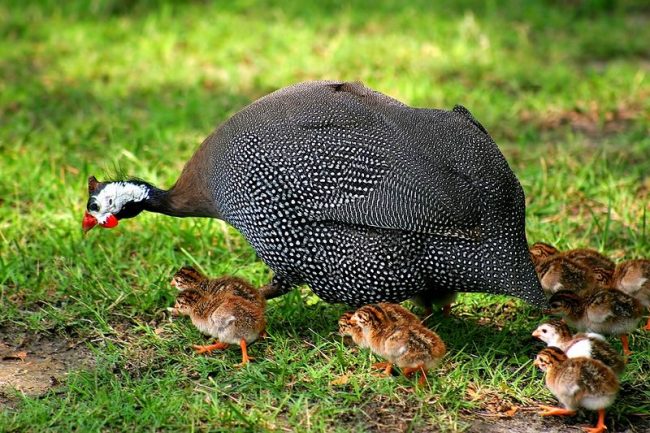
Wild guinea fowl mating season is in the rainy season (September – April). On the ground, among shrubbery and grasses, guinea fowls arrange nests in which 5 to 10 eggs are laid. Only the female incubates eggs. Chicks are born after 25 days
Nesting
Wild guinea fowl mating season is in the rainy season (September – April).
On the ground, among shrubbery and grass, guinea fowl arrange nests in which 5 to 10 eggs are laid.
Only the female incubates eggs. Chicks are born after 25 days. Weak, afraid of dampness and drafts kids often die.
Only half of the chicks survive, which start very early eat yourself.
Despite its “overseas” origin, call оригинальную курочку иностранкой нельзя. Цесарка, разведениекоторой началось 500 лет назад, давно стала полноправнойжительницей российских и европейских птичников
Home Content
Despite its “overseas” origin, call оригинальную курочку иностранкой нельзя.
Цесарка, разведение которой началось 500 лет назад, давно сталаa full resident of Russian and European poultry houses.
There are over 20 breeds of birds bred in different countries. Among them:
- Cream
- Zagorsk white-breasted
- Volga white
- Speckled gray
- Siberian white
Interesting! Guinea fowl as a gift presented to Ivan the Terrible. After which he obliged to breed overseas bird on the shores of Lake Plescheeva. Outlandish bird served on the table to kings and noble persons, therefore, their Russian the name bird came from the word “king”.
Home guinea fowl descended from wild relatives.
When growing it does not require additional medication interventions since it has a high immunity barrier to diseases.
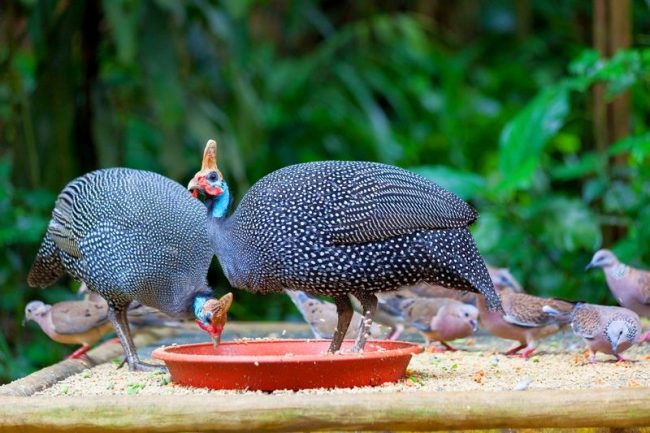
Guinea fowl eats almost everything: grass, grain, vegetables, fruits, food waste. Likes tops, corn leaves, beets. Mashinka on milk from a grain mixture, mineral top dressing (ash, chalk, crushed seashells) increase bird productivity
“African” origin does not interfere with the bird perfectly feel in Russian spaces – in closed indoor and outdoor areas.
It tolerates Russian winters and summer heat, but dampness does not loves.
Frosty and rainy days the birds spend in a closed house with temperature +10 C ?.
Guinea fowls are unpretentious and freedom-loving. Guinea fowl content requires more than for chickens or ducks, the area.
In the afternoon, a flock of birds freely walks around the site, in the evening returns “home” in the hope of refreshments – abundant food and water.
Herd life lead: peacefully get along with the inhabitants of the yard, playfully run and can even take off.
They fly reluctantly, only in case of danger. Therefore, in adults on one of the wings are trimmed by 5-6 cm flywheels feathers.
With a clipped wing, the bird cannot keep its balance necessary for the flight.
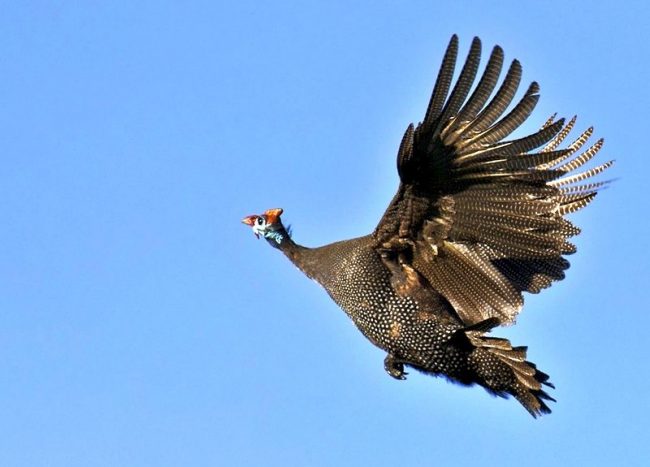
For breeding guinea fowl at home, use one male, fixing 4 to 5 females behind him. In captivity, they rush only in the summer months, bringing an average of 15 to 20 eggs per month
Birds are mobile, very shy, do not tolerate sharp noise.
At the slightest occasion, they scream loudly, forcing tribesmen flee.
But the owner is recognized and attached to him, taking off amiably on the shoulders and grabbing food from the palm of your hand.
Interesting! Guinea fowl voice piercing voiced. It scares away small predators: mice and rats. Resourceful farmers sometimes specially instead of dogs get these “singers” guard your compound. Vocal guard will immediately usher to the owner about the approach of a stranger, be it a dog, a cat or just passerby.
For breeding guinea fowl at home, use one male, fixing 4 to 5 females behind him.
In captivity, they rush only in the summer months, bringing in an average of 15 to 20 eggs per month.
The birds kept the habits of their wild relatives.
For oviposition, a future mother, trying to find a secluded corner, not wanting to rush in the nest.
After oviposition, a fearful guinea fowl escapes from the nest, not hatching eggs.
Therefore, to obtain a brood of guinea fowl, an incubator or Experienced brood chicken.
Guinea fowl albino
Guinea fowl eggs are medium-sized, pear-shaped, light brown or dark shade.
The shell is strong, it will not crack when dropped from a small heights.
Eggs are smaller than chicken, but according to the content of vitamins A, D, E almost double their size.
Shelf life of caesarine eggs is up to six months.
Guinea fowl, breeding which differs little from breeding any poultry grown on poultry farms to obtain valuable dietary meat.
Its calorie content is 7.2 MJ / kg. Abroad, guinea fowl meat to buy which can be in stores highly appreciated.
Guinea fowl is an omnivorous bird. The metabolism of the king bird is faster than the neighbors in the house of other breeds, so you need to feed it more often.
Unlike chickens, guinea fowl do not rake the ground with a clawed foot. Planting vegetables from such a “nurse” is one good. Только ккапустным грядкам подпускать птицу нельзя: от кочанов и кочерыжкине останется
Eats almost everything: grass, grain, vegetables, fruits, food waste. Likes tops, corn leaves, beets.
Mixer on milk from a grain mixture, mineral top dressing (ash, chalk, crushed seashells) increase productivity birds.
But the meat and bone meal and barley the bird bites only in the extreme case, very hungry.
Interesting! “Royal birds” adore Colorado beetles. It’s funny to watch a guinea fowl seek out a delicacy among potato tops. She pulls her skinny neck looks under the leaves and quickly pecks striped pest.
Experienced owners even conduct special training for their pets: collect potato pests in a jar, chop them and add powder to bird food.
“Guided” in this way guinea fowl more readily prowls in the garden beds in search of a favorite delicacy.
Unlike chickens, guinea fowl do not rake the ground with a clawed foot. Planting vegetables from such a “nurse” is one good.
Только к капустным грядкам подпускать птицу нельзя: от кочанов иthere will be no stumps left.
Guinea fowl: VIP person of the poultry yard
Meet: Guinea fowl is a VIP person in a bird’s yard. Classification breeds, main characteristics. Maintenance and care. Breeding Guinea fowl at home. Interesting Facts.