
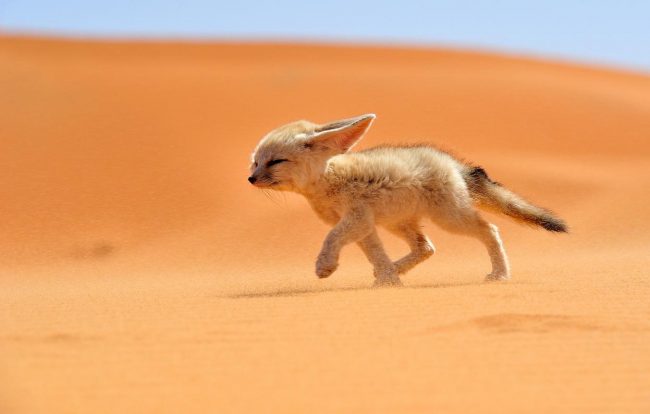
Classification
View: Fenech (Vulpes zerda)
Gender: Foxes
Family: Canids
Order: Predatory
Class: Mammals
Type: Chordates
Subtype: Vertebrates
Kingdom: Animals
Sizes: height at the withers – 18-22 cm; body length – 30-40 cm, tail length – up to 30 cm; weight – up to 1.5 kg
Life expectancy: 7-8 years, in captivity – up to 20 years
Fenech – a small cute animal that looks exclusively home decorative pet.
In fact, it is a predator of harsh deserts, which has almost no enemies.
Fenech is a touching and seemingly fragile animal. In fact it is a fast, smart and highly organized night predator.
And let its prey rarely exceed locusts in size, Fenech is an excellent hunter.
Interesting! The word “Fenech” comes from Arabic fanak, which translates as “fox”.
Content
- 1 Habitat
- 2 Characteristic
- 3 Appearance
- 4 Key Features
- 5 Nutrition
- 6 Reproduction
- 7 Content and breeding
Habitat
Feneki live in northern Africa: from the northern end of Morocco to the Arabian and Sinai Peninsulas.
Geographically, the main population inhabits the central part Sahara Desert. In countries, Fenech lives in addition to Morocco in Algeria, Libya, Tunisia, Egypt, Sudan, Mauritania, Mali, Niger, Chad.
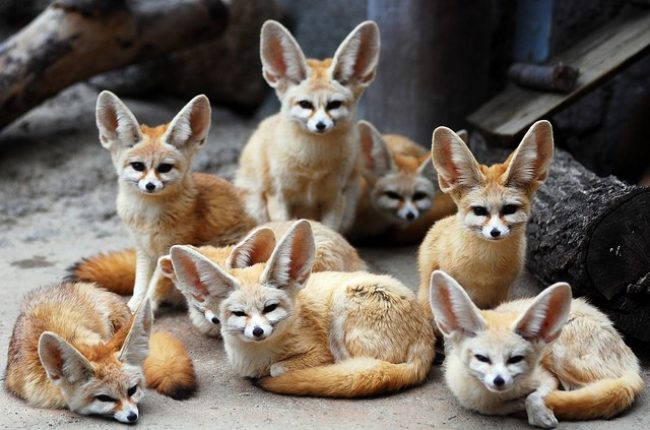
Sociality is one of the main signs of behavior of small foxes
The harsh desert climate is the natural habitat for little foxes. Here they mostly stay close to the little ones. oases of grass and sparse shrubs.
This is a shelter from the heat, and some kind of food. Fenech lives in burrows with a complex device: they have a lot of hidden moves. In the afternoon animals sleep, and at night they hunt and lead an active lifestyle.
Therefore, a good photo of the animals in vivo do difficult. But we know very well what the phoenixes look like, they like to eat and how they behave thanks to domesticated individuals.
Interesting! Paws on the legs of an animal covered with fur: it protects them from hot sand during the day, helps keep warm on cold nights and maneuver on soft and loose dunes.
It is not known how many Fenechs live in Africa. Them often fished for two purposes: to sell as a pet or for the sake of a very valuable fur, which is valued even more than a fur coat ferret, otters and Arctic fox.
Characteristic
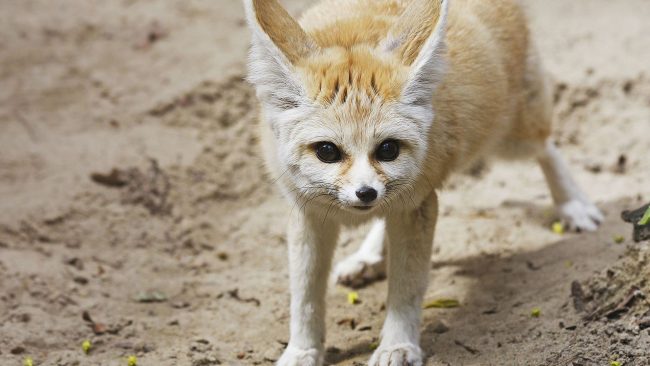
Feneki – not only hunters, but also excellent shrews – they live in minks dug up on their own
In fact, this is the smallest animal from the canine family. Despite the fact that officially this animal belongs to the genus of foxes, it is often included in a separate special genus Fennecus.
This animal survives well in captivity and in general, with the right approach to him turns out to be a great pet, same as a cat.
True, there is no point in waiting for cat habits from mini foxes.
Interesting! In relation to the size of the head, Fenech’s ears are record-breaking among all the predators of the planet.
Appearance
In height, this animal reaches an average of 20 cm, in length – about 35 cm and almost the same tail, which, like all foxes, different splendor.
If you happen to pet Fenech – do not refuse such Pleasure: Its fur is very soft and pleasant to the touch.
It’s hard not to notice the 15-centimeter ears of Fenech: they are the most large among predators compared to other body proportions.
Interesting! Fenech is smaller than most domestic cats. Moreover, he has a sea of energy, which he sure to find what to spend on.
Another interesting detail is the lowered foot, due to which the animal can easily move on the knee-deep sun the sand.
The animal was “out of luck” with its teeth: too small, especially small fangs, but for its prey and daily diet no longer needed.
The coat has a protective color to match the desert: reddish or fawn.
The tip of the fluffy tail is black, while the kids are almost not snow-white, but darken with age.
In general, the appearance of Fenech vaguely resembles it South African relative – Larger fox.
But the face of the North African animal looks more touching, perhaps that is why they love to breed him so much in captivity.
It’s hard to tear from the expressive look of these cute animals eyes. For some reason, the question of what Fenech looks like, some answer – with tassels on the ears.
But these animals do not have any brushes.
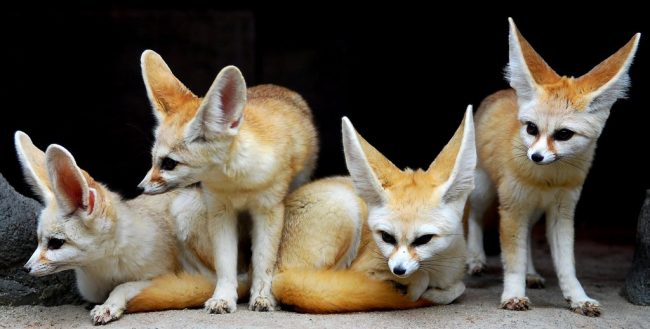
Big ears, legs fully covered with fur and a fluffy tail, black at the end – these are the main external signs of Fenech
Key Features
Feneca’s earache is not a joke of evolution. So big earpieces sinks allow you to catch the quietest, barely noticeable rustling.
This is especially true in hunting, because chanterelles in the desert have a choice food is not so great – you have to hunt down insects and scorpions.
In addition to such a hunting function, the ears help to hear the approach enemies and normalize heat transfer on hot days.
Interesting! Feneki able to reproduce a large number of different sounds: they howl, whine, twitter, whimpering, screaming, barking and grumbling.
Like other foxes, phoenixes have a supernatal gland. But this they are hidden under a dark hard woolen coat.
Feneki are very social. They live in families or real clans in which all relatives.
At the top position is the senior couple, then – them older children, and then younger babies. In rarer In cases, one den is occupied by several families.
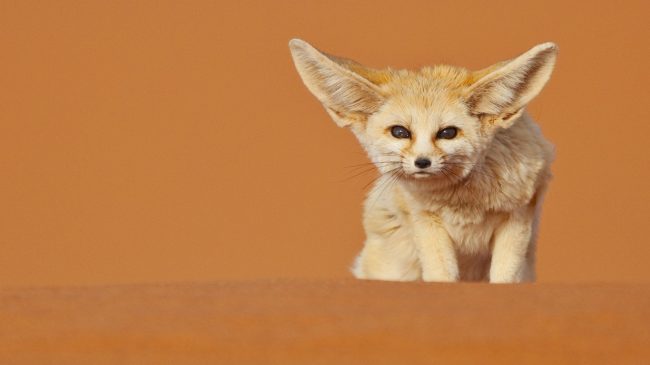
In the midst of the sand dunes, the Phoenix have almost no competitors in the hunt. for prey
In the process of their communication, Phoenixes are extremely “talkative” and use for this a huge number of different loud sounds.
This is a real test for those who decide to make some little chanterelles at home. They will scream constantly.
In nature, predators larger than him do not hunt Fenechs. The only enemy in the sky is large birds of prey.
These animals are very agile. Jump a meter in length for them not problem. Thanks to the color of their coat, animals hide easily in the middle of a desert landscape.
A serious and agile hunter whose nutrition is worth tell separately. And this digger in danger is capable of completely buried in the sand.
Interesting! Fenech is able to jump in height up to 70 cm.
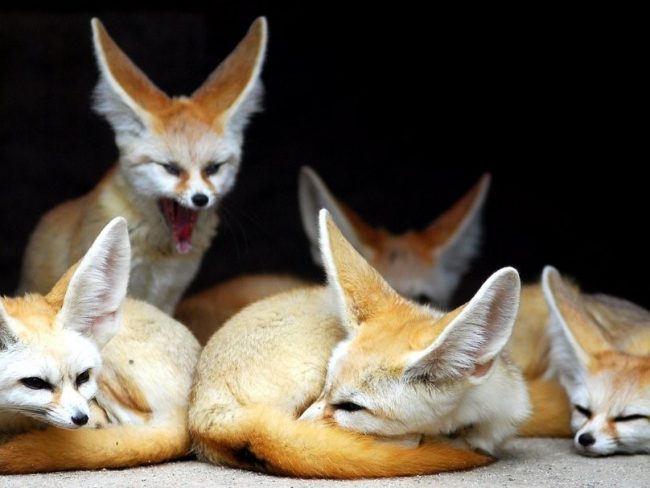
One family of Fenechs can count up to 10 individuals.
Interesting! Day at the zoos Feneki almost always they sleep because, as in nature, they prefer to have a night look life, and gain strength in the afternoon.
Food
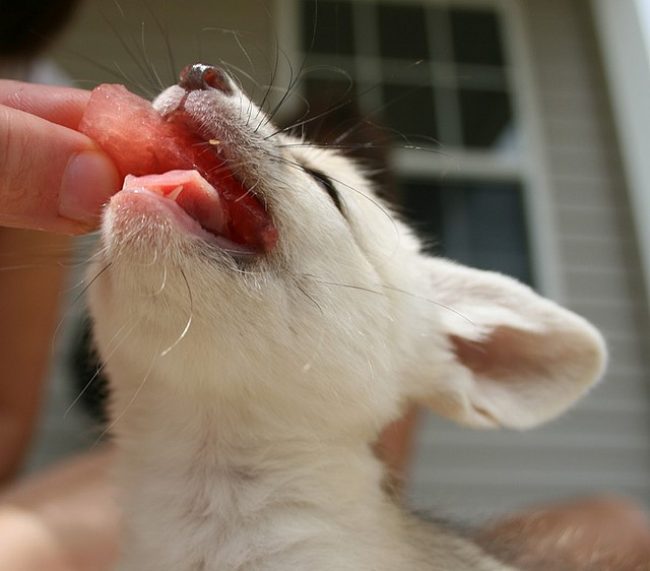
At home, the daily diet of Fenech must include fruits and vegetables
In the desert there is no time for selectivity in food. Therefore fenech, although it was repeatedly called in this article a predator, in practice omnivorous.
And everything that he eats, somehow digs out land. The ability to dig generally helps foxes in life: from digging holes to chasing some tasty insects or the rodent.
Interesting! The fox’s main enemy is African owl. Scientific observations have not revealed larger predators, preying on small foxes.
Fenech hunts alone. Practically everything goes to food: fruits, roots, eggs and small vertebrates, insects and even carrion.
Thanks to the ears, the fox catches even the quietest prey. Organism in Feneca is designed in such a way as to be content only liquid obtained directly from food.
Therefore, animals can live long without a constant source. water. By the way, Fenech is sometimes stocked with food.
Breeding
January-February – mating season for Fenechs, which differ brightly pronounced monogamy, that is, they form stable pairs. Each of the pairs has its own plot of territory.
In the mating season, males show aggression and actively mark their plot of urine. Female estrus lasts only two days. Pregnancy is about 52 days, so by April female Fenechs bring from 2 to 6 cubs.
Interesting! Feneki are big sociability: couples are created once for life, and matured the cubs sometimes stay with their parents to assist them in cultivating and educating the next generation.
They will grow in a mink where specially for them the earth is paved grass, wool and bird feathers. 50 gram foxes first 2 weeks are blind.
The male takes care of his family, dragging food into the hole, but the female he doesn’t let him in and behaves aggressively, protecting puppies from any, even potential danger.
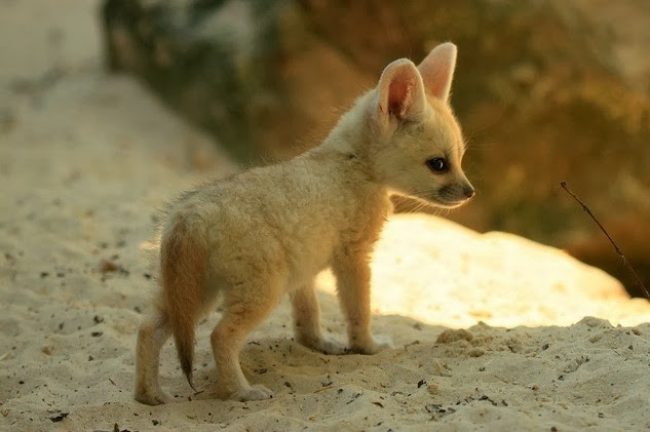
This kid is just starting to explore the endless world.
For the first time, small phoenixes come out at the age of 5 weeks. At first they wander only near the hole.
At the age of three months, females stop feeding them milk and the kids, having gained strength, begin to go far from their den in looking for food.
At the age of six months, many of them are already mature individuals, although some can only reach puberty at 9 months.
Interesting! Fenech cubs are almost white wool and only with age does it darken.
Very often phoenixes stay with their parents and help them raise the next brood. Fenech lives in vivo to 7-8 years old.
Content and breeding
As a pet Fenech – a very expensive pleasure – they are only a little cheaper than the savannah and ocelot.
But those who were fortunate enough to have these beautiful animals, nor have never regretted it.
Unless the constant squealing with which phoenixes communicate, but those who want to keep them at home know what they’re doing.
In captivity, Feneks are able to live up to 14-20 years, that is, a minimum twice as much as in their natural habitat.
Feneki are attached to a man, need his care. At in this they do not lose their natural quick wits and tricks.
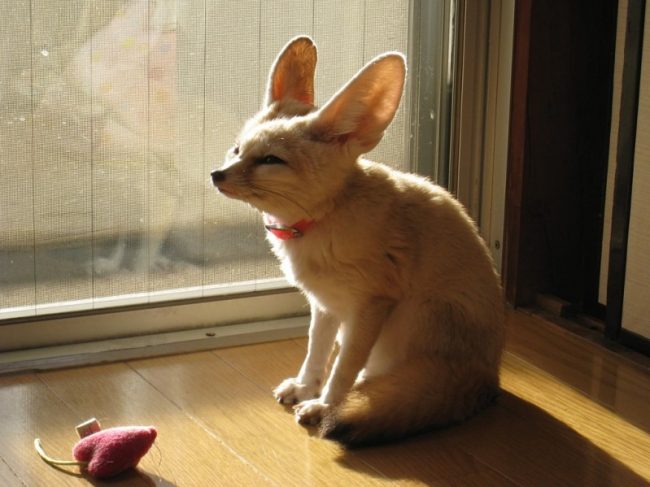
It’s sometimes difficult for Fenechs to make friends with other pets – in this case, a person can remain the only friend for these animals
At home, the little foxes and their foxes are great they feel. True, to get soft and flexible. character, they need some upbringing.
Of course, keeping a Fenech at home is not so simple. Especially worth pay attention to nutrition. Since in nature Fenech is omnivorous, then and at home his diet will be extremely extensive.
Usually the owners of Fenechs pamper them with lizards and small rodents wrodelemmings, locusts and cicadas.
The daily diet contains fruits and vegetables, of which the fox receives the moisture necessary for life.
Some owners give Feneca fish, cereals and dairy products. In general, the animal itself is able to make it clear that it is loves, and what is not to the liking of his stomach.

Find a veterinarian who is well versed in the features little foxes – big luck
How well Fenech will take root at home, Depends on his age.
With these animals you need to be affectionate, do not raise them voice and in communication with them do not make too sharp movements and do not make loud noises.
The fact is that the animal is shy and very sensitive, he has extremely sensitive hearing that is easy to damage.
For the animal to live a normal life in an ordinary apartment, should be based on information about their natural habits in original habitat.
For example, Phoenixes do not like the bright sun. Living in the desert, from their hole they go out in the twilight area. Therefore, at home most of the day they sleep, and at night they begin to lead an active lifestyle.
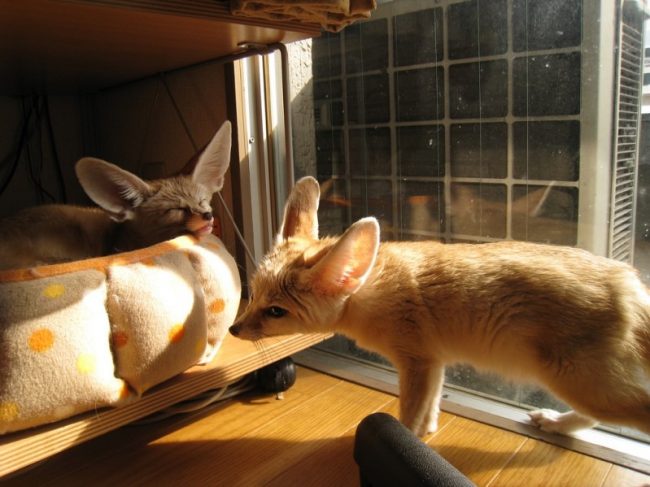
Those who want to have Fenechs need to be prepared for non-stop squealing: this is the main way of communication of animals together
There is experience in retraining Fenechs to sleep at night, but it is unlikely it is a good idea for animal health.
In the apartment for Fenechs it is necessary to allocate a place where they can play with sand. If this is not done, they can gnaw through the sofa or make a “hole” in another more or less soft object furniture.
If you want to have a Fenech, get ready for scattered all over apartment things, the construction of holes from clothes, spilling loose substances all over the floor, dropping objects from tables.
In the absence of the owners of the house in the daytime, this is solved the acquisition of an enclosure that is spacious enough for the animal to play while no one is home.
The fox loves to study the environment, therefore it is necessary to close windows and doors, hide wires and breakage items.
Feneki love heat, so the room should be good heated.
Walking them outside in winter is critically life-threatening animals, and in cold weather in the summer they need to be worn.
This is only a small part of the rules that you should adhere to while keeping Fenech as a pet. In fact, there are many more, and for any owner of such an animal – this is a big a responsibility.
Fenech Big-eared Fox – Desert Survival Master
Fenech – a small cute animal (photo), looking exclusively home decorative pet. This is actually a harsh predator deserts, which have almost no enemies.