Classification
Family: Echidaceae
Squad: Single Pass
Class: Mammals
Subclass: First Beasts (cloacal)
Type: Chordates
Subtype: Vertebrates
Kingdom: Animals
Domain: Eukaryotes
Sizes: Torso on average 35-45 cm, weight – from 5 to 7 kg. Life expectancy is 50 years.
Question from the crossword: “What is the name of a small animal, in whose needle is a hedgehog, beak-like mouth, bag possum laying eggs like gecko but feeds the cubs with milk like koale? “- the answer is echidna.
Content
- 1 Appearance
- 2 Habitat
- 3 Characteristic
- 4 Key Features
- 5 Nutrition
- 6 Reproduction
- 7 Captivity
Appearance
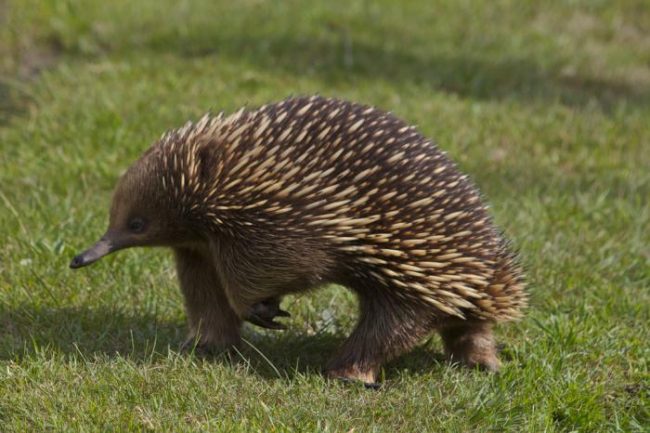
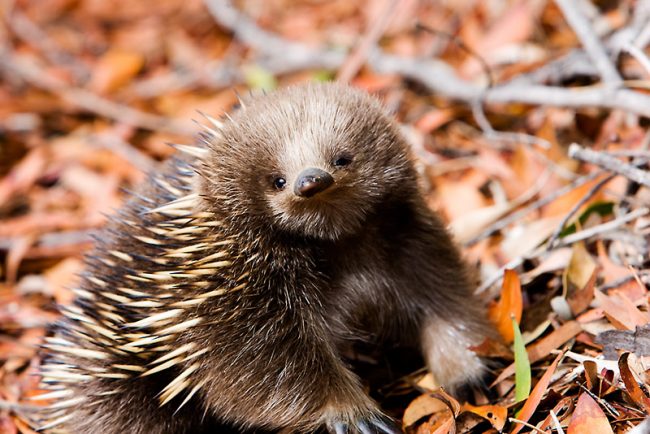
What does echidna look like? This is a small squat animal, outwardly similar to porcupine or hedgehog. His back is strewn with thick needles to 6 cm in length, dark at the base and light at the end. Rest parts of the body are covered with a rough coat of dark brown, brown or black color
A small head sits on such a short neck that its almost imperceptibly. From the side it seems that the head begins straight from the torso.
Deep on the sides of the head are medium-sized eyes, which, in addition to the eyelids, have a blinking membrane.
External auricles absent. The auditory meatus is shaped wide enough gap, located almost on the neck and hidden skin fold. When the echidna listens, she lifts this crease.
The muzzle ends with a small mouth, elongated in the shape of a narrow beak. Scientists call the echidna’s mouth “beak-like.”
She cannot open it wide, the mouth gap is very narrow – not more than 2-3 centimeters, which is enough to stick out a long the sticky tongue with which the echidna grabs food.
About how other animals adapt to life in the wild nature you can find out here: https: //kot-pes.com/adaptaciya-zhivotnyh-7/
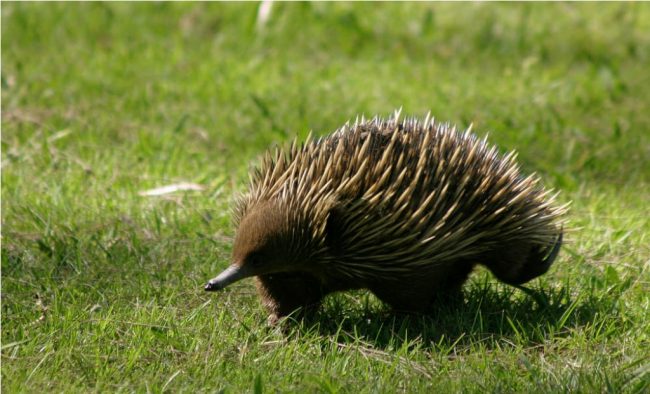
The animal has short, wide and strong paws, on each paw 5 fingers with strong large claws, with which it digs perfectly the ground. In addition, there is one special claw on each hind paw. 5 cm long with which it combs the wool and cleans the needles
Interesting! On the heels of the hind legs male echidna are horned spurs, hollow inside, connected with a special gland whose secret is poisonous. But scientists watching animals for many years, never noticed that these spurs somehow were used, therefore there is an opinion that these processes are atavism.
The echidna has a very short tail, often imperceptible. He’s all covered with needles.
The animal belongs to the single-pass squad, which means that everything feces, urine, sexual excretions in him go through the only common hole – cesspool.
Actually, this is a very cute and harmless creature, but for some reason ancient Greek mythology describes it in a completely different way.
The Ancient Greeks echidna is a gigantic creature with beautiful the female face and body of the snake. Half-female half-snake possessed a fierce character, abducted travelers.
Ancient Greek mythology says that she was killed by Hercules (there are versions that Hippo, the king of Oedipus, or multi-eyed giant Argus).

How the ancients imagined the echidna
The mythology of the Gauls endowed the echidna with a beautiful female face with the body of a crocodile. A gem burns in the girl’s forehead which she takes out every time she goes swimming.
One who manages to steal this gem will be incredible rich: all the underground treasures will be revealed to him.
Habitat
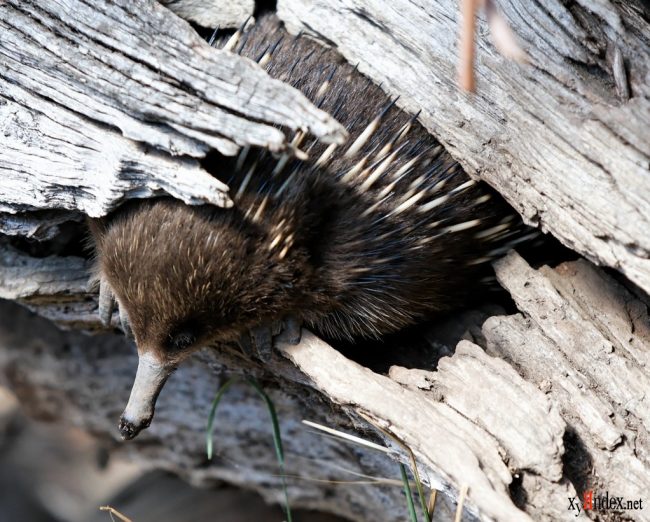
Echidna Natural Habitat – Australia, Tasmania and New Guinea. Therefore, this animal is also called Australian Echidna
The animal prefers moist shady places with thick vegetation, forests, hilly or mountainous terrain, climbing sometimes up to 2500 meters above sea level. The plains avoid.
This animal has no permanent habitat. It stops for rest or overnight in the first suitable place – under the roots of trees, in crevices of rocks, in small caves, in burrows of other animals, most often rabbits or wombats.
Or maybe just lie down in the thick grass. Having a rest, immediately leaves and forgets about the temporary abode.
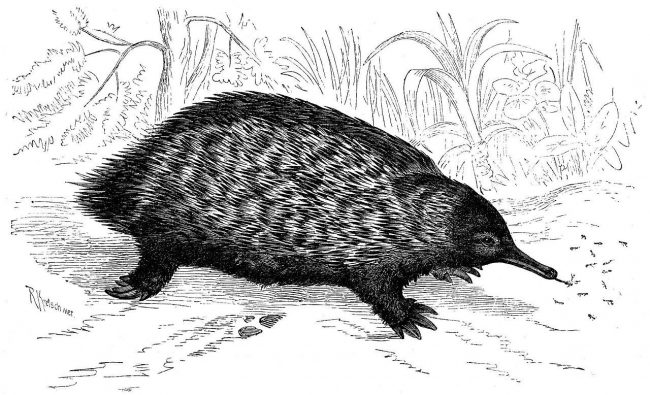
One of the first sketches of the echidna
Interesting! First researcher who more or less detailed described the echidna – George Shaw in 1792. After him, many researchers became interested in mammals. But this animal is very difficult to study, since it is “malicious” – very secretive and careful, in every possible way avoids interference in his a life. Echidna somehow feels that they are watching her, and immediately hiding in a secluded place. For a long time I could not do it photo, therefore, sketches were presented in the scientific literature the beast.
Characteristic
We figured out how the echidna looks, where she lives, Now we learn its basic characteristics and habits.
Echidna is a lone animal. She always prowls alone, only in mating season males group in courtship a female.
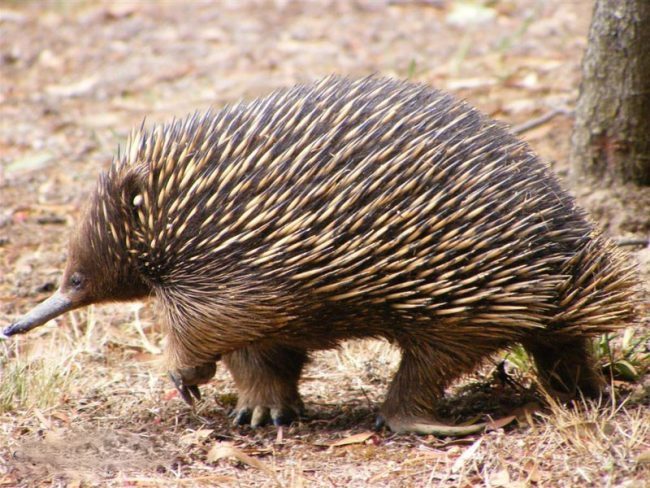
The animal moves awkwardly; side to side, bends the head and front to the ground torso. But in case of danger runs away very briskly
To protect yourself from your natural enemies – the dingo dogs, a fox, a Tasmanian devil, a marsupial wolf, sometimes a monitor lizard – she collapses into a ball.
But an experienced predator still gets to her tender belly, which partially remains unprotected.
Advice! If by chance in your way echidna will meet, do not try to pick her up. Curling up in tangle, she inflicts deep and painful wounds with her long and strong needles.
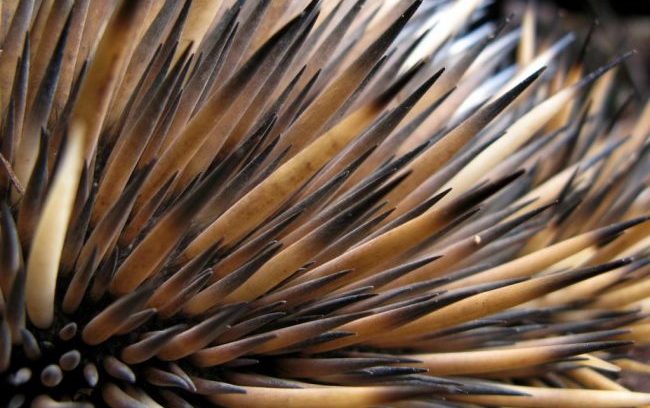
The needles on the back of the echidna are very sharp and thick, are excellent protection from any predator
If you can’t escape, then the animal with amazing dexterity and burrows fast into the ground so that only stick out from above needles.
It is very difficult to get him out of such a shelter. Besides Australian echidna is a good swimmer.
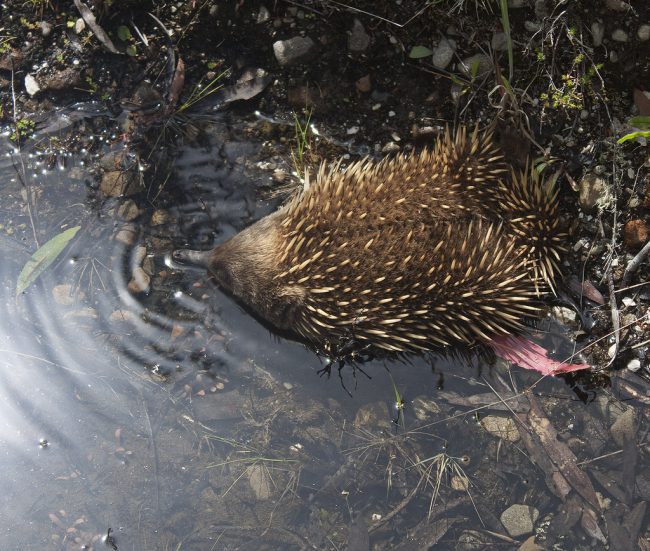
Another form of protection is the fetid liquid that it releases from under the tail if the enemy came too close
She has poor eyesight, but sensitive hearing and keen sense of smell.
Often hunts at night, but scientists have established that the echidna is not is strictly a nocturnal animal, can hunt during the day when favorable weather when not very hot.
The fact is that she has no sweat glands, and her body temperature only 30-32 ° C, so it tolerates high air temperatures bad, however, like low ones.
If you are interested in learning other amazing facts about animals, recommend reading articlehttps: //kot-pes.com/fakty-o-zhivotnyh-13/
Therefore, when it gets cold, this animal becomes lethargic, vital processes in the body are inhibited.
Interesting! With significant lowering the temperature, the animal may even hibernate, which lasts from 1 to 4 months. During this period, food supplies subcutaneous fat, which the echidna walked up for the season.
Key Features
Echidna is an amazing animal, she combined characteristics of other animals:
- I took the needles from a porcupine or a hedgehog,
- has a bag like an opossum or a kangaroo,
- lays eggs for procreation, like a bird,
- feeds their babies with milk,
- eats exactly like an anteater,
- can hibernate like a bear,
- digging holes no worse than a mole
- for a long time without water, like a camel,
- if the animal gets angry, then grunts cute, like a pig.
Interesting! On echidna lives the most the world’s largest flea Bradiopsylla echidnae length 4 mm
Food
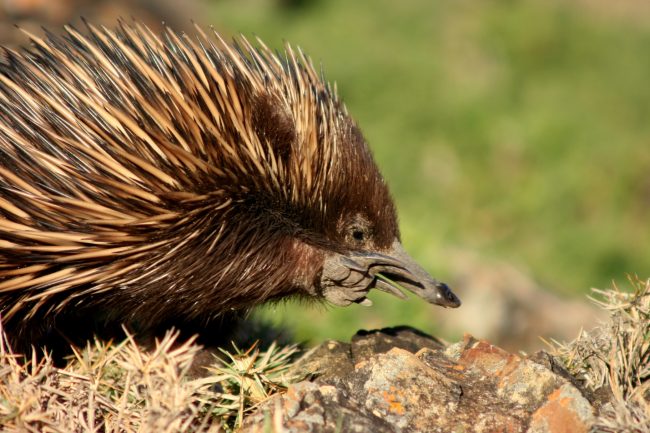
The main food of the echidna is ants and termites. Having discovered an anthill, she immediately begins to cleverly tear it apart, deepening to until he gets to the ants. Right there begins to lick them with their long sticky tongue
The sticky secret that greased her tongue profusely stands out from large paired salivary glands.
Echidna has no teeth in her mouth, but the upper palate is dotted with hard keratin plates, about which she crushes insects, holding them firmly with their tongue.
Termites await the same fate, if suddenly the Australian echidna find termite maker. Moreover, she easily breaks hard paws external walls of the termite mound.
If she teaches ants or termites under the bark of a tree, then forepaws easily tear off a piece of bark and lick found insects.
Interesting! Echidna tongue very fast movements, they can stick it out in a minute more than 100 time!
In search of goodies, the Australian echidna can move stones, even large ones, sometimes simply comb through their sensitive nose-beak forest litter.
Together with food, she, like birds, swallows a large amount land and small pebbles. They help digest food by grinding her in the stomach.
In addition to ants and termites, bugs, worms, sometimes clams.
Echidna almost never drink water. They get the fluid along with eaten by insects.
Interesting! Scientists suggest that on the nose of the echidna there are special cells with which she picks up electromagnetic impulses emitted by all living creatures. Only sharks and whales have such receptors, they have not yet been found in no terrestrial mammal.
Breeding
Scientists have long been trying to figure out how the Australian breeds echidna. But only in 2003 were reliable research results in this area.
After 12 years of observation, it was found that the vipers the season begins in May and ends in September (this is the period Australian winter).
Only at this time animals agree to live in a small group, which consists of one female and several males (usually 4-6 individuals).
Animals eat and relax together, and when moving from place to the place follows one after another, and in the head of this a kind of “marriage caravan” is always a female.
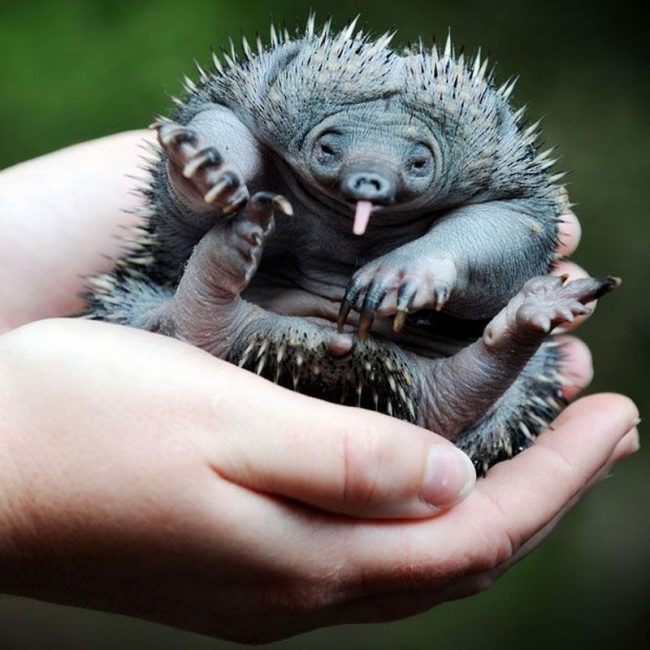
Echidna Hatchling
The males look after a long time – a whole month, but very modestly – they just drag around the female and sniff her, nuzzling her tail the only female in the group.
The female emits a strong musky odor during this period.
After 4 weeks of courtship, the female lays on the ground, showing that is ready for mating.
The males come to life and start vigorously circling around her, dropping clods of earth and trampling a trench up to 30 cm deep.
Then the “boys” begin to push, rather roughly pushing each other from the trench until there is only one left the winner, who immediately begins to mate with the female. Mating takes place on its side and lasts an entire hour.
Interesting! The male echidna amazing penis – it has 4 heads at once.
Echidna pregnancy lasts 3-4 weeks (the hotter, the shorter pregnancy).
After she lays a leathery egg in a special brood bag – a fold of skin that appears only during the period maternity.
Interesting! Biologists still not can understand how the echidna manages to roll an egg in a bag. Even though it and tiny – with an average diameter of 15 mm and a weight of just 1.5 grams, but still with her small mouth she couldn’t do it, but her paws echidna too short and awkward. There is a hypothesis that, laying the egg, the animal curls up in a ball, the egg rolls out from cloaca directly to the stomach, where it sticks to the fold sticky a secret.
Bearing lasts 10 days, after hatching from an egg miniature cub – puggle (zoological name) – up to 15 in length mm and weighing half a gram.
He is completely helpless, his eyes are hidden by leathery eyelids, the back paws not yet developed.
Interesting! To appear on light, the baby breaks the shell of the egg with a horny growth on nose.
In a few hours, the baby, using the front paws, gets over to the front of the mother bag.
Here is the so-called “milky field” – a patch of skin, where up to 100 pores of the mammary glands, from which it is secreted very nutritious milk. His cub licks his tongue.
Interesting! Echidna’s milk pink due to its high iron content.
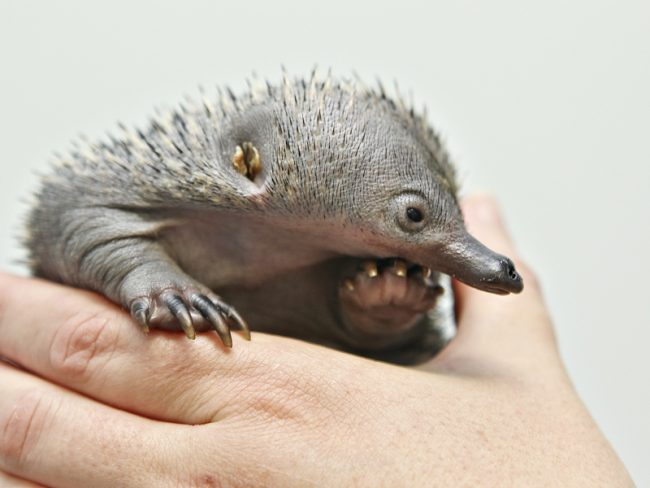
Puggle remains in the mother bag for up to 2 months. Over this time he adds up to 400 grams in weight, that is, increases his initial weight about 800 times!
This growth rate is a record among mammals. Just in At 2 months of age, spines begin to grow in the puggle, and the mother takes him out of the bag.
She pulls out a special shelter for him under the roots of the trees. or stone and leaves the baby in this secluded place.
Every 4-5 days, the echidna visits her cub to feed him.
More often and not required, firstly, so as not to attract attention predators, secondly, the nutritional value of echidna milk is very high. So lasts 6-7 months until the baby is completely independent.
The life of a puggle in a hole is critical for him. He is very vulnerable at this time. If a predator finds it, then the chance to be saved is there will be no echidna cub.
The only protection is the pungent odor that comes out from puggle, and also the fact that he is very, very quiet, practically making no sounds.
Some facts about the reproduction of echidna:
- puberty in a female occurs in 3-4 years,
- it reproduces very rarely – on average it lays an egg every 4-5 years,
- the echidna always lays only 1 egg,
- mother bag is a temporary phenomenon. She disappears after of how the mother throws the cub out of there,
- while hatching the egg and staying the puggle in the bag, the temperature there is higher than the rest of the animal’s body.
Interesting! In wild nature Australian echidna lives 15-17 years, and in captivity the animal survives up to 45 years old!
Captivity
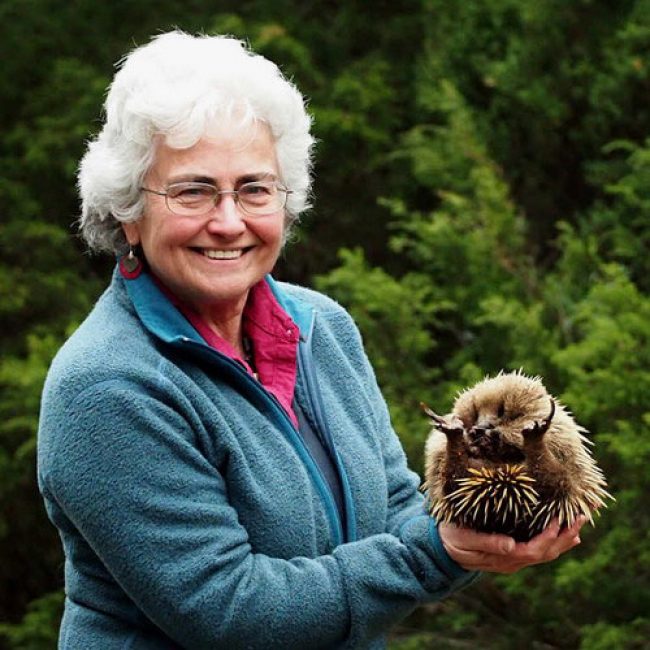
Establishing an Australian echidna is a very bad idea. it the animal will move furniture in search of ants and termites, it does not shine with intellect, cannot be trained at all, is not attached to a person, however, it is quite curious and can poke your nose-beak to where the owners least expect
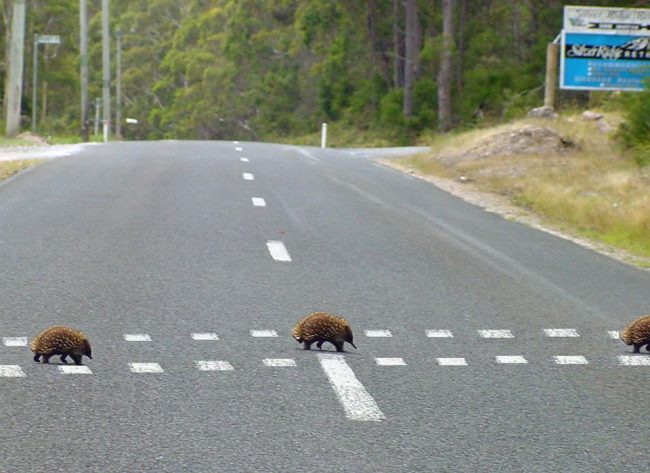
In the photo you can see how the echidna crosses the highway. Are moving they are in the side of a small place. Recently, more and more these animals began to appear at the human home. They climb into gardens, on flower beds. Australian housewives are forced to call professionals who move the viper back to the forest. Scientists perplexed by such behavior of these amazing animals
At the zoo, the echidna feels great. They live in captivity by all over the world and, as it turned out, love milk very much. But here they cannot reproduce under unnatural conditions.
Only 5 zoos in the world managed to get offspring from echidnas. But the puggles, unfortunately, were dying at a young age.
A miracle happened in 2012 at Perth Zoo in West Australia Here to scientists during the Australian breeding program echidn in captivity managed to get healthy offspring from two at once females.
Moreover, the puggles grew up and became parents themselves in August 2015 year. Thus, the first in the world was born in this zoo a viper cub whose father and mother are also born in captivity.
Echidna: an amazing animal from Australia
Echidna is a small squat animal that looks similar to porcupine or hedgehog. His back is strewn with thick needles up to 6 cm in length, dark at the base and light at the end. Other parts the bodies are covered with a rough coat of dark brown, brown or black colors.