
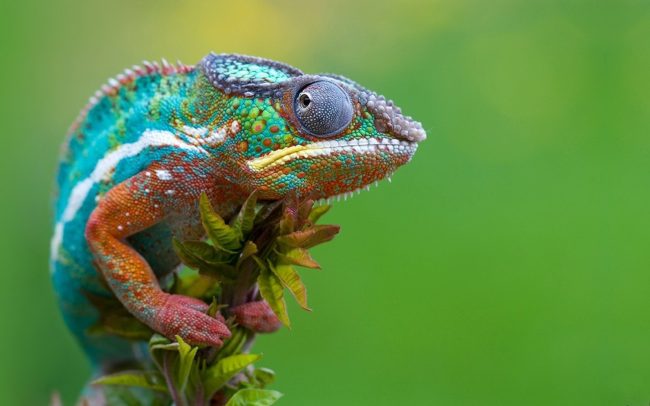
Classification
View: Chameleon
Family: Chameleons
Order: Scaled (Squamata)
Class: Reptiles
Type: Chordates
Subtype: Vertebrates
Dimensions: the length of an individual depends on the species and may make up from 15 mm. up to 68 cm., weight varies from 35 g. up to 1.5 kg
Life span: 7-9 years
Depending on the species, chameleons may have as standard for nature colors: yellow, green, brown, so accept absolutely amazing color: blue, orange, red and others.
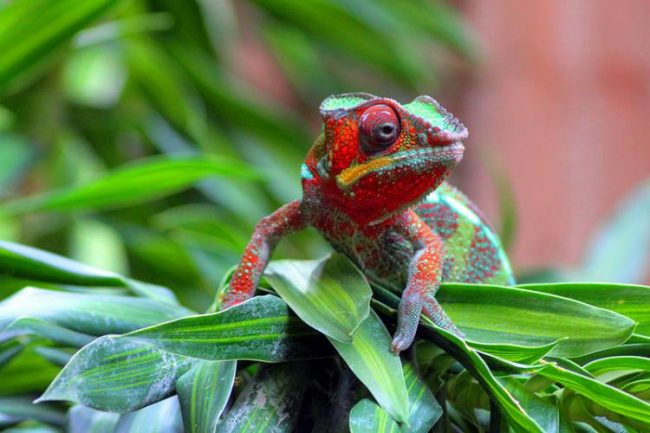
The entire chameleon skin is covered with tubercles of different diameters, and on males’s heads may have horns, a comb, or something similar to crest
Chameleons are very unusual lizards that can change color according to their environment. This property allows them not to just go unnoticed during the hunt, but also not become prey. This is their only way of protection. For humans they are not dangerous.
Other unusual animals can be read. here: https: //kot-pes.com/samyie-neobyichnyie-zhivotnyie-mira/
Probably meeting this animal in dense foliage, you will not distinguish it from bright greenery, and when walking along a rocky path, do not pay attention to a bizarre stone.
Such a useful feature could not go unnoticed and long used by people – remember the principle of camouflage, and ourselves chameleons have become a favorite, albeit very exotic, a pet.
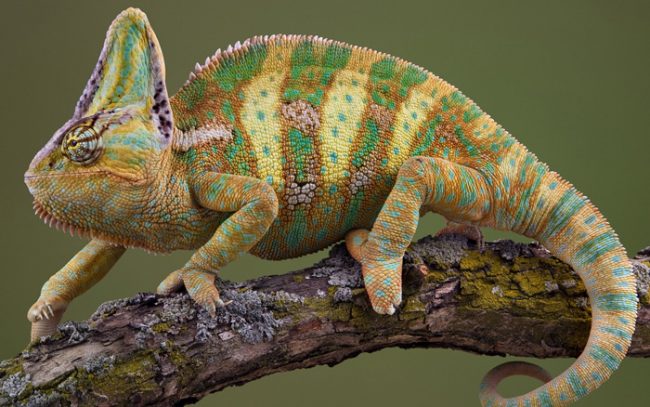
The chameleon has a very powerful tail, which allows it to tightly stay on tree branches, sometimes even letting go of the front or the back pair of paws to look like a leaf
Content
- 1 Appearance
- 2 discoloration
- 3 Habitat
- 4 Lifestyle
- 5 Nutrition
- 6 Hunt
- 7 Reproduction
- 8 Home Maintenance
- 9 How to feed a chameleon
Appearance
Chameleons are lizards with squeezed sides body, short neck and long tail tapering to the end. With this tail, twisting into a spiral, they can wrap branches and hold on tight to the trees.
The skin of chameleons is covered with tubercles, and on the head many species have horns or some kind of crest.
Paws, like human hands, have five fingers, which look like small ticks. This shape of the legs allows you to cling even for the thinnest branches.
The eyes are round and surrounded on all sides by skin with a slight a hole for the pupil. They have a very interesting feature: can rotate independently 360 degrees.
The tongue is very long and elongated longer than the body and heads.
Interesting! Chameleons do not have medium and external ears, and therefore hard of hearing.
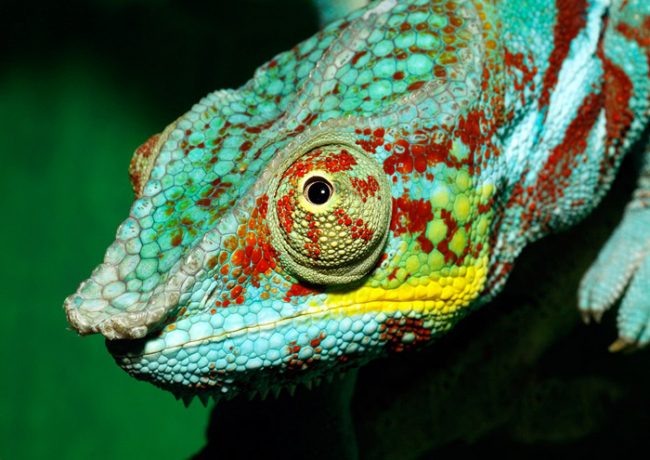
There are more than 135 species of chameleons that differ in place habitat, color and size. For example, the length of an animal may vary from 15 mm. up to 68 cm
Discoloration
Chameleons change color in two cases: in case of danger and in hunting time. They adjust to the surrounding temperature and lighting, thereby becoming completely invisible. Besides chameleons, some types of skin can change color geckos.
Some species can change their color only from green to brown, which allows them to successfully hide in the crown of trees. Other species can take almost any color. They do it’s pretty fast: a color change can occur within 20 seconds.
How does color change occur? You need to start with the fact that all chameleons are born with a set of specific cells that have their own pigment called chromatophores.
They are under the upper skin of the chameleons. Receiving a message from brain, chromatophores change color, depending on whether whether they are given the task of expanding or contracting.
At this moment, the same process occurs as on the palette artist: paints mix together, creating a completely new shade.
Scientists have long concluded that not only the environment affects discoloration. For example, a new hue shows that the chameleon is calm or to help him in communication with other individuals of this kind.
Advertising often uses a trick when a chameleon takes any color, including a wallpaper pattern or a checkerboard pattern boards. This is a popular stereotype, because opportunities animals are limited and no ornaments are subject to it.
True, some species of chameleons can copy color. leaves along with veins. So that the disguise is still more reliable and the individual has completely merged with the leaf, it can stand still for several hours in an uncomfortable position, tearing a couple of paws from branches.
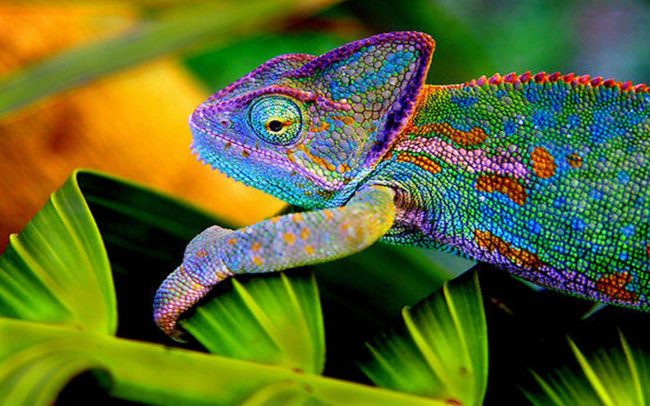
Chameleons can change color not only in case of danger or during hunting time, but also in order to chat with other individuals
Habitat
Most of the known species of chameleons, and there are about 135 of them, live in Madagascar or in Africa. Several species are found in Asia and only one, an ordinary chameleon, – in Europe.
These amazing animals live only where the climate is warm, since they belong to the class of reptiles. During a cold snap chameleons hibernate.
They live mainly on trees. Their natural color is most similar to the color of the bark and leaves: green, brown, beige, yellowish.
As mentioned above, thanks to its long powerful tail, these animals calmly feels among the branches.
Tightly clutching the tail for thick and fingering tenacious thin branches with your fingers, chameleons occupy the most convenient position for hunting or recreation. In this position, practically motionless, they can spend up to twenty hours.
They descend to the ground only during hibernation or reproduction. However, there are a couple of species that lead a land-based lifestyle.
Interesting! Almost half of all known The science of species of chameleons resides in Madagascar.
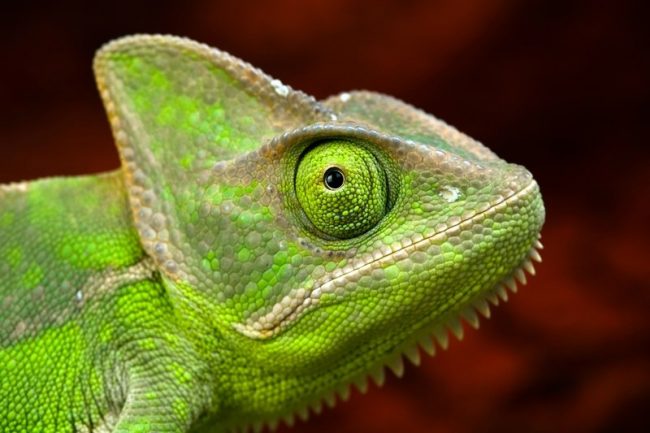
Chameleons belong to the class of reptiles and therefore prefer a warm climate. When cooling, they fall into hibernation
Lifestyle
As a rule, chameleons, like many other reptiles, including salamanders, lead a solitary lifestyle. Despite the fact that these lizards are very inactive and during days can only move a couple of centimeters, they are always ready for to catch an insect. Their eyes and tongue are ready.
When two males meet, a fight can occur. There are times when they start to hiss at each other and try to drive it away rival, but most often they diverge on the sides with the world.
Some chameleons gather on branches in groups of 5-6 individuals.
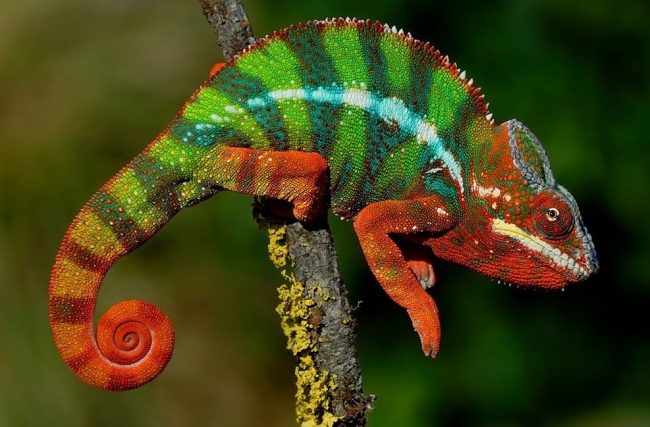
Chameleons prefer a solitary lifestyle, but sometimes gather in groups of several individuals
Food
The main food of chameleons is the insects that they catch in large quantities. Sometimes in their diet is added vegetable food, fruits and water. Large species can eat small lizards and little birds.
Chameleons can easily tolerate hunger, but their thirst is quite not easy.
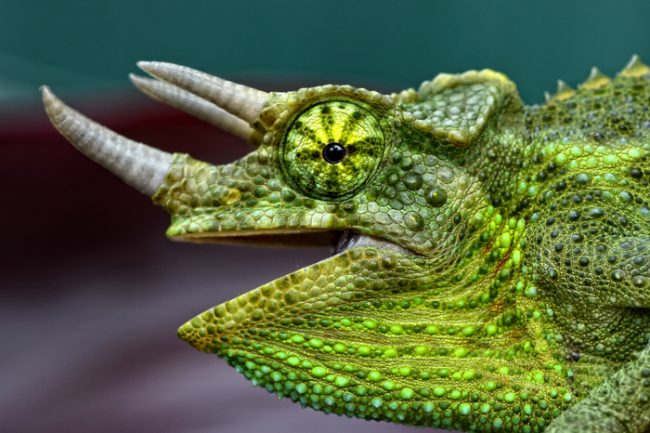
The main diet of chameleons is insects. They can also enjoy the fruits of trees and drink water
Hunting
Thanks to its long powerful tongue and rotating in different side to eye, the chameleons are quite successful hunters. Noticing the victim, they direct both eyes at her and “shoot” tongue in her direction.
The tip of the tongue takes the shape of a cup, and the insect caught sent straight to the mouth of this unusual lizard. Also hunting it helps that the tongue acts like a sucker. It robs sacrifice of every chance of salvation. Capture takes a tenth seconds.
The tongue can hold food weighing up to 50 grams, and yet it can take a position in which it becomes possible grab an insect on the opposite side sheet.
Chameleons await prey very patiently, sitting for hours in stationary state. But all this does not mean that they are lazy and clumsy: if necessary, chameleons can not only quickly run, but also make tree jumps.
Interesting! Chameleons are not bad for reptiles with vision and can see even a small insect with distances up to 10 meters.
Chameleons have unusual vision: eyes can rotate 360 degrees independently, allowing them to immediately see the victim and prevent danger to yourself
Breeding
During the mating season, males behave aggressively by relation to each other. All their actions are aimed at drive away the opponent and prove to the female that they are the most suitable candidates for reproduction.
Male hiss, fight, drive away with their territories can fight with horns, as deer do. It goes and changing colors to brighter and more intimidating.
For reproduction, chameleons use several methods: one species lay eggs, which is inherent in most species of reptiles, others – viviparous, in third species, females can lay unfertilized eggs without the participation of males.
Those species that lay eggs in the traditional way burrow they are in the ground or suspended from tree branches. Eggs in clutch can be from 15 to 80, and the incubation period is up to 10 months.
In viviparous species, up to 14 cubs can be born. Them glue mucus to the branches and feed the first time so way.
The species where a female can do without a male are very interesting, because the resulting offspring is quite capable of a full life and further breeding.
If adult chameleons are protected by disguise, then cubs Generally incapable of any kind of self-defense. They move clinging to the backs of mothers.
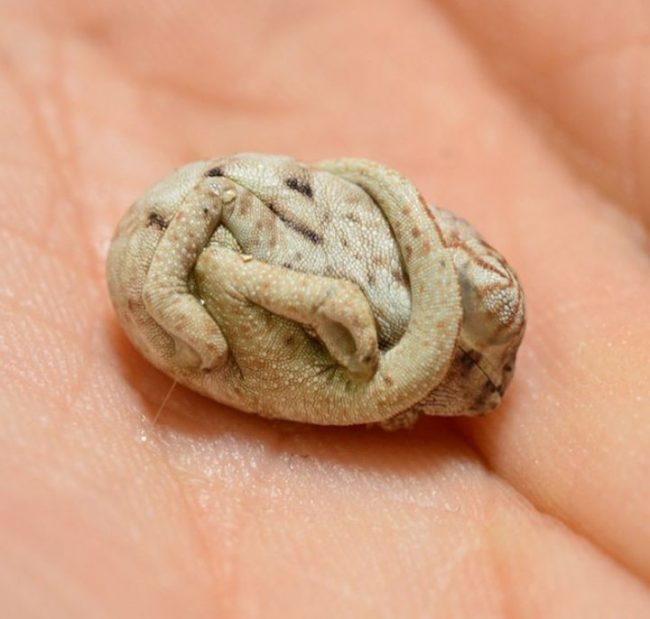
Interestingly, different types of chameleons breed different ways: some lay eggs in the traditional way, in others types of females, dispensing with the male, lay unfertilized eggs, and some species are viviparous
House maintenance
Chameleon houses are kept in a terrarium, like pythons, scolopendras and others creatures requiring a special wet microclimate. Caring for them pretty simple. It is necessary to arrange a place for them and periodically clean it.
Great views for the apartment are leopard and ordinary chameleons. Many breeders choose for themselves Yemeni chameleons. They really adapt well to new conditions.
It’s best to have a vertical terrarium where you can put branches at different levels. Choose deciduous plants and make sure that they do not have any spines that may damage the pet’s paws.
A layer of sand is poured at the bottom, which is recommended from time to moisten with water. This will help keep the level of humidity.
The same can be done with the walls of the terrarium: chameleons can lick the water with which you will spray the walls. Put a drip.
Advice! Chameleons are very sensitive to temperature, so you need to carefully monitor it. IN The terrarium should be around 25 degrees. It will allow you enjoy watching your pet year-round, because in otherwise, if it feels cold, it may fall into hibernation. Also at temperatures below 18 degrees, chameleons stop take food.
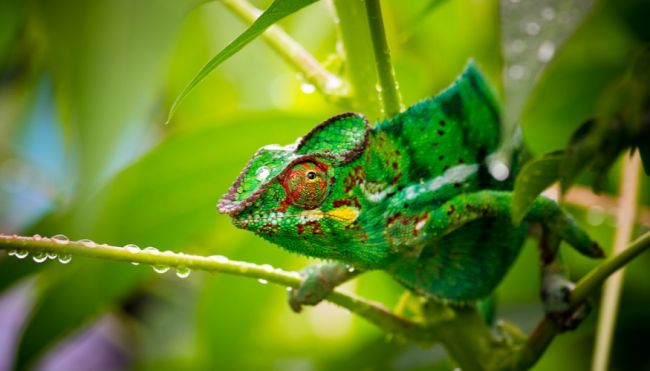
The best chameleon pet will feel in vertical terrarium. The bottom needs to be covered with sand, placed branches of spineless trees at different levels, monitor the temperature and humidity
How to feed a chameleon
- Young chameleons need to be fed twice a day with a mixture newborn crickets and powders of calcium phosphate and vitamins for reptiles.
- To maintain moisture and to prevent thirst pet, terrarium must be sprayed twice or thrice in day.
- Adult chameleons can be fed from a feeder or tweezers crickets or tropical cockroaches, but the walls of the feeder you must first grease with vegetable oil to insects did not run away.
- Need to teach your pet to drink from a syringe with a blunt needle or inject him with water the moment he opens his mouth, so how these animals do not know how to drink from an ordinary drinker.
- An excellent honey treat you can make solution.
Now it has become fashionable to have exotic pets. Due to its unpretentiousness, a chameleon becomes a coveted pet for many people. If you also want to surprise your guests an unusual resident of your home, then feel free to opt for chameleon.
Chameleon: Inventive conspirator of wildlife
Chameleons are very unusual lizards that can change color according to their environment. This property allows them not to just go unnoticed during the hunt, but also not become prey.