Classification
View: Bustard
Family: Bustard
Order: Crane
Class: Birds
Type: Chordates
Subtype: Vertebrates
Dimensions:
Length: males up to 105 cm, females from 75 to 80 cm
Weight: males up to 16 kg, females – up to 8 kg
Life expectancy: 20-25 years, in captivity about 30 years
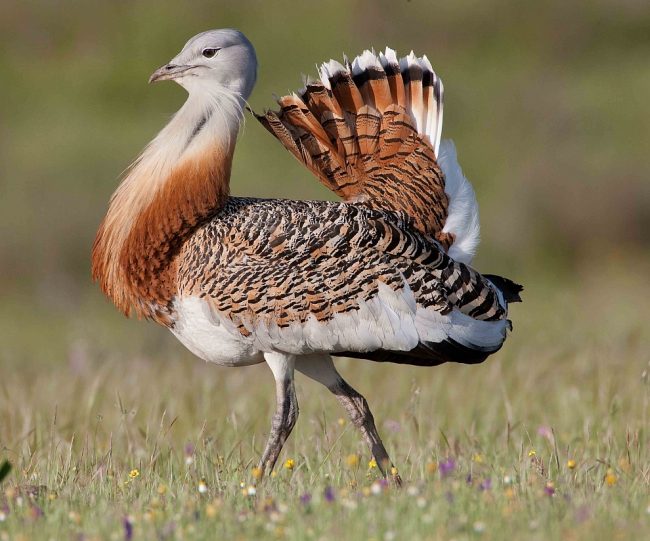
Bustard is recognized as the heaviest of flying birds, this steppe the inhabitant mainly moves on the ground and quickly runs into case of danger.
Individuals are considered omnivorous, in their diet plant foods (seeds, shoots, wild garlic) and animals (insects, rodents, frogs), in the mating season, males perform a spectacular dance.
A true feathered heavyweight in the wild in Russia – bustard bird. Males are much larger than females, and their weight is about two times more.
Thanks to strong legs, the bird can overcome daily significant distances.
Content
- 1 Habitat
- 2 Characteristic
- 3 Appearance
- 4 Key Features
- 5 Nutrition
- 6 Behavior, reproduction
- 7 Relations with people
Habitat
Bustard is mainly a steppe bird. She lives in the open plains without copses, meadows and fields. This is due caution of birds, since the free space there is far viewed.
During nesting, individuals stop in areas with high vegetation. There are times when bustards nest among crops of grain, sunflower and other crops.
The bustard habitat extends across North Africa and Eurasia, captures the steppe regions from the Pyrenees to Mongolia.
Wintering birds leave for Turkmenistan, Tajikistan, Northern Iran.
Characteristic
Bustard is a rather large bird, about twice as large black grouse. Males are superior in weight and size females.
Of the external differences, it is worth noting the pale gray antennae, which in courtship dance rise up. The popular names of this representative of the bustard family – Dudak, spoonbill.
The diet includes vegetation – herbs, crops, so is animal food – insects such as grasshoppers rodents, rodents such as steppe mice and lemmings.
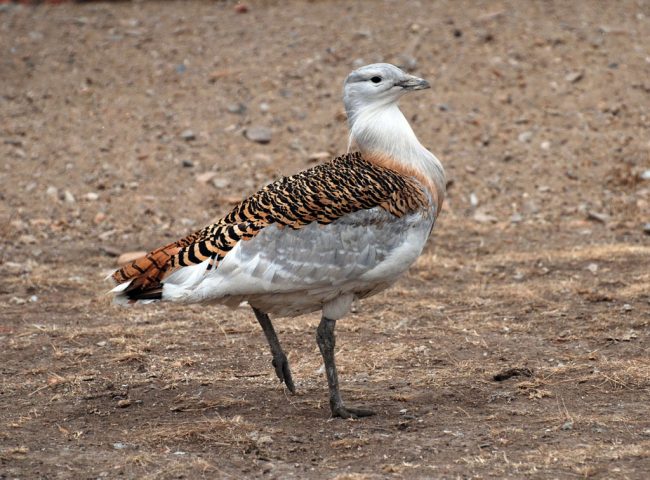
Pale gray tendrils are visible in male photo
Important! Sometimes the bustard is divided into two subspecies. However, differences in plumage are noticeable only in aging males.
Manner of flight
Bustard is able to run fast, but more often moves slowly and impressively. This is one of the heaviest flying birds. To rise into the air, individuals have to scatter.
Gain height gradually, in flight make powerful rare swings wings. Despite the apparent slowness, the bird develops speed up to 50 km / h. Doesn’t gain great height, flies closer to the earth.
When birds fly
Spring migration of birds is carried out at the very beginning warming and the appearance of thawed patches. They fly in pairs or small flocks up to 5 individuals. One by one, the birds return with wintering is extremely rare.
Wintering birds leave at the turn of August-September. The duration of the flight depends on the habitat. In the south areas the stay of birds to the place of wintering can only end to September.
Appearance
The description of the bustard should start with its long legs and neck. On the picture the head is large, rounded, the neck is thickened. The wings are long and wide.
The tail also looks elongated, with generally rounded outlines. Birds have bright colorful plumage – on the back and wings. reddish-brown, on the chest – white.
The males are distinguished by a stronger body and threadlike feathers, reminiscent of a mustache.
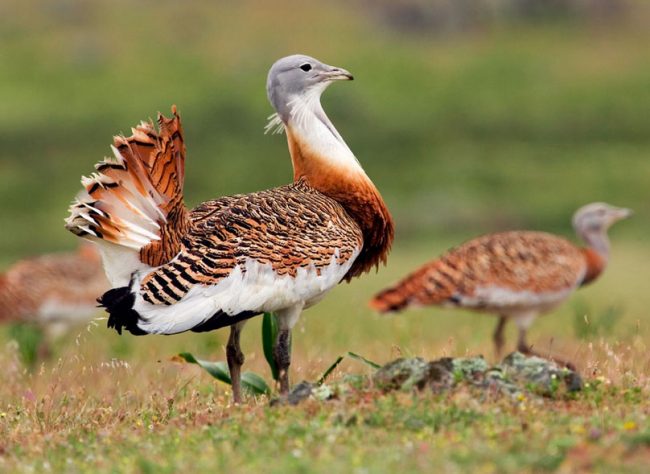
Bustard has long legs and a neck
Important! In the East Siberian subspecies, inhabiting the territory of the Krasnoyarsk Territory and Eastern Siberia, long feathers near the beak form together with antennae a whole a beard.
In flight, the bustard looks like a goose: head and neck are stretched forward, legs are strongly laid back. Wingspan unhurried and uniform, at the same time, the flight description shows that individuals develop high speed.
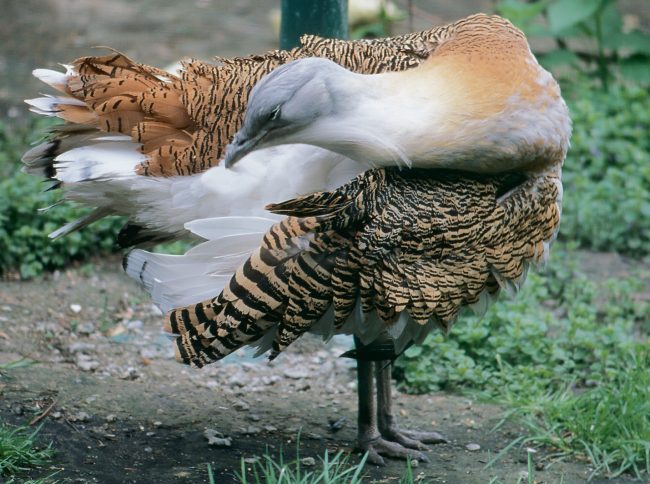
The bustard plumage is reddish-brown with white areas
Key Features
The features of the structure and behavior of birds include following:
- Lack of the coccygeal gland, as well as sweat glands. By this reason feathers are not covered by secret. To cool in the sultry weather, individuals settle directly on the ground and spread their wings. Bustard breathes deeply through its open beak. Feathers without grease strongly get wet during rains. Freezing is especially dangerous for birds after rainfall. Soaked feathers freeze, in this state of bustard completely defenseless.
- Despite the fact that in flight individuals are able to develop high speed, they practically do not move through the air at distances more than 100 m.
- Gray-brown color – a perfect camouflage against the field vegetation.
- Fleeing from the enemy, the bird lies on the ground and merges with the grass. In this, her behavior is similar to snipe or woodcock – these birds also rely on their disguise.
- Bustard is sometimes grown on poultry farms. Eggs deposited in the fields, collected and placed in incubators. Grown up the chicks are then released into their natural habitat.
- A male bustard performs a spectacular mating dance. Bird is strong inflates the throat sac, retracts its head, raises its tail and feathers.
- During the year, the bird sheds twice. First run in spring (pre-wedding molt), when fluff is replaced mainly and small feathers. The second call in the fall (post-wedding molt). In it time there is a complete replacement of plumage.
- Bustard practically does not make sounds. In the repertoire of birds only the deep sound reminiscent of the bleating that the male makes during marriage dance. For communication with chicks, the female uses short deaf cries. Youngsters speak in their own way. Small chicks make a squeak, and grown-ups make thin trills.
Food
Bustard is considered omnivorous. In the bird menu, you can mark following:
- seeds of herbs and cultivated plants;
- gentle shoots;
- wild garlic;
- larvae and insects (locusts, beetles, grasshoppers);
- mice and other small rodents;
- frogs and lizards;
- chicks of small birds.
In hot weather, after eating the bustard descends to lakes or keys to a watering place. The bird consumes both fresh and salt water, although gives preference to the first.
Then rest in a shady place follows. When the heat subsides, bustard continues to search for food.
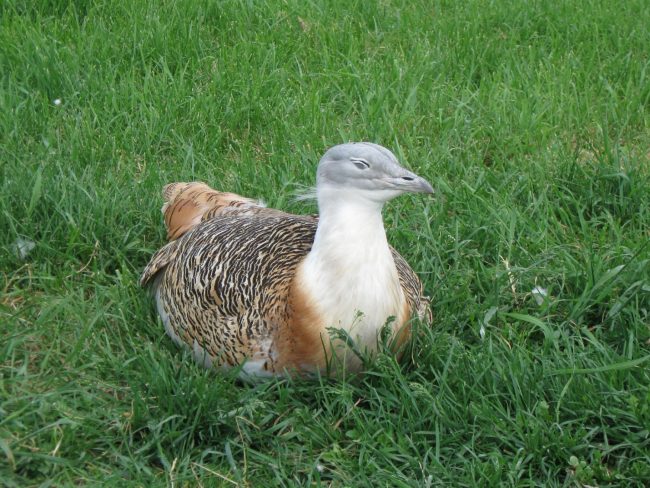
Bustard on vacation
What do the chicks eat?
Chicks feed mainly on insects. To feed them the females dig paws from the soil of ants and their pupae, which make up the bulk of the diet of young animals.
If the watering hole is far from the nesting place, the chicks can dispense with dew drops and the liquid contained in stern.
Important! In summer, the bustard diet consists of mainly from animal food, whereas in winter it eats more vegetation. The menu of chicks is mainly insects.
During the day, the bird has at least two meals. Feed volume consumed per day – 100 g or more.
Behavior, reproduction
Behavior features
As the bustard’s life description shows, this bird leads the daylight Lifestyle. In search of feed goes in the morning and evening time.
The exception is cloudy weather, when individuals can feed all day. Bustard at lunchtime prefers to relax, comfortably sitting on the ground.
Birds prefer to sit in the shade of high vegetation.
Important! Bustards flying also fall in the daytime.
Nesting
In the period after nesting, birds keep in large flocks, in which can be up to one hundred individuals. Such groups form birds of the same sex.
Individuals that do not participate in breeding hold on. flock all year long. This includes females who have lost their masonry.
Males reach puberty by 6 years, females mature earlier – in 3-4 years. Nesting lasts from April to June. Bustard lays one to three eggs once a year.
However, most often in the clutch there are two eggs. Demolishes their female with with a frequency of 1-2 days.
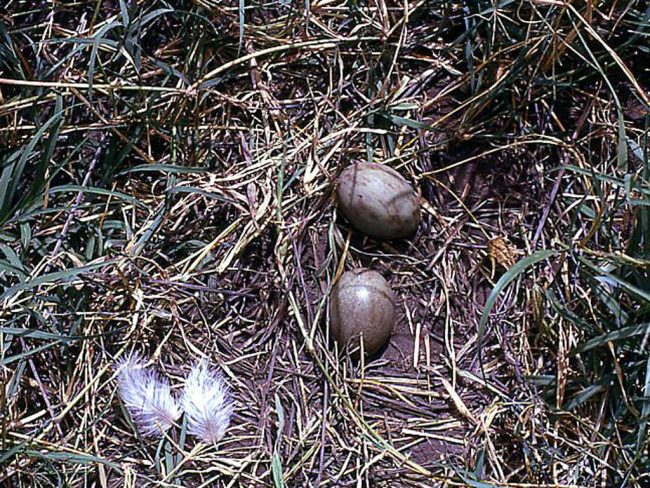
In the clutch, most often two eggs
Bustard ritual
Current in males begins immediately after returning from wintering. For the marriage ritual they choose an open area in the field either on top of a hill.
Dancing in the air is extremely rare, and then only some individuals. Current males gather in a group and begin their ritual at a distance from each other.
When females appear nearby, they become agitated, which sometimes leads to fights between individuals.
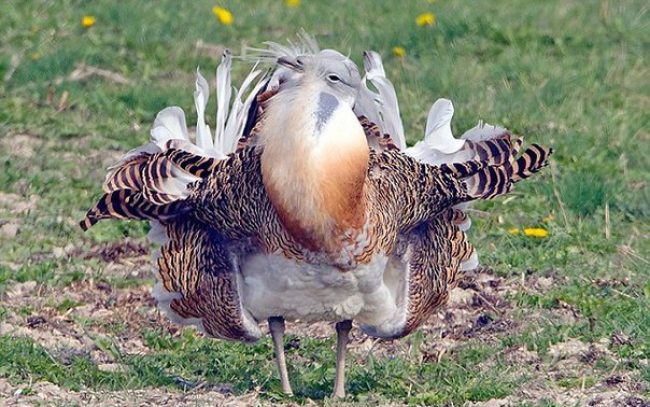
The male performs mating dance
Bustards do not create pairs. If they add up, then only on a short time. The male will not leave a description of the mating dance indifferent: he puffs feathers, raises his tail and greatly inflates volumetric neck bag.
In the photo in this position, it seems much larger than it is in fact. Wearing a festive “outfit”, the male pulls his head in and performs peculiar movements.
Mating takes place directly on the current. After that the females go to lay eggs.
How the nest works
Bird nests are arranged right on the ground. The female pulls out paws a hole with a diameter of about 25-40 cm.
She does not lay the litter as such, but at the bottom of the nest leaves and stems of plants fall. There are several options nest placement:
- on open ground;
- under the branches of shrubs;
- in the midst of tall grass.
Sometimes a bustard can make a nest on plowed land. Then after emergence, the masonry will be well covered. Distance between nests varies from a few hundred to forty meters.
The time for masonry largely depends on environmental conditions and air temperature. Bustard, living in the south, lays eggs in the end of April.
Females from northern populations lay eggs later, in early May. In this case, the delay can reach two to three weeks.
It happens that the female loses her clutch. In this case, sometimes she lays eggs again. It is probably this circumstance explains why insufficiently hatched masonry was found.
In one nest there are mainly 2-3 eggs in the form of an ellipse dark olive or clay color with dark spots.
Oily luster of the shell is noticeable, towards the end of the incubation period becomes more pronounced.
Hatching lasts about four weeks. Bird is tight sits on eggs. If a female nearby notices danger, she lurks and is lost due to camouflage coloring herbs.
Thanks to the color scheme of the plumage, the large bird becomes almost imperceptible even among low vegetation. Twice per day, the female leaves the clutch at the time of feeding.
Lunch lasts no more than 40 minutes. In the morning, the bird leaves in search of food. from 8 to 12 hours, in the evening – from 17 to 21 hours. Distance from nests no more than 400 m.
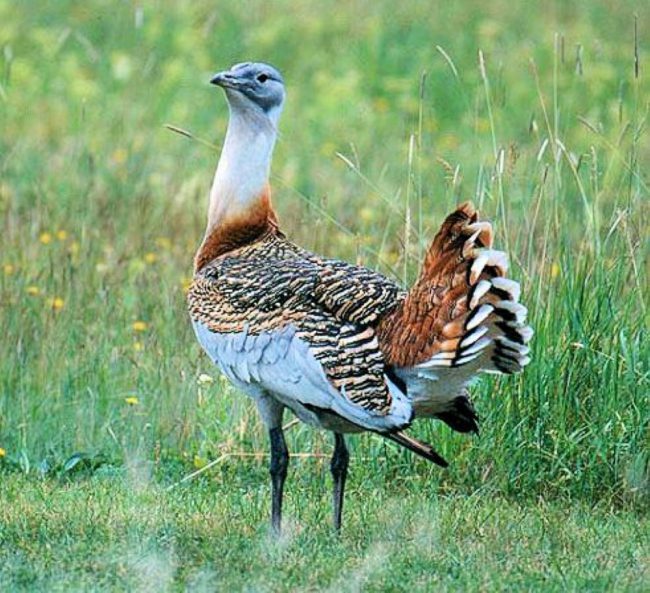
Bustard in tall grass
How a female takes care of chicks
The care of the chicks rests entirely with the female, the males in the care of offspring are not involved. Just hatched chicks the female feeds from the beak, at this time they move little and completely defenseless.
At first, she herself brings them insects and feeds them. 3-5 days after the shell is discarded, the chicks themselves begin to take food.
After two weeks, they can feed on their own, although they still get top dressing. Freshly hatched chicks, not managed to dry, are in the nest under the control of the female.
The downy color is buffy, with dark spots and stripes. Already later 4 days they walk nearby. Youngsters learn to fly at the age of 5-6 weeks. At this point, the weight of the bird is up to 2 kg.
The female carefully guards her chicks. Noticing the threat, she gives them a signal. In response, the chicks hide in the grass, snuggling up to soil and straightening the neck.
The photo shows that they are perfectly masked against the background of field herbs. Noticing the approach of the enemy, the bird pretends to be sick and trying to take him away. In case of critical danger, she attacks on the enemy.
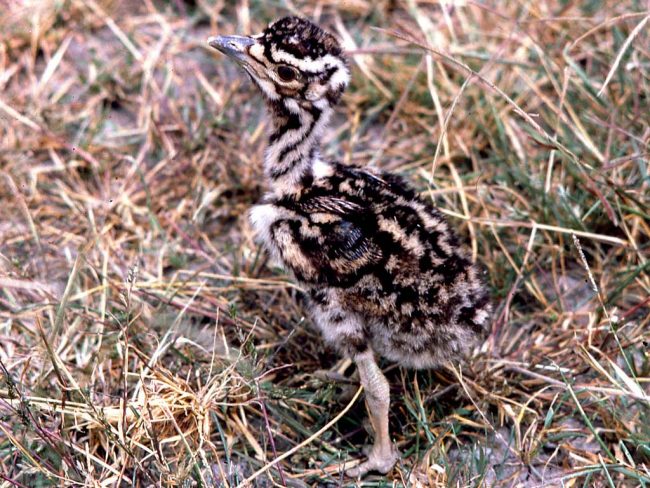
Bustard nestling camouflages on grass background
By early August, young growth is ready to leave the nest. Grown up chicks gather in packs and go roaming. This is a journey will last until next spring.
Relationship with people
Bustard is in the Red Book. Abundance of these birds decreased due to uncontrolled hunting and use land suitable for nesting for economic purposes.
To prevent a decline in numbers, measures for the protection of nests, the collection of eggs from failed clutches and their incubation.
Bustard is known for its caution. Suspecting danger, she can get a person close and then imitate the wounded bird to distract attention from the masonry.
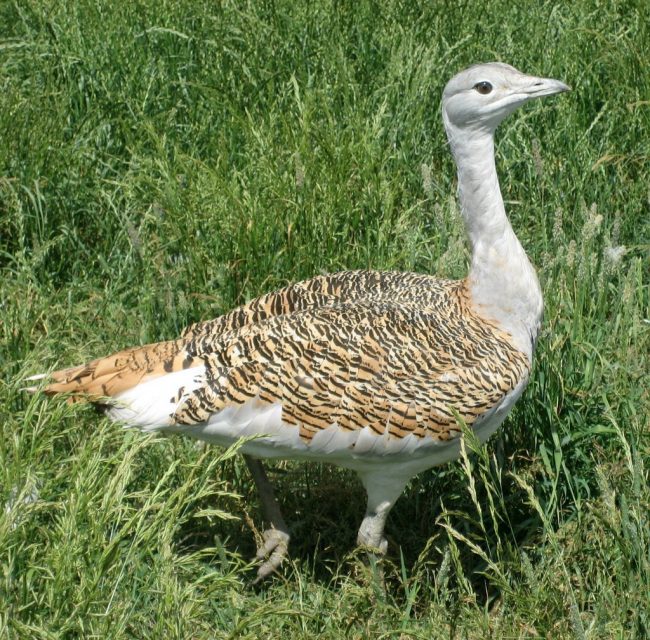
Bustard is a careful bird
Bustard is recognized as the largest flying bird. She is also famous. their caution. During the mating season, males perform unique dance.
At the moment, the species is listed in the Red Book; measures to conserve populations.
Bustard Bird: Fast Steppe Inhabitant
Bustard is recognized as the heaviest of flying birds, this steppe the inhabitant mainly moves on the ground and quickly runs into case of danger. Individuals are considered omnivorous in their diet. vegetable feed (seeds, shoots, wild garlic) and animals (insects, rodents, frogs), in the mating season, males perform spectacular dance.