
Foxes as pets are gaining popularity. On the background spiders and chameleons this fluffy playful little animal with a reputation sly man has great advantages and causes universal emotion. Meanwhile, her appearance is deceiving. Full Tailed Ginger Pet requires a special approach and a trained host. Foxes warn: the domestic fox is not what it seems. And before decide to purchase such an extraordinary pet, you need carefully study the features of its content and soberly evaluate your capabilities.
Content
- 1 When a fox became a pet
- 2 Description and colors
- 3 Pros and Cons
- 4 Maintenance and care
- 4.1 What to feed
- 4.2 Diseases and treatment
- 4.3 Conditions of detention
- 4.4 Home breeding
- 4.5 How many domestic foxes live
- 5 Character and education
- 5.1 Features of behavior
- 5.2 How to tame a domestic fox
- 5.2.1 Speak her language
- 5.2.2 Use her habits
- 5.2.3 Be patient
- 5.2.4 Do not spare the time for the pet
- 5.3 Animal Games
When the fox became a pet

The domestic fox has the character traits of both a cat and a dog
According to the biological classification of the fox refers to to the canine family and as close as possible to the dogs, wolves and coyotes. But unlike a dog, a fox never became a one hundred percent pet, although people tried it to do.
For example, in the USSR in the middle of the last century long experiment on domesticating a fox. A group of scientists Novosibirsk Institute of Cytology and Genetics Dmitry Belyaev tried to bring domesticated hand foxes. Basis took the breed of ordinary foxes, silver-black populations as most susceptible to the taming process.
During the experiment, a new group was developed that was different from their wild relatives with a greater degree of obedience and affection to man.
But not all species of foxes could be tamed, but only the most curious and easy to contact. Predator genes continued make themselves felt and did not completely disappear. For this reason, scientists were forced to admit that the fox as a pet requires special precautions when handling.
Scientists set themselves the task of changing behavioral reactions foxes, but during the selection, external changes were also noted. The resulting domestic fox was not only playful and friendly, but also had a different color. A decrease in melanin and adrenaline has led to the appearance of white spots and blue eyes, curled tails and drooping ears.
Description and colors
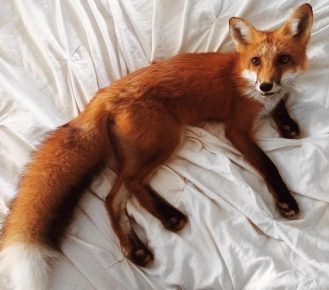
The most common and beloved domestic fox color is redhead
The domestic fox breed has two main colors – red and black-brown. But there are also pure white specimens, although more often white is present in the form of pretty “collars” and socks.
The weight of silver fox or red fox reaches 6 kg. Females usually larger than males.
The muzzle of the home variety is less elongated than the usual and has a rounded shape. Ears drooping, tail slightly bent up.
It’s also become fashionable to keep a Fenech as a pet – African desert fox. Phoenixes differ from ordinary tiny size (2 kg), huge ears (15 cm) and extremely long tail (30 cm).
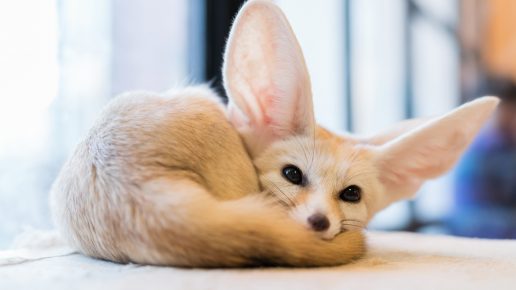
Big ears and a cute face Fenech will not leave anyone indifferent
Such proportions might seem strange and even ugly, but not in this case. Extremely cute creature with with expressive eyes on an elongated lop-eared muzzle for a long time won the hearts of the local population.
The color of the fur of the African fox is not so bright red coloring, like an ordinary relative, and as close to the color of sand to mask. On the stomach, the coat is white. By the way phoenixes are born entirely white and turn yellow as they grow older.
Big ears and eyes of Fenech are a clever idea of nature. The size the eye allows the desert fox to be a keen night hunter, and increased earedness plays the role of a kind of conditioner, cooling the body of an animal in a hot desert.
Advantages and disadvantages
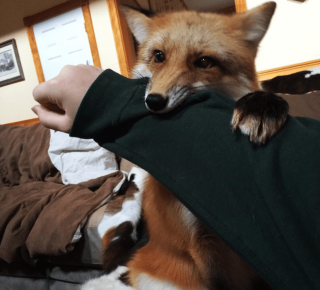
Do not forget that the fox is a predator, and, yielding instincts, she can bite the owner
Whatever fox the choice falls on – a descendant of red or silver fox, baby Fenech – you should remember that this animal requires special conditions of maintenance and care, as well as prepared the owner. The domestic fox is not a dog. She will not run to the foot it is useless to wait for the first call and dog devotion from her. And with a cat can’t compare it either. Wild predator genes and unpredictable temperament make neighborhood with a domestic fox pretty venture, especially for families with small children.
Advantages and disadvantages of the fox as a pet:
- Not every country can keep a fox at home.
- The fox smells, and it is strong and unpleasant.
- An animal is a loner by nature, and independently on his mind. Predict the course of his thoughts, as well as control behavior, difficult.
- The fox is a burrower. We must be prepared for the fact that in the house she will dig – on the couch, under the couch elsewhere
- Active and inquisitive. Will vigorously develop the territory. You should always be on the alert, otherwise you cannot avoid chewed pants and puddles on the carpets.
- Marks the territory, even the female.
- Poorly accustomed to the toilet.
- Screaming at night.
- Bites.
- Jumps high, especially Fenech.
- Domestic hamsters, mice, rabbits and chinchillas for the fox are prey, and not friends.
- Active and inquisitive. You will not get bored with it.
Maintenance and care
By the appearance in the apartment of a domestic fox follows prepare for the arrival of a noisy, awkward and playful a child. This means you need to remove it from its access zone. anything that could be dangerous or life-threatening, and valuable and expensive things to your home.
The fox should have its place – a cage with a den and a toilet, where it should be closed during the absence of owners, so as not to return to the ruined apartment.
Also, the animal will need:
- bowls (for food and water);
- filler for toilet / diaper;
- litter – hay;
- sand (for Fenech);
- leash and harness for walking.
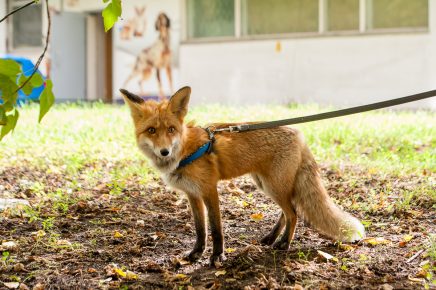
It is important to periodically walk the domestic fox, for this you can use harnesses or leashes and collars for dogs
In a private house, it is easier to create conditions for maintenance. Redhead and black-brown can live all year on the street – in an aviary with a booth. Experts also advise to make in it a slight elevation on sunny place – a kind of solarium for foxes.
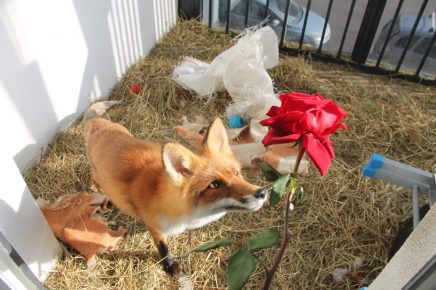
Sunlight must penetrate the enclosure
Feneki – African chanterelles, they can not live in the cold. BUT because the street content of the Russian winter does not suit them.
Domestic foxes inherited sharp claws from their wild ancestors, which need to be cut periodically. Perform this procedure with using a muzzle to which a fox is trained from childhood.
The fox does not need to comb, with the exception of the molting period, which occurs at the beginning of spring and lasts 3-4 weeks. Combed wool will not only reduce the duration of molting by a quarter, but also of value to artisans and artists creating different crafts and woolen things.
There is no need to wash the fox. She takes care of herself his skin, licking it like a cat. Frequent bathing may to dry the skin and cause dermatitis. Wash only foxes that are not differ in cleanliness, not more than 2 times a month. And the water use room temperature.
If a fox of a snow or marble color begins to darken, then the conditions of detention and diet should be reviewed.
What to feed

As with any pet, the diet of a domestic fox must be balanced
Foxes have a reputation for omnivores. And this is partly true, with the exception of some details.
Domestic foxes should not be given the following products. following reasons:
- Broccoli is toxic to animals.
- Yeast dough causes fermentation in the intestines and increased gas formation.
- Potatoes, peppers provoke diarrhea.
- Tubular bones (raw, cooked) can damage the esophagus, cause enteritis.
- Milk and dairy products provoke diarrhea. Give only when constipation and poisoning.
- Sweets cause obesity, caries, diabetes.
- Plums and peaches are toxic to the animal. Relevant in minimum doses.
- Persimmon is the cause of intestinal obstruction, enteritis.
- Citrus fruits can cause vomiting, an allergic reaction.
- Onions and garlic contribute to the development of anemia.
- Chocolate, coffee, tea. Caffeine provokes diarrhea, vomiting, toxic for the heart and nervous system.
- Pork is too fat.
- Sausage contains preservatives and spices.
- Bread is often an allergen for the canine family.
The ideal diet is the diet of a predator in the wild. For example, Phoenix in vivo feed on eggs of birds, catch small reptiles, insects, love locusts. Also do not shun roots plants and tree fruits. They get all the moisture they need from food and can go without water for a long time.
At home, Fenechs are fed fruit (figs, dates), vegetables, raw meat. Domestic fox – minced meat, boiled fish, raw eggs, low-fat cottage cheese (once a week), vegetables (carrots, zucchini) and fruits (grapes, pears).

Feneki really love to eat fruits, but do not forget to give and other food
You need to immediately determine the type of feed: natural or ready. For feeding foxes, dog foods of at least the premium class are suitable. The category is selected based on the size of the animal. Ordinary domestic foxes are suitable for medium-sized dogs, Fenechs – for small, decorative.
Disease and treatment
Like any pet, a fox needs care and maintenance. The state of health directly depends on its quality content and diet. The animal needs regular show to the veterinarian and conduct timely vaccination, especially from rabies.
Pets need antiparasitic treatments and protection against pyroplasmosis transmitted through a tick bite.
Any change in the behavior and appearance of the pet is a loss appetite, lethargy, apathy, dull hair, dry, warm nose, lacrimation, frequent sneezing – should be a signal for treatment to the vet. This could be a sign of a dangerous disease: the plague, rabies, parovirus enteritis, infectious hepatitis, salmonellosis, streptococcal infection, leptospirosis, ringworm lichen, toxoplasmosis, pyroplasmosis and several others.
Conditions of detention
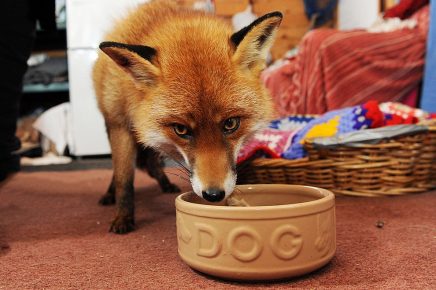
The domestic fox must have a separate bowl for food and water
To keep a domestic fox, you need a cage or aviary.
A good fox cage should have 4 qualities:
- Be spacious.
- Durable so that the animal cannot commit unauthorized the escape.
- With a secluded den.
- With toilet – cat toilet or sandbox.
In the apartment, foxes are often given a balcony. This is a good option for ordinary fox, which is hot in the apartment in the summer, but not suitable for Fenech, in need of warm (not lower than +20 degrees), dry indoors all year.
Before you transfer the fox to the balcony, you need to prepare it.
A good fox balcony should be glazed and have:
- Tiled floor.
- Booth-hole.
- Lack of sharp and fragile objects.
- Durable wire mesh on the window frame for ventilation. The heat for the fox is disastrous.
The best conditions for Fenech – a separate room or part rooms with equipped partition. Fenech loves bury in the sand. He does it with phenomenal speed. It is advisable to provide him with this bulk material so that he can realize your natural instinct.
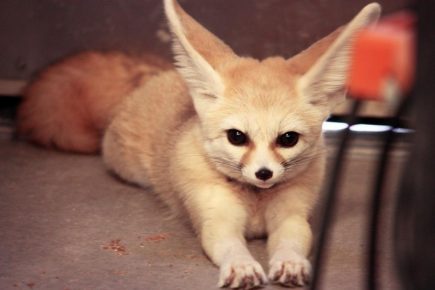
The eared fox has a very sensitive hearing – the noise of its big city They are worried, so she needs to choose a place away from the central streets and passages
Also feneki are night hunters. They are activated with dusk. The noise they make will interfere sleep with other inhabitants of the apartment.
Feneki are extremely jumping. Everything on the meter height – in the zone of their access.
In autumn and winter, Fenechs are not walked and protected from drafts.
The best conditions are enclosure on the street.
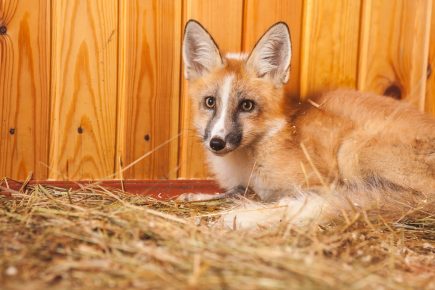
Hay is the perfect litter for the domestic fox contained in the aviary
The outdoor enclosure should have not only walls, but also a roof, a floor (foundation). Such precautions are necessary to prevent the escape of a cunning pet prone to digging (walls the enclosure is buried by 1m 20 cm) and high jumps.
In the aviary are installed:
- digging sand tank;
- climbing shelves and elevations;
- lairhouse for privacy;
- sand tray for toilet;
- bowls with food and water.
It is organized in a secluded place, away from neighbors, so that Fox’s night songs didn’t bother anyone.
When keeping the fox outdoors, you need to pay attention – carry out with her at least 4 hours daily, walk. If you don’t do this, communication with the animal will be lost, and it will run wild.
Home breeding
In captivity, foxes breed poorly. And them breeding without the necessary skills and knowledge – not too much rational decision. Usually professional foxes do this. and under the order, so as not to create problems for yourself with further implementation of the fox.
For home keeping animals are neutered. It helps reduce specific odor and aggressiveness, aggravated during rutting / estrus. The castration procedure is carried out in 6–9 months of age when puberty sets in.
How many domestic foxes live
In captivity, they live 15–20 years, subject to proper maintenance. and nutrition. Feneki – 10-13 years.
Character and education
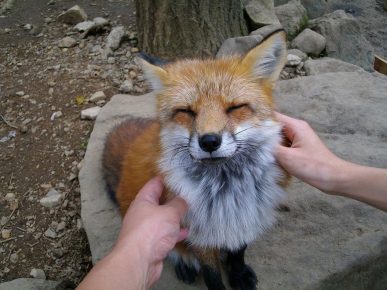
If the fox is constantly kindly treated, it will become more manual
As with any pet, you need to talk to the fox on language of love. Initially, there is no need to harbor illusions and conduct analogies with dog devotion. Have to be patient especially in the first year of a pet’s life. If you follow the selected course and establish contact with the animal, you can get smart, a funny friend reciprocating with warmth and care.
The fox rearing begins from the first days, as he appears in the house.
The fox is a night hunter. In the wild, its activity is at night, which is not suitable for home living. You can transfer the fox to day mode as follows: you need provide him with lessons and tire to such an extent that at night he slept “without hind legs.” This is usually achieved through games. and attention. You need to provide your pet with a sufficient set of toys, so that he would not be sad or bored in the absence of owners.
The animal must know the command “Fu!” The training is conducted by the method “gingerbread and the lack of gingerbread”, that is, you can give a treat for do not give the executed command if the pet does not obey.
Fox-growers are advised to use only the non-contact method punishment. Physical effects are not applicable to the fox – she move away, and contact will be lost, possibly forever.
The fox has a very good memory and is quick-witted. Enough for it’s wrong to lock your pet in a cage or skip one feeding. The lesson will be learned! You can clap your hands and to shout if a cheat is caught committing a crime, but it is useless to do this when the pillow has been “eaten” for 20 minutes back. The fox will understand nothing. In general, the best way to secure own property from leprosy of red beast – remove valuables from the field view and access of the animal and daily give him good physical activity, so that there is no force left on dirty tricks.
Behavior features
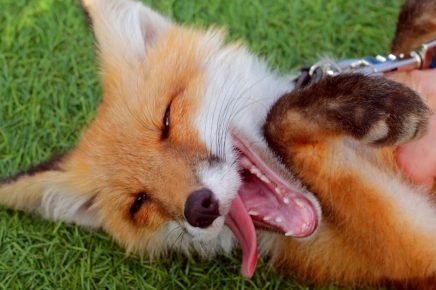
Foxes are very energetic, so you need to walk them, constantly play with them
Many habits of foxes are similar to dogs. For example, they also wag tail when satisfied and tuned to the game. Ears are pressed when they are afraid and substitute their stomachs as a sign of reconciliation and full confidence. how and dogs, they do not like loneliness and are glad to attention and company. BUT more foxes are susceptible to learning. They can easily be trained in a number of teams and walking on a leash, especially if you already have experience dog training.
Their character has a lot from cats. They also love to play. in boxes and easily accustomed to walk in the tray. They love foxes and that their stroked. And they themselves choose for this time and place. In his The independence and individualism of the fox is more of a cat than a dog.
How to tame a domestic fox
Speak her tongue
To tame a fox, it’s important to learn to understand it – sounds and language body. They will tell you in what mood the animal, as themselves feels.
For example, the lingering “u-ru-ru” is the call of a fox missing mothers. The first days in a strange house, he makes this sound. Whining together with a wagging tail means joy. But if, whining, the animal huddled in a corner – this is a completely different emotion, meaning “Do not touch me!”
The fox makes a sharp cough-like sound bite while protecting from the offender or guarding his property.
Use her habits
Given that foxes are very smart, cunning and curious, you can play on these qualities to get what you want. For example, try to outwit the prankster. If she pulled off her sock, don’t try to take it away by force, and offer a “fair exchange” – give toy, distracting the attention of the pet from the sock.
Be patient
Do not wait for a momentary return from your efforts. Get ready for that taming a fox is a long and laborious process and not always successful. For example, only 60% of foxes can be tamed to the tray. And those from time to time, they relieve themselves in the wrong place.
Do not spare the time for the pet
Practice shows that the more the owner spends time with your unusual pet, the faster and more successful it goes the process of animal socialization. The result is a fox peaceful, affectionate, attached animal.
Animal games
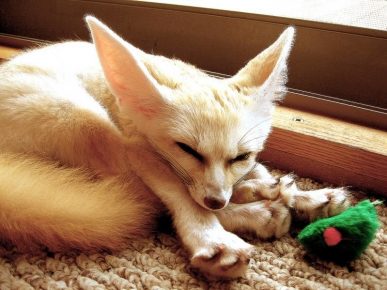
As toys, those sold in pet stores and target cats and dogs
Domestic foxes are playful creatures. This fact it is important for the owner to consider, taking advantage of him. Firstly, in During games with the animal contact is established. Secondly, it gives physical activity and the output of accumulated energy. Third, let a toy will suffer better than the legs of a chair or the upholstery of a sofa.
It is important to choose the right games. They must not contain elements struggle and aggression. The best options are with a ball or a search hidden item. Catching a clockwork mouse is also suitable.
Fox-growers are not advised to use plush, fleece toys – they will not be enough for a long time, the fox will deal with them in two counts. And to that they remind upholstery of forbidden items – a sofa, pillows, which confuses the animal. Recommend to choose toys that sound and moving – they attract the attention of a domestic predator, make her think and move.
In the toy arsenal of the animal must be at least 5 different toys. They do not need to be laid out all at once, but must be replaced by as weakening interest in them.
The domestic fox is not the easiest pet to keep. She never stop wanting to dig, tag, sing at night and steal socks. It is impossible to get rid of its pungent smell and achieve complete obedience and dog devotion. But if have patience and stock up on a hefty arsenal of tenderness and cares, you can get a wonderful companion, well-mannered, sensitive and playful. Only true love allows you to create real miracles.